ENHANCING EFL STUDENTS' ACADEMIC WRITING PROGRESSION FROM PARAGRAPHS TO ESSAYS USING GEMINI AS AN AI WRITING ASSISTANT
คำสำคัญ:
Academic Writing Progression, Gemini, Writing Assistant, English as a Foreign Language, AI Scaffoldingบทคัดย่อ
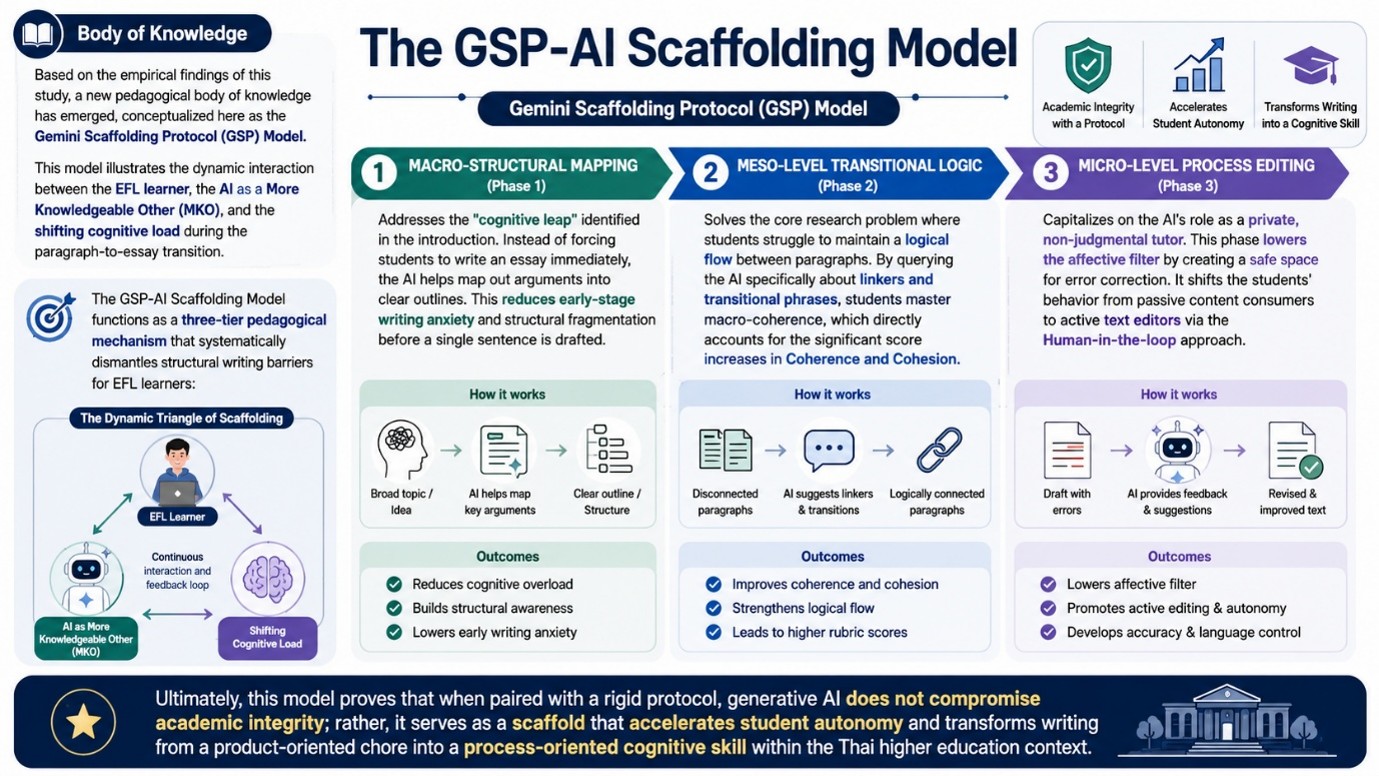
This research article aims to evaluate the effectiveness of Google Gemini as an AI-driven scaffolding tool in facilitating the critical transition from paragraph writing to multi-paragraph essay construction among English as a Foreign Language (EFL) learners. In academic writing, tertiary students often encounter a “cognitive leap” when moving beyond isolated paragraphs, frequently resulting in structural fragmentation and heightened writing anxiety. Drawing upon Vygotsky’s Zone of Proximal Development (ZPD), this study positions Gemini as a “More Knowledgeable Other” (MKO) designed to provide real-time, formative feedback through a structured pedagogical framework. The study employed a convergent parallel mixed-methods design involving 60 undergraduate Business English students at Dhurakij Pundit University, selected through purposive sampling. Over an 8-week intervention in the “Reading and Writing 2” course, participants followed the Gemini Scaffolding Protocol (GSP), which guided them through AI-assisted ideation, structural transitions, and reflective editing. Data were collected using three research tools: pre-tests and post-tests, a satisfaction questionnaire based on the Technology Acceptance Model (TAM), and semi-structured interviews. Quantitative data were analyzed using mean (M), standard deviation (SD), and a dependent samples t-test, while qualitative data from semi-structured interviews conducted with a sub-group of 10 key informants selected from the participants were analyzed using thematic analysis.
Quantitative findings revealed a statistically significant improvement in writing proficiency, with mean scores increasing from 12.45 (Moderate) to 18.82 (High) out of 25. Notably, the most substantial growth was observed in Coherence and Cohesion, suggesting that Gemini effectively helped students bridge the structural gap by mastering transitional logic and thesis development. Survey results indicated a high level of satisfaction (M = 4.39), with Perceived Usefulness (M = 4.52) emerging as the strongest dimension. Qualitative analysis further demonstrated that Gemini acted as a non-judgmental “private tutor,” which significantly lowered the students’ affective filter and increased their writing confidence. Participants reported that the AI provided “safe space” to experiment with language, shifting their focus from a product-oriented mindset to a dynamic, process-oriented approach. The study concludes that when integrated with proper prompt engineering, Gemini fosters student autonomy and critical thinking without compromising academic integrity. These results suggest that AI-assisted scaffolding is a vital pedagogical strategy for modern EFL writing instruction in the Thai higher education context.
เอกสารอ้างอิง
Braun, V. & Clarke, V. (2006). Using thematic analysis in psychology. Qualitative Research in Psychology, 3(2), 77–101.
Creswell, J. W. & Plano Clark, V. L. (2018). Designing and conducting mixed methods research (3rd ed.). SAGE Publications.
Davis, F. D. (1989). Perceived usefulness, perceived ease of use, and user acceptance of information technology. MIS Quarterly, 13(3), 319–340.
Hyland, K. (2019). Second language writing (2nd ed.). Cambridge, UK: Cambridge University Press.
Khlakheang, A. & Cherngroongroj, A. (2025). Exploring English vocabulary learning strategies through AI integration of Thai university students: A case study. Journal of Mani Chettha Ram Wat Chommani, 8(6), 574–585.
Krashen, S. D. (1982). Principles and practice in second language acquisition. Pergamon Press.
Kritpet, K. et al. (2024). Navigating the AI frontier: Challenges and opportunities for English language teaching in Thai universities. Journal of Liberal Arts and Linguistics, 12(1), 89–104.
Kurniasih, N. et al. (2023). AI-powered writing tools in EFL classrooms: A systematic review. Journal of English Education and Linguistics Studies, 10(1), 45-68.
Schmidt, R. W. (1990). The role of consciousness in second language learning. Applied Linguistics, 11(2), 129–158.
Su, J. & Cheng, Y. (2024). The role of Large Language Models in scaffolding EFL writing: A comparative study of ChatGPT and Google Gemini. Educational Technology Research and Development, 72(2), 112–135.
Vygotsky, L. S. (1978). Mind in society: The development of higher psychological processes. Cambridge, MA: Harvard University Press.
Warschauer, M. & Matuchniak, T. (2010). New technology and digital worlds: Analyzing evidence of equity in access, use, and outcomes. Review of Research in Education, 34(1), 179–225.