ความขัดแย้งทางภูมิรัฐศาสตร์กับการออกแบบโซ่อุปทาน และยุทธศาสตร์การค้าระหว่างประเทศยุคใหม่
คำสำคัญ:
ความขัดแย้งทางภูมิรัฐศาสตร์, โซ่อุปทาน, ความยืดหยุ่น, ยุทธศาสตร์การค้า, เศรษฐกิจโลกบทคัดย่อ
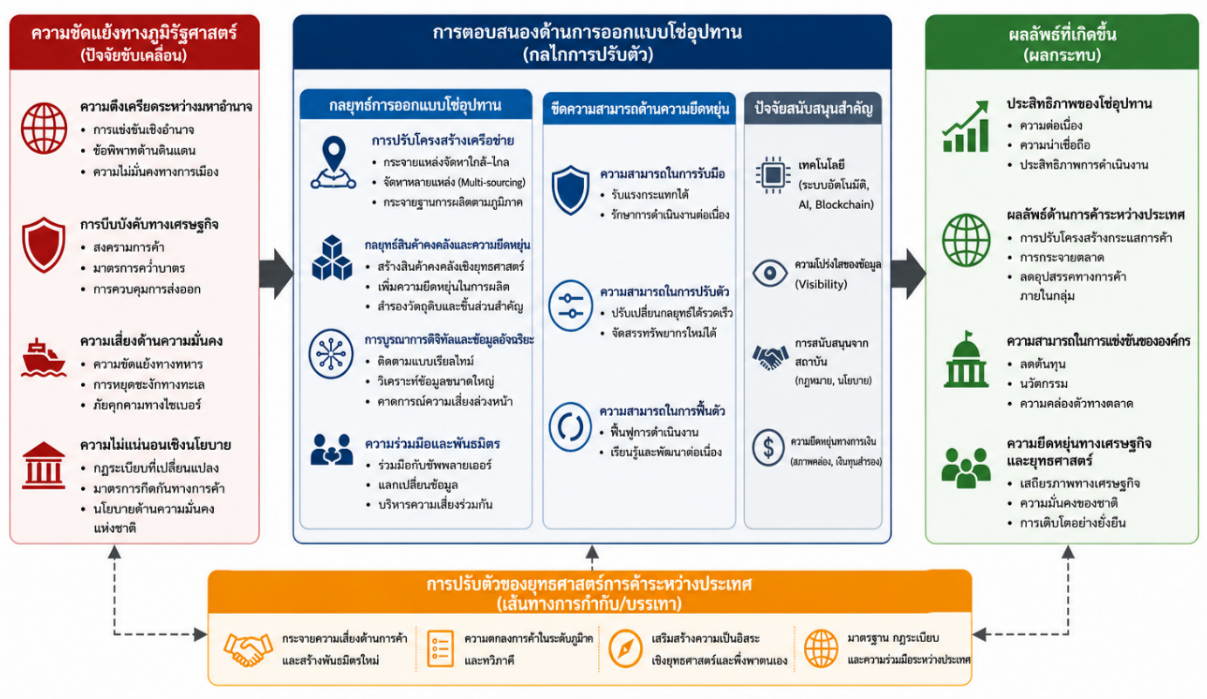
สถานการณ์ความขัดแย้งทางภูมิรัฐศาสตร์ได้กลายเป็นปัจจัยสำคัญที่กำหนดโครงสร้างเศรษฐกิจโลกและรูปแบบการค้าระหว่างประเทศ ทั้งในแง่ทิศทาง ต้นทุน และความมั่นคงของห่วงโซ่อุปทาน บทความนี้มุ่งศึกษาความสัมพันธ์ระหว่างความขัดแย้งทางภูมิรัฐศาสตร์ การออกแบบโซ่อุปทาน และยุทธศาสตร์การค้าระหว่างประเทศยุคใหม่ โดยใช้การสังเคราะห์วรรณกรรมและกรณีศึกษาร่วมสมัย เพื่อสร้างกรอบแนวคิดบูรณาการที่อธิบายกลไกและผลกระทบเชิงโครงสร้าง ผลการศึกษาแสดงให้เห็นว่า ความตึงเครียดระหว่างประเทศ มาตรการคว่ำบาตร และสงครามการค้า ส่งผลให้ธุรกิจต้องปรับยุทธศาสตร์โซ่อุปทานจากประสิทธิภาพสู่ความยืดหยุ่นเชิงยุทธศาสตร์ ผ่านการกระจายฐานการผลิต การใช้เทคโนโลยีดิจิทัลเพื่อเพิ่มการมองเห็นแบบเรียลไทม์ และการสร้างพันธมิตรเชิงยุทธศาสตร์กับคู่ค้าในภูมิภาคที่มีเสถียรภาพ ขณะเดียวกันรัฐบาลต่าง ๆ ได้ปรับนโยบายการค้าให้เน้นความมั่นคงและการกระจายตลาด โดยใช้ข้อตกลงการค้าแบบภูมิภาค (RTA) และการสร้างกลุ่มความร่วมมือใหม่เพื่อรองรับความไม่แน่นอน ในระบบโลก องค์กร รัฐบาลหรือประเทศ จะต้องเปลี่ยนจากการมองโซ่อุปทานไปสู่การเป็นศูนย์กลางการสร้างประสบการณ์ผู้บริโภค เนื่องจากความยืดหยุ่นของโซ่อุปทานคือความพึงพอใจของลูกค้า
เอกสารอ้างอิง
เกียรติอนันต์ ล้วนแก้ว. (2569). เปิด 2 ฉากทัศน์และทางรับมือสงคราม 'สหรัฐ-อิหร่าน' เขย่าเศรษฐกิจไทย. มหาวิทยาลัยธรรมศาสตร์. สืบค้นเมื่อ 4 พฤษภาคม 2569 จาก https://tu.ac.th/tu01090369/.
วาราดา ทองจำนงค์. (2569). การโจมตีอิหร่าน ส่งผลต่อเศรษฐกิจโลกและตลาดน้ำมันอย่างไร?. สืบค้นเมื่อ 4 พฤษภาคม 2569 จาก https://thestandard.co/iran-attack-oil-economy/.
ศูนย์วิจัยกสิกรไทย. (2569). ความตึงเครียดในตะวันออกกลางเสี่ยงกระทบส่งออกไทยปี 2569 ขยายตัวต่ำกว่า 1% (มองเศรษฐกิจ ฉบับที่ 4254). สืบค้นเมื่อ 4 พฤษภาคม 2569 จาก https://shorturl.asia/qjfnw.
สำนักงานนโยบายและยุทธศาสตร์การค้า. (2567). ความขัดแย้งทางภูมิรัฐศาสตร์โลกและแนวทางการรับมือของต่างประเทศ. นนทบุรี: กองยุทธศาสตร์การพัฒนาความสามารถทางการแข่งขัน กระทรวงพาณิชย์.
Alfaro, L. & Chor, D. (2023). Global supply chains: The looming “great reallocation”. Retrieved May 4, 2026, from https://papers.ssrn.com/sol3/papers.cfm?abstract_id=4567667.
Belhadi, A. et al. (2024). Digital capabilities to manage agri-food supply chain uncertainties and build supply chain resilience during compounding geopolitical disruptions. International Journal of Operations & Production Management, 44(11), 1914–1950.
Campos, R. et al. (2023). Geopolitical fragmentation and trade. Journal of Comparative Economics, 51(4), 1289–1315.
Charpin, R. & Cousineau, M. (2025). Friendshoring: How geopolitical tensions affect foreign sourcing, supply base complexity, and sub-tier supplier sharing. International Journal of Operations & Production Management, 45(5), 1006–1031.
Chen, J. et al. (2024). How does enterprise digital transformation impact supply chain resilience: A multi-case study from China. Industrial Management & Data Systems, 125(11), 2902–2930.
Contractor, F. (2025). Assessing the economic impact of tariffs: Adaptations by multinationals and traders to mitigate tariffs. Review of International Business and Strategy, 35(2), 145–172.
Dadush, U. & Dominguez Prost, E. (2023). Preferential trade agreements, geopolitics, and the fragmentation of world trade. World Trade Review, 22(4), 523–547.
Dawar, A. & Bai, Y. (2024). Impact of geopolitical risk on the maritime supply chain: A regional analysis of the effects on global trade. International Journal of Supply Chain Management, 13(3), 42–53.
Fan, D. et al. (2024). Locking in overseas buyers amid geopolitical conflicts. Journal of Operations Management, 70(3), 415–439.
Fathiya, D. N. (2025). Global supply chain restructuring: Business strategy amid geopolitical fragmentation. Jurnal Ekonomi Teknologi dan Bisnis (JETBIS), 4(4), 176–185.
Fernández-Miguel, A. et al. (2022). Disruption in resource-intensive supply chains: Reshoring and nearshoring as strategies to enable them to become more resilient and sustainable. Sustainability, 14(17), 10909.
Gereffi, G. et al. (2021). Trade policies, firm strategies, and adaptive reconfigurations of global value chains. Journal of International Business Policy, 4(3), 221–245.
Góes, C. & Bekkers, E. (2022). The impact of geopolitical conflicts on trade, growth, and innovation (WTO Staff Working Paper No. ERSD-2022-09). Geneva, Switzerland: World Trade Organization.
Hecker, C. (2025). Geopolitical risk in global supply chains: The case of Southeast Asia. Journal of Supply Chain Management Systems, 14(1), 33–49.
Hryhorak, M. & Dimitrova, A. (2024). Risk management in international supply chains: Geopolitical and geoeconomic dimensions. Intellectualization of Logistics and Supply Chain Management, 27, 6–20.
Jama, M. et al. (2024). Enhancing organizational performance through supply chain integration: A literature review. Journal of System and Management Sciences, 14(8), 426–438.
Ji, X. (2024). Securitising regionalism: Mega-regional trade blocs, Indo-Pacific Economic Framework and supply chain alliances in Asia. Asia Europe Journal, 22(4), 511–530.
Kassa, W. (2025). Regionalization of global trade: A new order in the making. Global Policy, 16(2), 245–262.
Kazançoğlu, Y. et al. (2023). The effects of globalization on supply chain resilience: Outsourcing techniques as interventionism, protectionism, and regionalization strategies. Operations Management Research, 17(2), 505–522.
Kencono, U. D. et al. (2025). Collaboration, Agility, and Redundancy: Key Strategies for Managing Global Supply Chain Disruptions. Logistica: Journal of Logistic and Transportation, 3(3), 136–149.
Khalid, M. B. et al. (2025). Impacts of geo-political conflicts on global trade: A case study of the Russia-Ukraine war. Physical Education, Health and Social Sciences, 4(1), 236–252.
Li, T. & Wang, M. (2025). The increase of regional trade agreements (RTAs) has led to the weakening of the universality of most-favored-nation (MFN) treatment in international trade. Journal of Education and Educational Research, 8(3), 77–89.
Lin, X. (2025). The Sino-US trade cost transmission mechanism and corporate response strategies under the background of escalating trade protectionism. Scientific Journal of Economics and Management Research, 4(2), 55–78.
Mykyta, S. (2025). Global trends in logistics: The impact of geopolitical factors on supply chains. The American Journal of Management and Economics Innovations, 7(3), 46–55.
Nemat, M. et al. (2025). Global trade and finance turmoil: The Ukraine–Russia war’s impact. The Journal of Risk Finance, 26(3), 345–365.
Obukadata, V. O. (2025). The economic consequences of the US–China trade war on global supply chains. International Journal of Research Publication and Reviews, 6(5), 123–135.
Odulaja, B. A. et al. (2023). Resilience in the face of uncertainty: A review on the impact of supply chain volatility amid ongoing geopolitical disruptions. International Journal of Applied Research in Social Sciences, 5(10), 463–486.
Patel, J. (2025). Navigating trade tariffs and protectionism: Strategic supply chain responses in an era of geopolitical uncertainty. International Journal for Multidisciplinary Research, 4(7), 10–28.
Qiao, X. & Wang, J. (2025). Reconfiguring regional supply chains: Southeast Asia amid evolving US–China economic relations. Journal of Applied Economics and Policy Studies, 3(2), 101–123.
Raja Hajarath, K. C. (2025). Geopolitical Trade Tensions and Their Strategic Impact on Global Supply Chains. International Journal of Global Innovations and Solutions, 2(2), 1-7.
Roscoe, S. et al. (2022). Redesigning global supply chains during compounding geopolitical disruptions: The role of supply chain logics. International Journal of Operations & Production Management, 42(9), 1407–1434.
Salamatov, V. et al. (2025). Mega-regional trade agreements in the context of conflicting strategies for global leadership between the United States and China. World Economy and International Relations, 69(1), 45–60.
Sarwar, D. & Rye, S. (2025). The impact of the Russia-Ukraine war on global supply chains: A systematic literature review. Frontiers in Sustainable Food Systems, 9, 145–167.
Shastry, V. (2021). FDI in the ASEAN states: The engine that roared. Asia Policy, 16(4), 27–52.
Shen, M. & Yang, M. (2024). Are geopolitical risks fuelling trade protectionism? Defence and Peace Economics, 35(8), 1060–1080.
Singh, P. & Kushwah, R. (2025). Effectiveness of risk mitigation strategies in global supply chains. International Journal For Multidisciplinary Research, 7(3), 1-9.
Smirnov, E. (2024). International trade: Challenges of modern geopolitical conflicts. International Trade and Trade Policy, 10(2), 34–46.
Smyrnov, I. et al. (2025). The impact of geopolitical risks on global supply chains. Journal of Information Systems Engineering and Management, 10(1), 1–15.
Srai, J. et al. (2023). Impact pathways: Unhooking supply chains from conflict zones—Reconfiguration and fragmentation lessons from the Ukraine–Russia war. International Journal of Operations & Production Management, 43(13), 289–301.
Xi, H. et al. (2024). Study of supply chain selection strategies of firms under geopolitics. International Journal of Social Sciences and Public Administration, 7(1), 88–10.
Xie, R. (2024). Impact of geopolitical and bilateral trade frictions on global supply chain resilience: Strategies for multinational corporations. Highlights in Business, Economics and Management, 39, 598–605.
Yu, M. & Wang, N. (2023). he influence of geopolitical risk on international direct investment and its countermeasures. Sustainability, 15(3), 1-14.
Zehri, M. (2025). The ripple effects of U.S.-China trade conflicts on global supply chain resilience and international trade networks. The Critical Review of Social Sciences Studies, 3(4), 1233-1240.
Zhang, Y. et al. (2025). Impact of geopolitical and international trade dynamics on corporate vulnerability and insolvency risk: A graph-based approach. Information, 16(7), 1-34.
Zheng, L. J. et al. (2025). Aligning risk and value creation: A process model of supply chain risk management in geopolitical disruptions. International Journal of Operations & Production Management, 45(6), 890–917.