BUDDHIST CONCEPTUAL FRAMEWORK FOR CLEAN AIR MANAGEMENT IN THAI SOCIETY: PUBLIC ADMINISTRATION AND GOOD GOVERNANCE PERSPECTIVES
Keywords:
Buddhist Conceptual Framework, Management, Clean Air, Public Administration, Good GovernanceAbstract
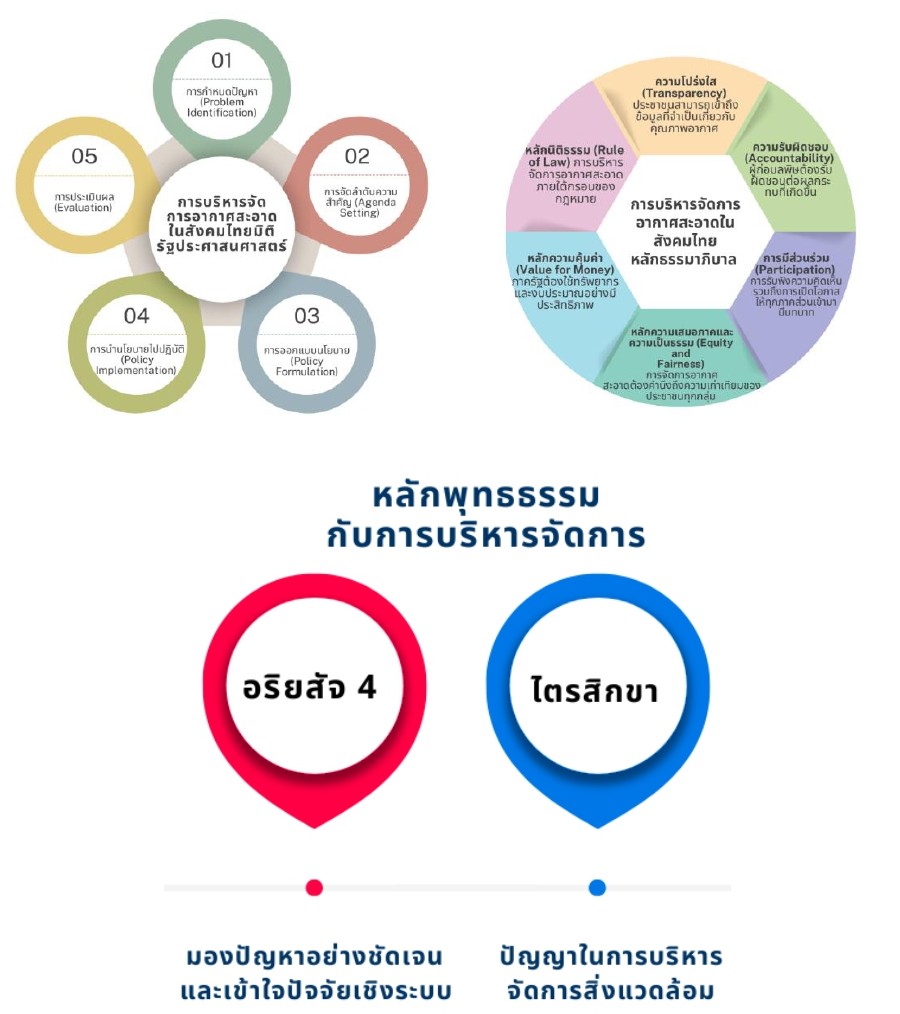
Air pollution is a critical issue that affects public health, the economy, and overall quality of life. Although the Thai government has implemented various measures, their effectiveness remains limited due to policy implementation challenges and insufficient public participation. This article aims to propose an integrated conceptual framework for clean air management based on the dimensions of public administration and good governance, complemented by Buddhist principles that emphasize morality and public consciousness. The public administration focuses on the five stages of the public policy process - problem identification, agenda setting, policy formulation, implementation, and evaluation together with result-based management and participatory administration. Good governance emphasizes transparency, accountability, equity, and participation as the foundation of effective and ethical public administration. When integrated with Buddhist principles, particularly the Four Noble Truths for analyzing structural causes of air pollution and the Threefold Training for developing ethical regulation, administrative discipline, and wisdom-based policymaking, the framework enhances both rationality and morality in governance. The study concludes that integrating these three dimensions fosters an effective, transparent, and sustainable system for clean air management. It promotes Buddhist-oriented public consciousness, shared responsibility, and moral evaluation alongside air quality indicators, thereby advancing Thailand toward a balanced state of economic development, environmental sustainability, and ethical public governance.
References
กรมควบคุมมลพิษ. (2566). รายงานสถานการณ์มลพิษของประเทศไทย พ.ศ. 2566. กรุงเทพฯ: กระทรวงทรัพยากรธรรมชาติและสิ่งแวดล้อม.
คณะกรรมการสิ่งแวดล้อมแห่งชาติ. (2564). แผนปฏิบัติการขับเคลื่อนการแก้ไขปัญหามลพิษทางอากาศ. กรุงเทพฯ: สำนักงานนโยบายและแผนทรัพยากรธรรมชาติและสิ่งแวดล้อม.
เจริญชัย กุลวัฒนาพร. (2563). หลักพุทธธรรมกับกลยุทธ์การบริหารจัดการความเปลี่ยนแปลงขององค์กร. วารสารวิจยวิชาการ, 3(2), 171–182.
พระครูโกศลศาสนบัณฑิต (กฤษณะ ตรุโณ). (2568). แนวทางแก้ปัญหาสิ่งแวดล้อมด้วยพุทธจริยศาสตร์: การศึกษาเชิงวิเคราะห์. มจร ปรัชญาปริทรรศน์, 8(1), 355–370.
พระพรหมคุณาภรณ์ (ป. อ. ปยุตฺโต). (2553). พุทธธรรม. กรุงเทพฯ: มูลนิธิพุทธธรรม.
รมิดา ศรีมันตา และคณะ. (2020). การพัฒนาแบบจำลองไตรสิกขาเพื่อการอนุรักษ์สิ่งแวดล้อม. วารสารวิจัยชุมชนและการพัฒนาสังคม, 14(4), 172–186.
สุทธินัย ผลขาว. (2568). พุทธศาสนาและการเปลี่ยนแปลงคุณค่าทางวัฒนธรรมในสังคมเมืองไทย. วารสารพุทธรัตโนบล, 1(3), 44–54.
Durongkaveroj, W. (2023). Recent developments in basic education and environmental governance in Thailand. Bangkok: Chulalongkorn University Press.
Dye, T. R. (2017). Understanding public policy (15th ed.). Boston, MA: Pearson.
Kiesewetter, G., Klimont, Z., Ru, M., & Slater, J. (2023). National assessment of the cost of inaction of tackling air pollution in Thailand. International Institute for Applied Systems Analysis (IIASA).
OECD. (2021). Environmental governance in practice. Paris: OECD Publishing.
UNEP. (2022). Air quality policies and practices. Nairobi: UNEP.
WHO. (2022). Air pollution and health. Geneva: WHO.