THE POLITICAL IDENTITY OF POLITICAL SCIENCE STUDENTS AT SURINDRA RAJABHAT UNIVERSITY IN THE BORDERLAND AREA THROUGH ONLINE MEDIA
Keywords:
Political Identity, Political Science Students, Border Area, Online Media, Digital CitizenshipAbstract
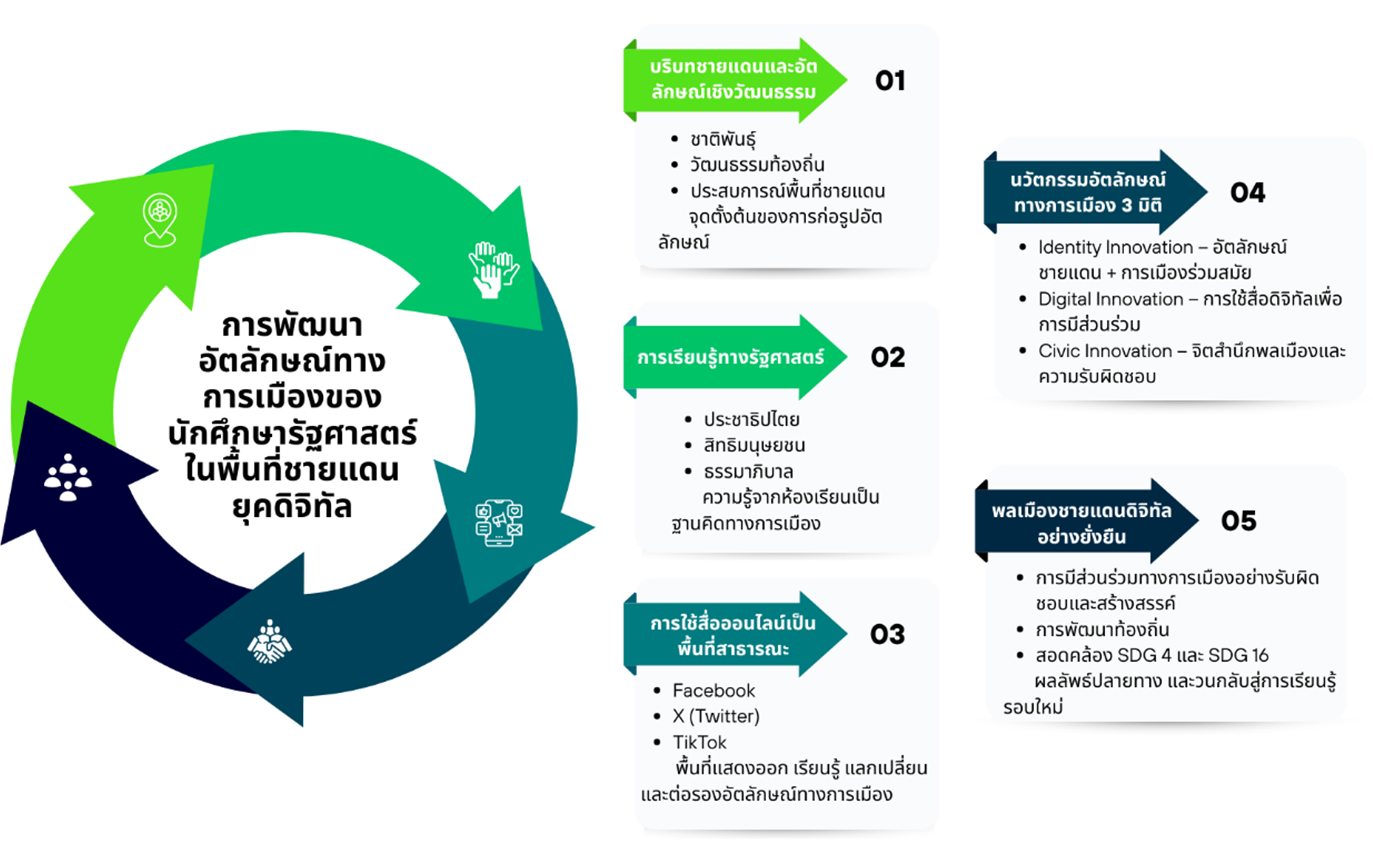
Objectives of this research article were: 1. To examine the characteristics and forms of the political identity of Political Science students at Surindra Rajabhat University as reflected through their use of online media within the context of a border area; and 2. To synthesize guidelines for promoting and developing the political identity of Political Science students in accordance with the digital society and the border context of Surin Province. This study employed descriptive qualitative research. The key informants consisted of 30 second-year Political Science students purposefullselected.selected. The research instruments included semi-structured in-depth-interview scripts and observation records of online media content on platforms such as Facebook, X (Twitter), and TikTok. Data were collected through in-depth interviews and verified using triangulation techniques. The collected data were analyzed using content descriptive interpretation.
The findings revealed that: 1. The political identity of Political Science students at Surindra Rajabhat University, as reflected through online media at the border context, appeared prominently in three dimensions: 1.1 the “border citizen” identity, reflecting a strong attachment to local communities alongside a sense of Thai citizenship; 1.2 the “new-generation political science student” identity, in which digital media served as spaces for political learning, opinion exchange, and public awareness building; and 1.3 the “political communicator” identity, demonstrating students’ roles in producing content, communicating public issues, and expanding spaces for constructive discussion in online society. 2. The guidelines for promoting and developing students’ political identity should focus on strengthening the “Digital Civic Sphere” to enhance political communication skills, media literacy, and democratic participation among students, leading to the development of strong and sustainable democratic citizenship within the Thai–Cambodian border context.
References
มหาวิทยาลัยราชภัฏสุรินทร์. (2566). แผนที่ยุทธศาสตร์มหาวิทยาลัยราชภัฏสุรินทร์ ระยะ 5 ปี (พ.ศ. 2566 – 2570). สืบค้น 2 มกราคม 2567, จาก https://shorturl.asia/9AuEb
สำนักงานสถิติแห่งชาติ. (2565). รายงานการใช้เทคโนโลยีดิจิทัลของประชากรไทย. กรุงเทพฯ: สำนักงานสถิติแห่งชาติ.
Bennett, W. L. & Segerberg, A. (2012). The Logic of Connective Action: Digital Media and The Personalization of Contentious Politics. Information. Communication & Society, 15(5), 739–768.
Bourdieu, P. (1986). The Forms of Capital. In J. Richardson (Ed.), Handbook of Theory and Research for The Sociology of Education (pp. 241–258). New York: Greenwood.
Castells, M. (2011). The Rise of The Network Society (2nd ed.). Malden: Wiley-Blackwell.
Choi, M. (2016). A Concept Analysis of Digital Citizenship for Democratic Citizenship Education in The Internet Age. Theory & Research in Social Education, 44(4), 565–607.
Dahlgren, P. (2013). The Political Web: Media, Participation and Alternative Democracy. Basingstoke: Palgrave Macmillan.
Habermas, J. (1989). The Structural Transformation of The Public Sphere: An Inquiry Into a Category of Bourgeois Society. Cambridge: MIT Press.
Henn, M. & Foard, N. (2014). Social Differentiation in Young People’s Political Participation: The Impact of Social And Educational Factors on Youth Political Engagement in Britain. Journal of Youth Studies, 17(3), 360–380.
Horstmann, A. (2018). Ethnicization and Borderlands Citizenship: The Political Subjectivity of Minorities in Thailand. Asian Ethnicity, 19(3), 398–415.
Huddy, L. (2001). From Social to Political Identity: A Critical Examination of Social Identity Theory. Political Psychology, 22(1), 127–156.
Knowles, M. S. (1980). The Modern Practice of Adult Education: From Pedagogy to Andragogy. New York: Cambridge Books.
Loader, B. D. et al. (2014). The Networked Young Citizen: Social Media, Political Participation and Civic Engagement. Information, Communication & Society, 17(2), 143–150.
Pongsawat, P. (2020). Urban politics and local governance in Thailand. Journal of Contemporary Asia, 50(3), 410–428.
Tajfel, H. & Turner, J. C. (1986). The Social Identity Theory of Intergroup Behavior. In S. Worchel & W. G. Austin (Eds.), Psychology of intergroup relations (pp. 7–24). Chicago: Nelson-Hall.
Theocharis, Y. & Van Deth, J. W. (2018). Political Participation in A Changing World: Conceptual and Empirical Challenges in The Study of Citizen Engagement. London: Routledge.
UNESCO. (2020). Education For Sustainable Development: A Roadmap. Retrieved March 20, 2025, from https://unesdoc.unesco.org/ark:/48223/pf0000374802
Vromen, A. et al. (2015). Young People, Social Media and Connective Action: From Organizational Maintenance to Everyday Political Talk. Journal of Youth Studies, 18(1), 80–100.
Walker, A. (2019). The Borderlands of Southeast Asia: Geopolitics, Territories and Identities. Ithaca: Cornell University Press.