Peer Review Process
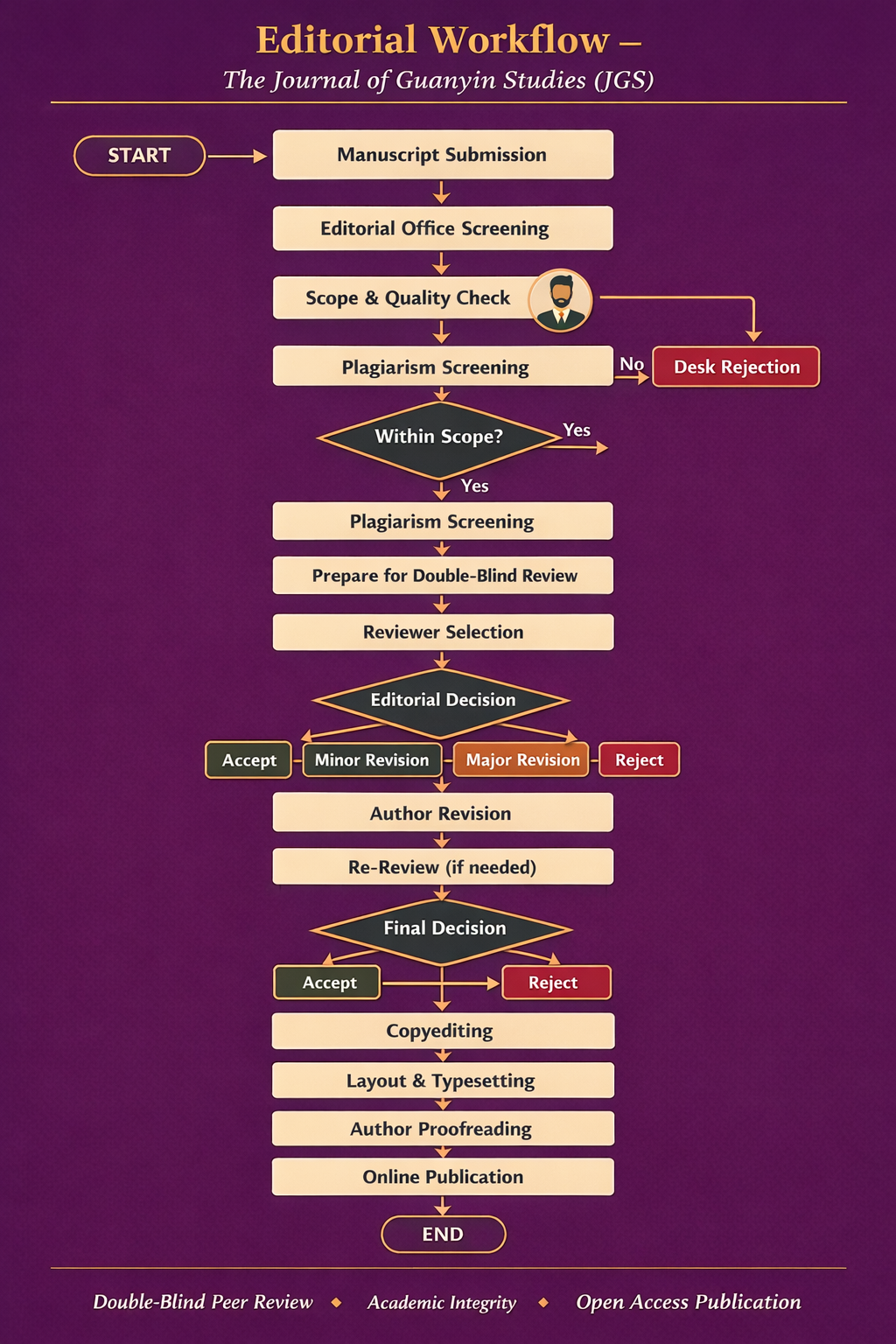
The Journal of Guanyin Studies (JGS) follows a rigorous, transparent, and fair peer review process to ensure that published articles meet high academic standards, demonstrate originality, and contribute meaningfully to scholarly discourse. The journal employs a double-blind peer review system, in which both the authors and reviewers remain anonymous throughout the review process.
The detailed review process is as follows.
1. MANUSCRIPT SUBMISSION
Authors must submit their manuscripts through the journal’s online submission system along with all required documents, including:
- The complete manuscript file
- An anonymized manuscript file for peer review
- Abstract, keywords, and author information
- Required submission forms or supporting documents
- Ethical approval documents for research involving human participants (if applicable)
- Disclosure statements for funding sources or conflicts of interest (if applicable)
Submitted manuscripts must be original works that have not been previously published and are not under consideration by any other journal.
2. INITIAL SCREENING BY THE EDITORIAL OFFICE
After submission, the editorial office conducts an initial screening to check:
- Completeness of submission materials
- Compliance with the journal’s formatting requirements
- Relevance to the journal’s aims and scope
- Clarity of language and academic structure
- Readiness of the manuscript for peer review
If the submission is incomplete or does not follow the journal’s formatting requirements, it may be returned to the author for revision before further processing.
3. PRELIMINARY EDITORIAL ASSESSMENT
The editor conducts an initial academic assessment to determine whether the manuscript is suitable for peer review. This assessment considers:
- Originality and significance of the research topic
- Relevance to the field covered by the journal
- Appropriateness of the conceptual framework or research methodology
- Completeness of academic components
- Quality of references and scholarly sources
At this stage, the manuscript may receive a desk rejection if:
- The topic falls outside the journal’s scope
- The manuscript does not meet minimum academic standards
- The manuscript format is substantially inconsistent with journal guidelines
- There are clear ethical concerns
4. PLAGIARISM SCREENING
Before sending the manuscript for peer review, the journal may conduct plagiarism screening using software such as Turnitin or other appropriate tools.
If significant similarity or plagiarism is detected, the journal may:
- Request clarification or revision from the author
- Suspend the review process
- Reject the manuscript
5. PREPARATION FOR DOUBLE-BLIND REVIEW
The journal ensures that the manuscript file sent to reviewers contains no identifying information about the authors. This includes removal of:
- Author names
- Institutional affiliations
- Acknowledgements that reveal identity
- File metadata or properties
- Self-citations that clearly identify the author
This process ensures the integrity of the double-blind peer review system.
6. SELECTION OF REVIEWERS
Each manuscript is sent to at least two independent reviewers who are experts in the relevant field.
Reviewers are selected based on:
- Expertise relevant to the manuscript topic
- Academic and research experience
- Independence from the authors
- Absence of conflicts of interest
If the reviewers’ evaluations differ significantly, the editor may invite a third reviewer to provide an additional assessment.
7. PEER REVIEW EVALUATION
Reviewers evaluate the manuscript based on academic criteria, including:
- Relevance to the journal’s scope
- Originality of the research
- Significance of the topic
- Clarity of research objectives
- Appropriateness of theoretical framework or methodology
- Reliability and validity of findings
- Quality of analysis and discussion
- Academic writing and clarity of language
- Adequacy and accuracy of references
- Overall scholarly contribution
Reviewers are encouraged to provide both evaluative comments and constructive feedback to help authors improve their manuscripts.
8. INITIAL EDITORIAL DECISION
After receiving the reviewers’ reports, the editorial board evaluates the recommendations and communicates a decision to the author. The decision may fall into one of the following categories:
- Accept without revision
- Minor revision required
- Major revision required
- Reject
Reviewer comments are normally shared with the authors, sometimes summarized or edited by the editorial office for clarity.
9. MANUSCRIPT REVISION BY AUTHORS
If the decision is minor revision or major revision, authors must revise the manuscript according to the reviewers’ comments within the specified timeframe.
Authors must submit:
- The revised manuscript
- A marked-up version highlighting revisions (if requested)
- A Response to Reviewers document explaining how each comment has been addressed
Responses should clearly indicate:
- What changes were made
- Where the changes appear in the manuscript
- Justifications if certain suggestions were not followed
10. SECOND REVIEW (IF REQUIRED)
For manuscripts requiring major revision, the revised manuscript may be returned to the original reviewers or sent to new reviewers to evaluate whether the revisions sufficiently address the concerns raised.
For minor revisions, the editor may assess the revisions without sending the manuscript back to reviewers.
11. FINAL EDITORIAL DECISION
Once the review and revision process is complete, the editorial board makes the final decision to:
- Accept the manuscript
- Request further revisions
- Reject the manuscript
The final decision is based on:
- The quality of the revised manuscript
- The reviewers’ recommendations
- The journal’s academic standards
- Editorial considerations
The editorial board’s decision is final.
12. COPYEDITING AND FORMATTING
Accepted manuscripts proceed to editorial processing, including:
- Language editing
- Formatting according to the journal style
- Verification of references
- Consistency of terminology
- Layout preparation for publication
The editorial team may contact authors for clarification if necessary.13. Author Proofreading
Before publication, authors receive page proofs for final checking of:
- Spelling and grammar
- Author details
- Tables and figures
- References
- Minor formatting issues
Authors should only correct typographical or technical errors at this stage. Substantial content changes are not normally permitted without editorial approval.
13. AUTHOR PROOFREADING
Before publication, authors receive page proofs for final checking of:
- Spelling and grammar
- Author details
- Tables and figures
- References
- Minor formatting issues
Authors should only correct typographical or technical errors at this stage. Substantial content changes are not normally permitted without editorial approval.
14. PUBLICATION
After final approval, the article will be published in the designated issue of the journal and made available on the journal platform under the Open Access policy.