THE ROLE OF PROPAGATION OF BUDDHISM OF DHAMMADUTA BHIKKHUS: A CASE STUDY OF LUANG PU DU (BRAHMAPANYO)
Keywords:
Propagation, Buddhism, Dhammaduta Bhikkhus, Luang Pu Du BrahmapannyoAbstract
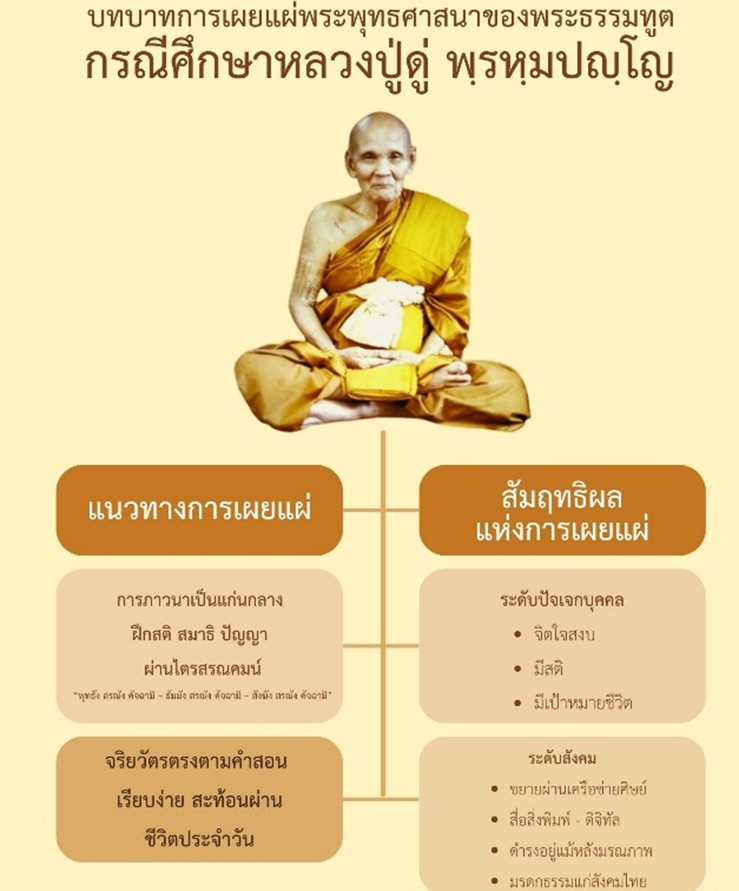
Objectives of this research were: 1. To study the life and role of Luang Pu Du in his capacity as a Buddhist Dhammatuta, 2. examine the principles and methods of Buddhist dissemination employed by Luang Pu Du, and 3. To investigate the achievements of his Buddhism dissemination. The study employed a documentary research methodology, collecting data from the Tipitaka, historical documents on his teachings, lecture records, and related academic articles. The collected information was analyzed using descriptive analysis.
The research findings revealed that Luang Pu Du Brahmapañño played a prominent role as a Dhammaduta monk emphasizing practical practice. He focused on disseminating the Dhamma with meditation as the central core and used the Triple Gem (Buddham, Dhammam, Sangham) as the principal foundation for cultivating mindfulness, concentration, and wisdom. His teachings were simple yet capable of leading to profound inner transformation, as reflected in his way of life and his exemplary moral conduct. The achievements of Luang Pu Du’s Dhamma dissemination appeared at two levels. First, at the individual level, those who were close to him or who followed his teachings experienced spiritual development, such as inner peace, mindfulness, and a stable sense of life purpose. Second, at the societal level, his teachings have been disseminated through networks of disciples as well as printed and digital media, allowing the dissemination of his teachings to continue even after his passing. This has become a valuable spiritual legacy for Thai society. Keywords: Dissemination; Buddhism; Dhammaduta Bhikkhus; Luang Pu Du Brahmapannyo.
References
พระครูโสภณธรรมวิจารณ์ และคณะ. (2559). รูปแบบการเผยแผ่พระพุทธศาสนาของพระธรรมทูตในจังหวัดอ่างทอง. วารสาร มจร สังคมศาสตร์ปริทรรศน์, 5(1), 29-42.
พระธรรมปิฎก (ป.อ. ปยุตฺโต). (2538). ไอ ที ภายใต้วัฒนธรรมแห่งปัญญา (ศาสนากับยุคโลกาภิวัตน์). สืบค้น 2 มกราคม 2567, จาก https://shorturl.asia/UK3MQ
พระมหาบัว ญาณสมฺปนฺโน. (2553). ประวัติท่านพระอาจารย์มั่น ภูริทัตตเถระ (พิมพ์ครั้งที่ 9). กรุงเทพฯ: ศูนย์หนังสือพระพุทธศาสนา.
พระเมธีธรรมภรณ์ (ประยูร ธมมฺจิตฺโต). (2539). พระพุทธศาสนาในยุคโลกาภิวัตน์ (พิมพ์ครั้งที่ 2). กรุงเทพฯ: มูลนิธิพุทธธรรม.
พระอธิการสุรศักดิ์ สุขุมาโล (คงเมือง) และพระมหาสุนันท์ สุนนฺโท. (2561). เทศนาวิธีเพื่อการเผยแผ่พระพุทธศาสนาของพระสงฆ์ในอำเภอแก่งคอย จังหวัดสระบุรี. วารสาร มจร สังคมศาสตร์ปริทรรศน์, 7(2-2), 195-207.
มหาจุฬาลงกรณราชวิทยาลัย. (2539). พระไตรปิฎกฉบับภาษาไทย ฉบับมหาจุฬาลงกรณราชวิทยาลัย. กรุงเทพฯ: โรงพิมพ์มหาจุฬาลงกรณราชวิทยาลัย.
สมเด็จพระพุทธโฆษาจารย์ (ป.อ. ปยุตฺโต). (2564). พุทธวิธีการสอน (พิมพ์ครั้งที่ 26). สืบค้น 15 มกราคม 2567, จาก https://www.watnyanaves.net/th/book_detail/313
Bandura. A. (1977). Social Learning Theory. New Jersey: Prentice Hall.
Campbell, H. A. (2013). Digital Religion: Understanding Religious Practice in New Media Worlds. New York: Routledge.
Dewey, J. (1916). Democracy and Education: An Introduction to The Philosophy of Education. New York: Macmillan.
Nguyen, H. H. (2022). Some Ethical Values in Buddhist Philosophy. International Journal of Education Humanities and Social Science, 5(4), 94-99.
Nonaka, I. & Takeuchi, H. (1995). The Knowledge-Creating Company: How Japanese Companies Create the Dynamics of Innovation. New York: Oxford University Press.
Shukla, S. (2019). Buddhist Ethics: Some Reflections. Pracya Journal, 11(1), 86-95.
Stark, R. & Finke, R. (2000). Acts of Faith: Explaining The Human Side of Religion. Berkeley: University of California Press.