WOMEN’S POLITICAL PARTICIPATION IN SIKHORAPHUM DISTRICT, SURIN PROVINCE
Keywords:
Women’s Political Participation, Women’s Roles, Sikhoraphum District, Surin ProvinceAbstract
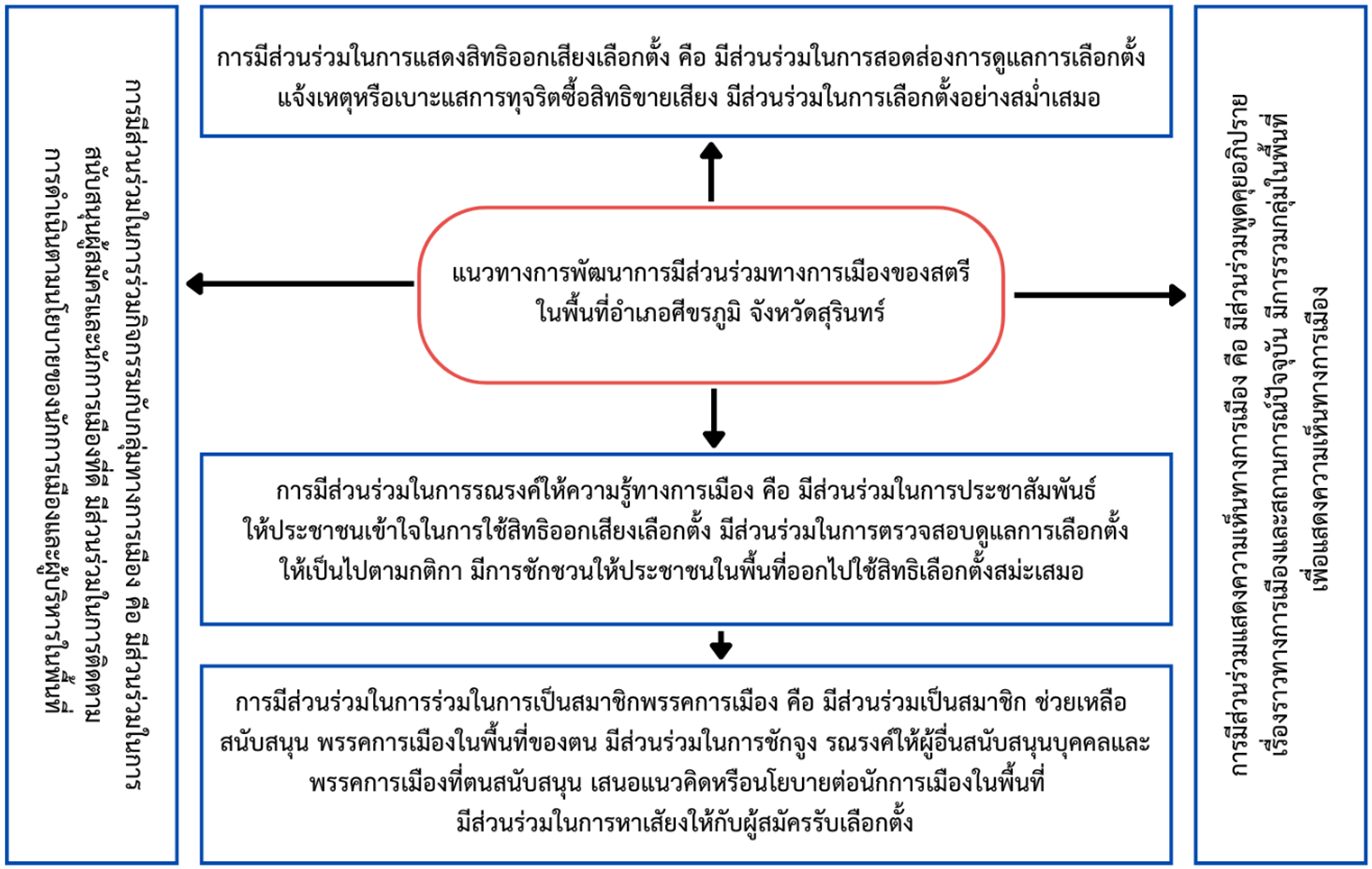
Objectives of this research article were:1. To examine the level of women’s political participation; 2. To compare women’s political participation categorized by personal demographic factors; and 3. To propose guidelines for enhancing women’s political participation, conducted by the mixed-methods research. The quantitative method utilized a questionnaire with a reliability coefficient of 0.93, administered to 383 residents aged 18 years and above at Sikhoraphum District, selected through multi-stage sampling based on Taro Yamane’s formula. Data were analyzed using percentage, mean, standard deviation, t- test, one-way ANOVA, and the Least Significant Difference (LSD) post hoc test. For the qualitative method, in-depth interviews were conducted with seven key informants purposefully selected, comprising the District Chief Officer, the District Development Officer, representatives from local administrative organizations, representatives from the Sub-District Headmen and Village Headmen Association, and representatives from civil society. Data were analyzed by contextual descriptive interpretation.
The findings revealed that: 1. The overall level of women’s political participation was moderate ( = 3.38, S.D. = 0.494). When examined by aspect, the highest-rated aspect was the exercise of voting rights, followed by participation in political campaigns and public relations, engagement with political groups, political expression, and, lastly, membership in political parties; 2. Differences in opinions regarding women’s political participation were statistically significant at the 0.05 level among respondents with different ages, education levels, and occupations. However, gender did not produce significant differences in overall opinions; and 3. The proposed guidelines for enhancing women’s political participation included supporting women’s organizations, promoting safe political spaces, establishing democratic learning centers, conducting media-based campaigns, forming women’s volunteer democracy networks, producing local media showcasing women role models, expanding political participation spaces for local women’s groups, fostering active citizenship among women, promoting women’s quotas, and supporting mentorship systems for women aspiring to enter politics.
References
จุฑาทิพชูมณี วรรณดีกุลภัทร. (2563). การมีส่วนร่วมทางการเมืองของสตรีในจังหวัดนครปฐม. ปทุมธานี: มหาวิทยาลัยธรรมศาสตร์.
ณัฐนรินทร์ เฉลิมฤทธิวัฒน์. (2559). การมีส่วนร่วมทางการเมืองระดับท้องถิ่นของสตรีในเขตเทศบาลตำบลชุมแสง อำเภอวังจันทร์ จังหวัดระยอง (วิทยานิพนธ์รัฐประศาสนศาสตรมหาบัณฑิต สาขาวิชาวิชาการจัดการภาครัฐและภาคเอกชน). ชลบุรี: มหาวิทยาลัยบูรพา.
ถวิลวดี บุรีกุล และรัชวดี แสงหะหมัด. (2559). การเสริมพลังของผู้หญิงในการมีส่วนร่วมทางการเมืองของ ประเทศไทย. วารสารสถาบันพระปกเกล้า, 14(2), 63-86.
สุภาพร บุญเกื้อ และคณะ. (2566). การมีส่วนร่วมทางการเมืองท้องถิ่นของสตรี ในเขตเทศบาลตำบลคอนสวรรค์ : ศึกษาเฉพาะ กรณีเทศบาลตำบลคอนสวรรค์ อำเภอคอนสวรรค์ จังหวัดชัยภูมิ. วารสารชัยภูมิปริทรรศน์, 6(3), 12-23.
โอภาส จิตระยนต์. (2565). การมีส่วนร่วมทางการเมืองของประชาชนในเขตองค์การบริหารส่วนตำบลหน้า พระธาตุ อำเภอพนัสนิคม จังหวัดชลบุรี (วิทยานิพนธ์รัฐศาสตรมหาบัณฑิต สาขาวิชารัฐศาสตร์). ชลบุรี: มหาวิทยาลัยบูรพา.
Inter-Parliamentary Union. (2022). Women in Parliament: 2022 Global Report. Geneva: Inter-Parliamentary Union.
Putnam, R. D. (1993). Making Democracy Work: Civic Traditions in Modern Italy. Princeton, NJ: Princeton University Press.
UN Women. (2020). Women’s Political Participation and Leadership: Evidence from Asia-Pacific. Bangkok: UN Women Regional Office for Asia and the Pacific.