POLITICAL PARTICIPATION IN THE DIGITAL AGE AMONG STUDENTS OF BOROMARAJONANI COLLEGE OF NURSING SURIN
Keywords:
Political Participation, Digital Era, Nursing Students, Boromarajonani College of Nursing SurinAbstract
Objectives of this research article were: 1. To study the level of political participation in the digital age among students at Boromarajonani College of Nursing, Surin; 2. To analyze the factors affecting political participation in the digital age among students at Boromarajonani College of Nursing, Surin; and 3. To propose appropriate guidelines for promoting and developing political participation among students in the digital era, condcted by the mixed-methods combining quantitative and qualitative researches. The quantitative research used a sample of 227 nursing students, derived from a population of 522, calculated using Taro Yamane’s formula and stratified random sampling. The research instrument was a questionnaire with a reliability coefficient of 0.978. Data were analyzed using mean, standard deviation, Pearson’s correlation coefficient, and multiple regression analysis. For the qualitative research, eight key informants were purposefully selected. Data were collected through in-depth interviews and analyzed using content descriptive interpretation.
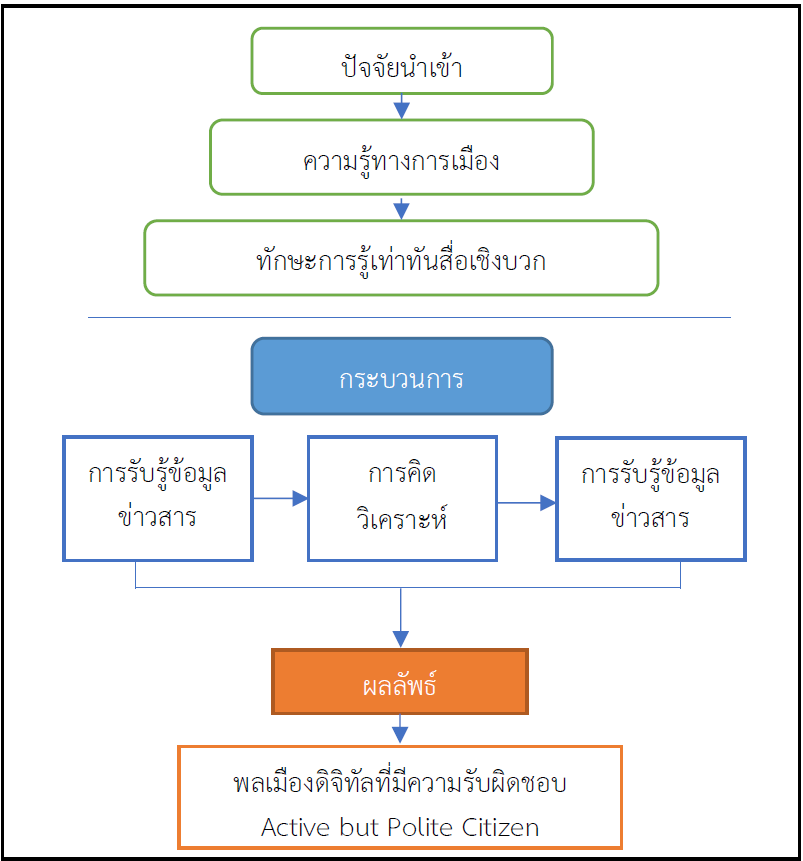
The results revealed that: 1. The overall level of political participation in the digital age among students was at a moderate level; 2. The factors affecting political participation in the digital age were at a high level, namely political knowledge and understanding, media and information literacy, and political attitudes; and 3. The analysis of recommendations for promoting and developing political participation among students in the digital age appropriately was found that enabling students to access political information, news, and opinions from various sources quickly and diversely through social media should be emphasized. Therefore, students should be encouraged to develop skills in media literacy and effective digital information filtering in order to utilize diverse information for analysis and constructive political participation. In addition, discussion activities and media literacy training should be organized so that students can gain knowledge, analyze information with critical judgment, and express opinions constructively.
References
งานทะเบียนและประมวลผล วิทยาลัยพยาบาลบรมราชชนนี สุรินทร์. (2568). รายงานจำนวนนักศึกษาวิทยาลัยพยาบาลบรมราชชนนี สุรินทร์ ปีการศึกษา 2568. สุรินทร์: วิทยาลัยพยาบาลบรมราชชนนี สุรินทร์.
พรรชรนันท์ สายจันดี และคณะ. (2565). การรับรู้ทางการเมือง การกล่อมเกลาทางการเมือง และการมีส่วนร่วมทางการเมือง ของเยาวชนในประเทศไทย. วารสารพุทธปรัชญาวิวัฒน์, 6(2), 26-40.
ศิพิมพ์ ศรบัลลังก์. (2565). ปัจจัยที่ส่งผลต่อการมีส่วนร่วมทางการเมืองของนิสิตนักศึกษา หลังการประกาศใช้รัฐธรรมนูญปี 2560. วารสารสังคมศาสตร์ มหาวิทยาลัยศรีนครินทรวิโรฒ, 25(2), 140-153.
สุดารัตน์ ต้นทอง และพระครูปริยัติปัญญาโสภณ. (2568). ผลกระทบของสื่อออนไลน์ในยุคดิจิทัลต่อการมีส่วนร่วมทางการเมืองของเยาวชนในสังคมประชาธิปไตย. วารสารพุทธสุขภาวะศึกษาและสังคมศาสตร์, 1(1), 39-49.
Howard, P. N. & Hussain, M. M. (2013). Democracy’s Fourth Wave? Digital Media and the Arab Spring. Oxford: Oxford University Press.
Kaplan, A. M. & Haenlein, M. (2010). Users of The World, Unite! The Challenges and Opportunities of Social Media. Business Horizons, 53(1), 59-68.
Rainie, L. et al. (2012). Social Media and Political Engagement. Retrieved March 20, 2025, from https://shorturl.asia/ubho4
Yamane, T. (1973). Statistics: An Introductory Analysis (3rd ed.). New York: Harper and Row.