BUDDHADHAMMA APPLICATION FOR ENHANCING THE QUALITY OF LIFE OF PERSONS WITH DISABILITIES IN SAMUT PRAKAN PROVINCE
Keywords:
Quality of Life of Persons With Disabilities, Bhavana 4, Holistic Development, Samut Prakan ProvinceAbstract
This research article aimed: 1. To study the general conditions of the quality of life of disabled persons in Samut Prakan Province; 2. To study the factors contributing to the enhancement of the quality of life of disabled persons in Samut Prakan Province; and 3. To propose guidelines for applying Buddhist principles to enhance the quality of life of disabled persons in Samut Prakan Province, conducted by the qualitative research. Data were collected through in-depth interviewing 20 key informants who were involved in the development of the quality of life of disabled persons. The research instrument was structured in-depth interview script, and the data were analyzed using descriptive content analysis.
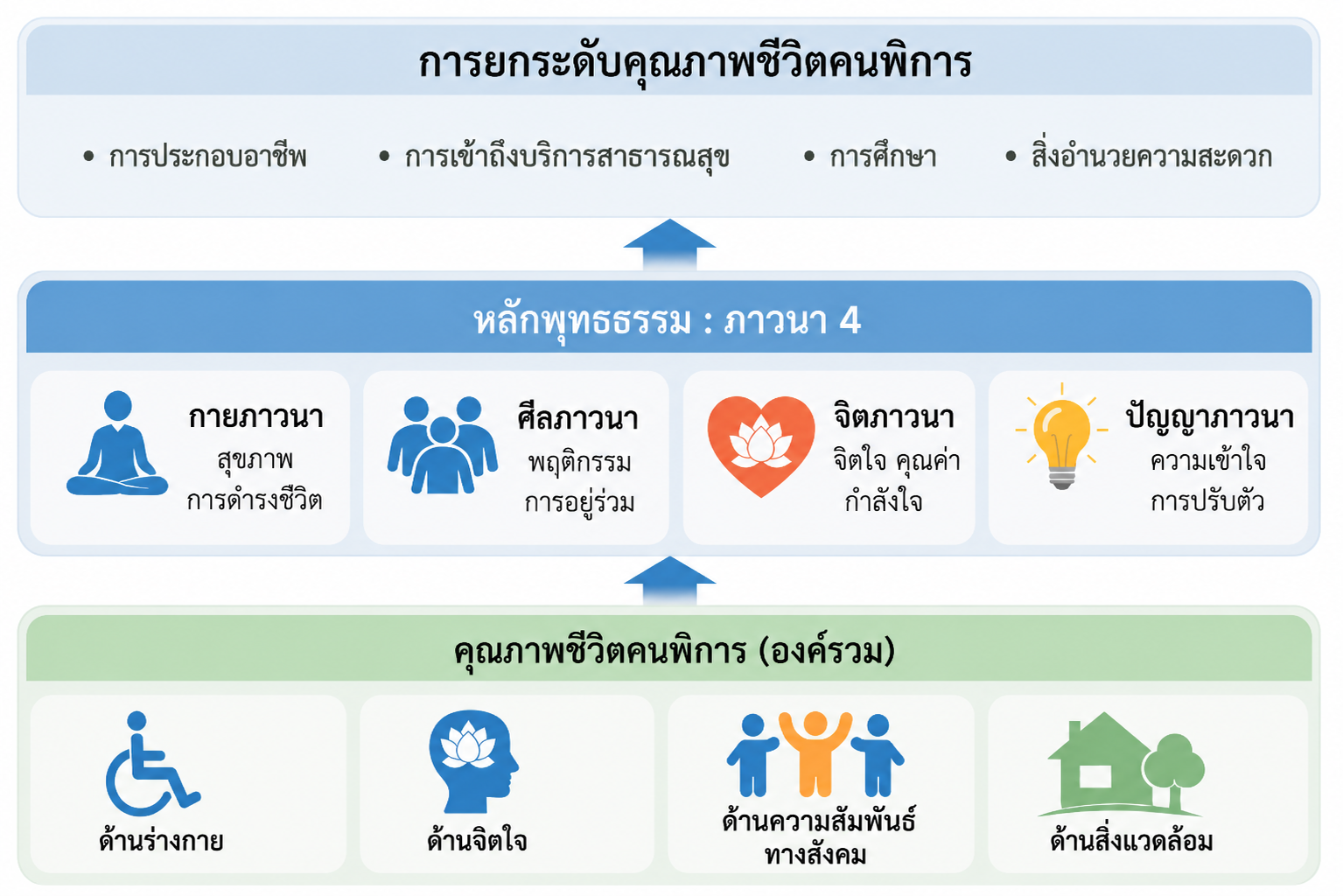
The findings revealed that: 1. The quality of life of disabled persons in Samut Prakan Province consisted of four interconnected aspects: physical, psychological, social, and environmental. Access to healthcare services, rights and welfare, psychological stability, social networks, and public facilities were key factors supporting self-reliance and social participation although limitations in service coverage and continuity remain. 2. The enhancement of quality of life was explained by Bhavana 4, namely, Gaya-bhavana, Sila-bhavana, Citta-bhavana, and Panna-bhavana, which functioned synergistically to strengthen internal capacities, including health, behavior, emotional stability, and adaptive learning. 3. The application of Buddhist principles was driven through four main domains: employment, healthcare access, education, and facilities, which are integrated with Bhavana 4 to connect external factors with internal capacity development in accordance with the local context. The findings also reflected the integration between external factors and internal capacities, with Bhavana 4 functioning as a connecting mechanism, constituting a novel finding that explained the holistic and sustainable development of the quality of life of disabled persons.
References
กรมส่งเสริมและพัฒนาคุณภาพชีวิตคนพิการ. (2566). (ร่าง) แผนปฏิบัติการด้านการพัฒนาคุณภาพชีวิตคนพิการแห่งชาติ ฉบับที่ 6 (พ.ศ. 2566–2570). สืบค้นเมื่อ 15 พฤษภาคม 2568 จาก https://shorturl.asia/ba20r.
คณะกรรมการส่งเสริมและพัฒนาคุณภาพชีวิตคนพิการแห่งชาติ. (2560). แผนพัฒนาคุณภาพชีวิตคนพิการแห่งชาติ ฉบับที่ 5 พ.ศ. 2560–2564. กรุงเทพฯ: กรมส่งเสริมและพัฒนาคุณภาพชีวิตคนพิการ.
เฉลิมขวัญ สิงห์วี. (2548). ปัจจัยที่ส่งผลต่อคุณภาพชีวิตของคนพิการทางกายในศูนย์ฟื้นฟูอาชีพคนพิการในเขตกรุงเทพมหานครและปริมณฑล. กรุงเทพฯ: มหาวิทยาลัยเกษตรศาสตร์.
ฐิติวัจน์ ทองแก้ว และคณะ. (2562). การวิจัยเชิงเอกสารเพื่อสังเคราะห์องค์ประกอบของแนวคิดคุณภาพชีวิตของคนพิการ ในบริบทสากล บริบทเฉพาะสำหรับคนพิการ และบริบทด้านการประกอบอาชีพ. วารสารพิชญทรรศน์, 14(1), 29–38.
ทับทิม ศรีวิไล และคณะ. (2565). การบริหารการพัฒนาที่ส่งผลต่อคุณภาพชีวิตคนพิการโดยกรมส่งเสริมและพัฒนาคุณภาพชีวิตคนพิการ ในเขตภาคกลาง. วารสารรัชต์ภาคย์, 16(49), 371–385.
นคร จันทราช และคณะ. (2568). การพัฒนาคุณภาพชีวิตผู้พิการวิถีพุทธในสังคมไทย. วารสารชัยภูมิปริทรรศน์, 8(2), 128–143.
นวินดา นิลวรรณ และคณะ. (2563). การประยุกต์ใช้หลักภาวนา 4 ตามแนวพระพุทธศาสนาเถรวาทสู่สังคมผู้สูงอายุ. วารสารมหาจุฬานาครทรรศน์, 7(3), 39–49.
พระสุนทรกิตติคุณ. (2560). หลักพุทธธรรมกับการดูแลสุขภาพแบบองค์รวมในผู้สูงอายุ. วารสารมหาจุฬาวิชาการ, 3(1), 11–25.
พูลศักดิ์ หอมสมบัติ. (2563). การสร้างรูปแบบ มาตรการ และวิธีการพัฒนาคุณภาพชีวิตของผู้พิการในสังคมไทย. วารสารวิชาการธรรมทรรศน์, 20(2), 57–68.
สำนักงานจังหวัดสมุทรปราการ. (2566). แผนพัฒนาจังหวัดสมุทรปราการ 5 ปี (พ.ศ. 2566–2570) ฉบับทบทวน ประจำปีงบประมาณ พ.ศ. 2568. สืบค้นเมื่อ 15 พฤษภาคม 2568 จาก https://url.in.th/KWbGV.
UNESCO. (1993). World Education Report 1993: Monitoring Education-for-All Goals. (Mimeographed). Paris: UNESCO and UNICEF.