BUDDHIST PRINCIPLES INTEGRATION FOR PROMOTING THE LIFE QUALITY OF PEOPLE OF SUBDISTRICT ADMINISTRATIVE ORGANIZATION IN THAWUNG DISTRICT, LOPBURI PROVINCE
Keywords:
Integration, Buddhadhamma, Life Quality, Subdistrict Administrative OrganizationAbstract
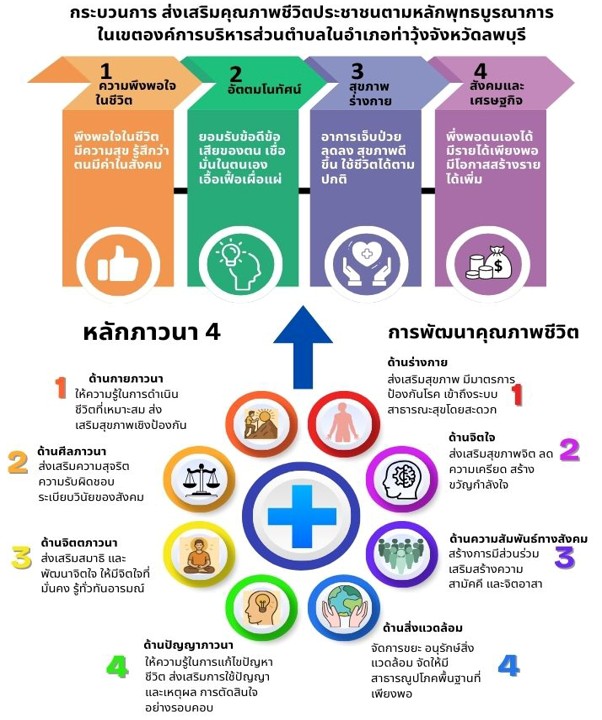
This research article aimed to: 1. study the current conditions, problems, causes, and needs for improving the quality of life of people in the Subdistrict Administrative Organization areas of Tha Wung District, Lop Buri Province; 2. examine the factors affecting the quality of life of people in these areas; and 3. propose a process for promoting people’s quality of life based on Buddhist integration in the Subdistrict Administrative Organization areas of Tha Wung District, Lop Buri Province. This study employed a mixed-methods research design. For the quantitative research, data were collected from a sample of 396 respondents using a five-point rating scale questionnaire with a reliability coefficient of 0.935. Data were analyzed using frequency, percentage, mean, standard deviation, and multiple regression analysis. For the qualitative research, in-depth interviews were conducted with 18 key informants, and the data were analyzed using content analysis.
The findings revealed that 1. Regarding the current conditions, the overall quality of life of the people was at a high level. The major problems and causes affecting their quality of life included unstable income, lack of occupational skill development, an increasing older population, household debt burdens, and the lack of concrete integration of Buddhist principles into daily life. 2. Quality-of-life promotion and the Bhavana 4 principles significantly affected the quality of life of people in all aspects at the 0.01 level. Quality-of-life promotion factors jointly predicted 63.3 percent of the variance in people’s quality of life, while the Bhavana 4 principles predicted 78 percent. and 3. The process for promoting people’s quality of life based on Buddhist integration consisted of: 3.1 quality-of-life development through continuous health promotion programs, activities supporting mental well-being, opportunities for public participation and expression of opinions, and appropriate waste and environmental management; 3.2 application of the Bhavana 4 principles by promoting healthy lifestyles, encouraging honesty and integrity, organizing activities to enhance concentration, and providing knowledge that enables people to solve problems in daily life; and 3.3 enhancement of people’s quality of life, reflected in satisfaction with community life, self-confidence, good health, sufficient income, and the ability to achieve self-reliance.
References
เครือวรรณ เทพดำ และสุปรีชา ชำนาญพุฒิพร. (2565). การพัฒนาคุณภาพชีวิตตามหลักพุทธธรรมของประชาชนในชุมชนท้องลำเจียก อำเภอเชียรใหญ่ จังหวัดนครศรีธรรมราช. วารสารพุทธสังคมวิทยาปริทรรศน์, 7(2), 130–143.
จันทรา จาติระเปา. (2568). การพัฒนาคุณภาพชีวิตประชาชนตามหลักไตรสิกขาของเทศบาลตำบลทาปลาดุก อำเภอแม่ทา จังหวัดลำพูน. วารสาร มจร.หริภุญชัยปริทรรศน์, 9(3), 338–352.
ณิชาพัฒน์ คำดี. (2567). การบูรณาการหลักพุทธจริยธรรมเพื่อส่งเสริมการปฏิบัติงานของบุคลากรองค์การบริหารส่วนจังหวัดลำพูน. วารสารสหวิทยาการนวัตกรรมปริทรรศน์, 7(4), 123–135.
ถนอมขวัญ อยู่สุข และคณะ. (2565). การพัฒนาคุณภาพชีวิตเชิงพุทธของผู้เกษียณอายุการปฏิบัติงานจากกรมชลประทาน. วารสาร มจร สังคมศาสตร์ปริทรรศน์, 11(4), 40–54.
ทัศมาวดี ฉากภาพ และคณะ. (2564). โมเดลความสัมพันธ์เชิงสาเหตุการพัฒนาสุขภาวะของผู้สูงอายุในองค์กรปกครองส่วนท้องถิ่น จังหวัดพระนครศรีอยุธยา. วารสาร มจร สังคมศาสตร์ปริทรรศน์, 10(2), 226–239.
ธัญญลักษณ์ เวียงอินทร์ และคณะ. (2566). ปัจจัยที่มีอิทธิพลในการพัฒนาคุณภาพชีวิตของประชาชนในจังหวัดร้อยเอ็ด. วารสารสหวิทยาการวิจัยและวิชาการ, 3(6), 541–560.
ประยงค์ จันทร์แดง. (2561). การพัฒนาคุณภาพชีวิตตามแนวศาสนา. กรุงเทพฯ: บริษัท โอ.เอส. พริ้นติ้ง เฮ้าส์ จำกัด.
ปาริชาติ เปรมวิชัย และคณะ. (2567). การประยุกต์หลักพุทธธรรมเพื่อพัฒนาทรัพยากรมนุษย์ของตัวแทนประกันชีวิตในจังหวัดพิษณุโลก. วารสารสหวิทยาการนวัตกรรมปริทรรศน์, 7(2), 142–154.
พระจักรพงศ์ จนฺทปญฺโญ (สุริน). (2568). การพัฒนาคุณภาพชีวิตของประชาชนตามหลักภาวนาธรรมในเขตเทศบาล ตำบลประตูป่า อำเภอเมือง จังหวัดลำพูน. วารสาร มจร.หริภุญชัยปริทรรศน์, 9(3), 619–633.
พีระ อุดมกิจสกุล และคณะ. (2567). การบูรณาการหลักพุทธธรรมเพื่อการพัฒนาทรัพยากรมนุษย์ของบริษัทไปรษณีย์ไทย ดิสทริบิวชั่น จำกัด. วารสารสหวิทยาการนวัตกรรมปริทรรศน์, 7(1), 194–206.
สาริณี มะลิลา และคณะ. (2566). การพัฒนาท้องถิ่นที่ส่งผลต่อคุณภาพชีวิตของประชาชนในจังหวัดราชบุรี. วารสารวิทยาลัยนครราชสีมา สาขามนุษยศาสตร์และสังคมศาสตร์, 17(3), 126–142.
สาวิตรี กระทุ่มทอง. (2568). การมีส่วนร่วมของประชาชนและการพัฒนาท้องถิ่นขององค์การบริหารส่วนตำบลที่ส่งผลต่อคุณภาพชีวิตของประชาชนในจังหวัดชลบุรี. วารสารมหาจุฬานาครทรรศน์, 12(1), 298–307.
สำนักงานสถิติแห่งชาติ กระทรวงดิจิทัลเพื่อเศรษฐกิจและสังคม. (ม.ป.ป.). สถิติผู้มีสิทธิเลือกตั้ง (อายุ 18 ปี) ของจังหวัดลพบุรี ปี 2564-2568. สืบค้นเมื่อ 20 พฤศจิกายน 2567 จาก https://directory.gdcatalog.go.th/Dataset/Content/f63005de-52a5-46f2-a237-4406c7581122.
สำนักงานสภาพัฒนาการเศรษฐกิจและสังคมแห่งชาติ. (2565). แผนพัฒนาเศรษฐกิจและสังคมแห่งชาติ ฉบับที่ 13 (พ.ศ. 2566–2570). กรุงเทพฯ: สำนักงานสภาพัฒนาการเศรษฐกิจและสังคมแห่งชาติ.
สำนักเลขาธิการนายกรัฐมนตรี. (2566). คำแถลงนโยบายของคณะรัฐมนตรี นายเศรษฐา ทวีสิน นายกรัฐมนตรี แถลงต่อรัฐสภา วันจันทร์ที่ 11 กันยายน 2566. สืบค้นเมื่อ 10 มกราคม 2569 จาก https://www.soc.go.th/wp-content/uploads/2023/09/history_66.pdf.
องค์การบริหารส่วนตำบลท่าวุ้ง. (ม.ป.ป). วิสัยทัศน์/พันธกิจ/ยุทธศาสตร์. สืบค้น 10 พฤศจิกายน 2567 จาก https://www.thawung.go.th/vision-rev2.
อาทิตย์ พุทธิศักดิ์แสง. (2566). การบริหารและการพัฒนาที่ยั่งยืนที่ส่งผลต่อคุณภาพชีวิตของประชาชนในจังหวัดนครราชสีมา. วารสารวิทยาลัยนครราชสีมา สาขามนุษยศาสตร์และสังคมศาสตร์. 17(1), 316–331.
Creswell, J. W. (2014). Research Design: Qualitative, Quantitative and Mixed Methods Approaches (4th ed.). Thousand Oaks, CA: Sage.
Yamane, T. (1973). Statistics: An introductory analysis (3rd ed.). New York: Harper & Row.