PROMOTING MORALITY AND ETHICS OF STUDENTS AT SA LUANG PHITAYAKOM SCHOOL, KHLONG KACHENTHRA SUBDISTRICT, MUEANG DISTRICT, PHICHIT PROVINCE
Keywords:
Behavioral Development, Ethics and Morality, Promotion of Virtues, Students of Saraluang Pittayakom SchoolAbstract
This research article aimed to: 1. study the level of students’ morality and ethics; 2. compare opinions toward the promotion of students’ morality and ethics; and 3. propose guidelines for promoting students’ morality and ethics. This study employed a mixed-methods research design. For the quantitative research, questionnaires were administered to 292 students at Sraluang Pittayakom School. Data were analyzed using frequency, percentage, mean, standard deviation, t-test, F-test, and one-way analysis of variance. For the qualitative research, in-depth interviews were conducted with nine key informants, and the data were analyzed using contextual content analysis.
The findings revealed that 1. The students’ overall practice of the Eight Basic Moral Principles was at a high level ( = 4.28, S.D. = 0.25), with all individual aspects also at a high level. Their overall practice of the Sangahavatthu 4 principles was also at a high level (
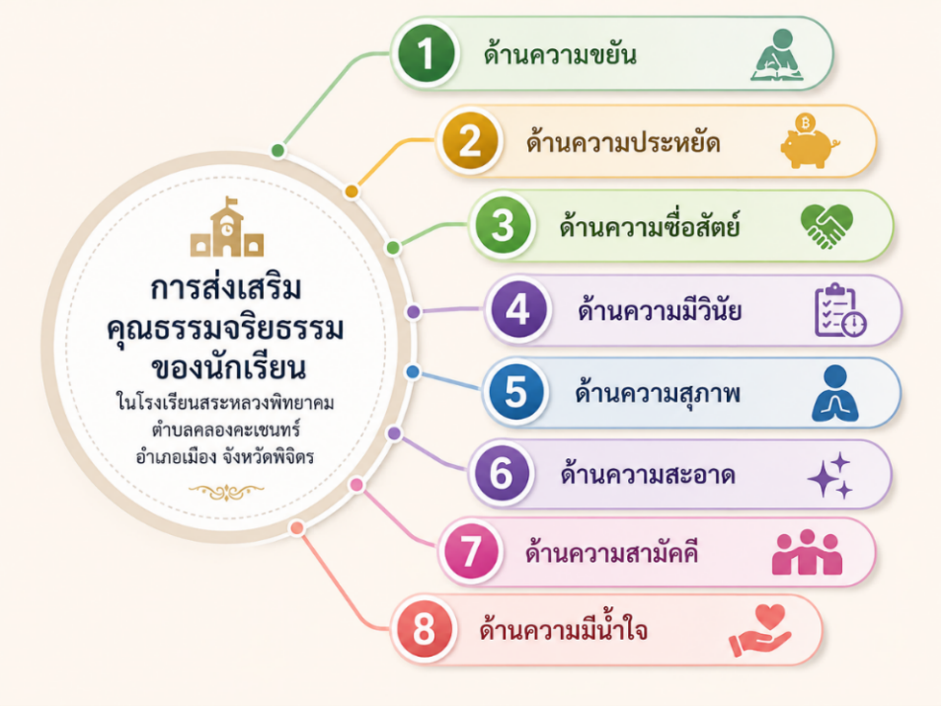
= 4.38, S.D. = 0.66), with all individual aspects at a high level. 2. The comparison of students’ morality and ethics promotion according to personal factors revealed that students with different genders, ages, parental incomes, and grade levels did not differ in their overall practices or in any individual aspect. and 3. The promotion of students’ morality and ethics included: diligence through motivation and the integration of technology and religious principles; frugality through cultivating saving and money management skills; honesty through early cultivation and cooperation among schools, families, and communities; discipline through clear rules, positive discipline, and student participation; politeness through appropriate manners and communication, volunteer activities, and peer mentoring; cleanliness through cultivating individual and collective responsibility, task sharing, and teamwork; unity through collaborative activities; and generosity through cultivating helpfulness and sharing through learning, volunteer activities, and collaborative work.
References
พระครูธรรมนาถวิศิษฐ์ (มงคล นาถธมฺโม). (2567). การส่งเสริมจริยธรรมแก่เยาวชนของพระสงฆ์ในอำเภอจักราช จังหวัดนครราชสีมา (สารนิพนธ์ปริญญาพุทธศาสตรมหาบัณฑิต สาขาวิชาการจัดการเชิงพุทธ). พระนครศรีอยุธยา: มหาวิทยาลัยมหาจุฬาลงกรณราชวิทยาลัย.
พระพิพัฒน์ โสภณจิตฺโต (ทับงาม). (2562). การบริหารจัดการสำนักปฏิบัติธรรมประจำจังหวัดอ่างทองเพื่อเสริมสร้างศักยภาพทางปัญญา (ดุษฎีนิพนธ์ปริญญาพุทธศาสตรดุษฎีบัณฑิต สาขาวิชาการจัดการเชิงพุทธ). พระนครศรีอยุธยา: มหาวิทยาลัยมหาจุฬาลงกรณราชวิทยาลัย.
พระไพโรจน์ สุจิตฺโต (เทพพิทักษ์). (2562). การพัฒนาคุณธรรมจริยธรรมแก่เยาวชนของคณะสงฆ์อำเภอบางสะพานน้อย จังหวัดประจวบคีรีขันธ์ (สารนิพนธ์ปริญญาพุทธศาสตรมหาบัณฑิต สาขาวิชาการจัดการเชิงพุทธ). พระนครศรีอยุธยา: มหาวิทยาลัยมหาจุฬาลงกรณราชวิทยาลัย.
พระอธิการธรรมวิโรจน์ สุริโย (พลสัสดี). (2564). การส่งเสริมคุณธรรมจริยธรรมตามหลักไตรสิกขาโรงเรียนมัธยมศึกษา อำเภอนาแห้ว จังหวัดเลย (วิทยานิพนธ์ปริญญาครุศาสตรมหาบัณฑิต สาขาวิชาพุทธบริหารการศึกษา). พระนครศรีอยุธยา: มหาวิทยาลัยมหาจุฬาลงกรณราชวิทยาลัย.
โรงเรียนสระหลวงพิทยาคม จังหวัดพิจิตร. (2568). สระหลวงพิทยาคม สพม.พิจิตร (รหัสโรงเรียน: 66012005). สืบค้นเมื่อ 12 มีนาคม 2568 จาก https://www.shorturl.asia/hcaobx.
สุกาญดา เทนอิสสระ. (2567). การส่งเสริมคุณธรรมจริยธรรมนักเรียนในสถานศึกษาขั้นพื้นฐาน สังกัดสำนักงานเขตพื้นที่การศึกษาประถมศึกษาขอนแก่น เขต 2. วารสารโพธิศาสตร์ปริทัศน์, 4(2), 21–32.
Yamane, T. (1973). Statistics: An introductory analysis (3rd ed.). New York: Harper & Row.