LEADERSHIP IN TEMPLE MANAGEMENT OF ABBOTS IN SAK LEK DISTRICT PHICHIT PROVINCE
Keywords:
Leadership, Temple Management, AbbotAbstract
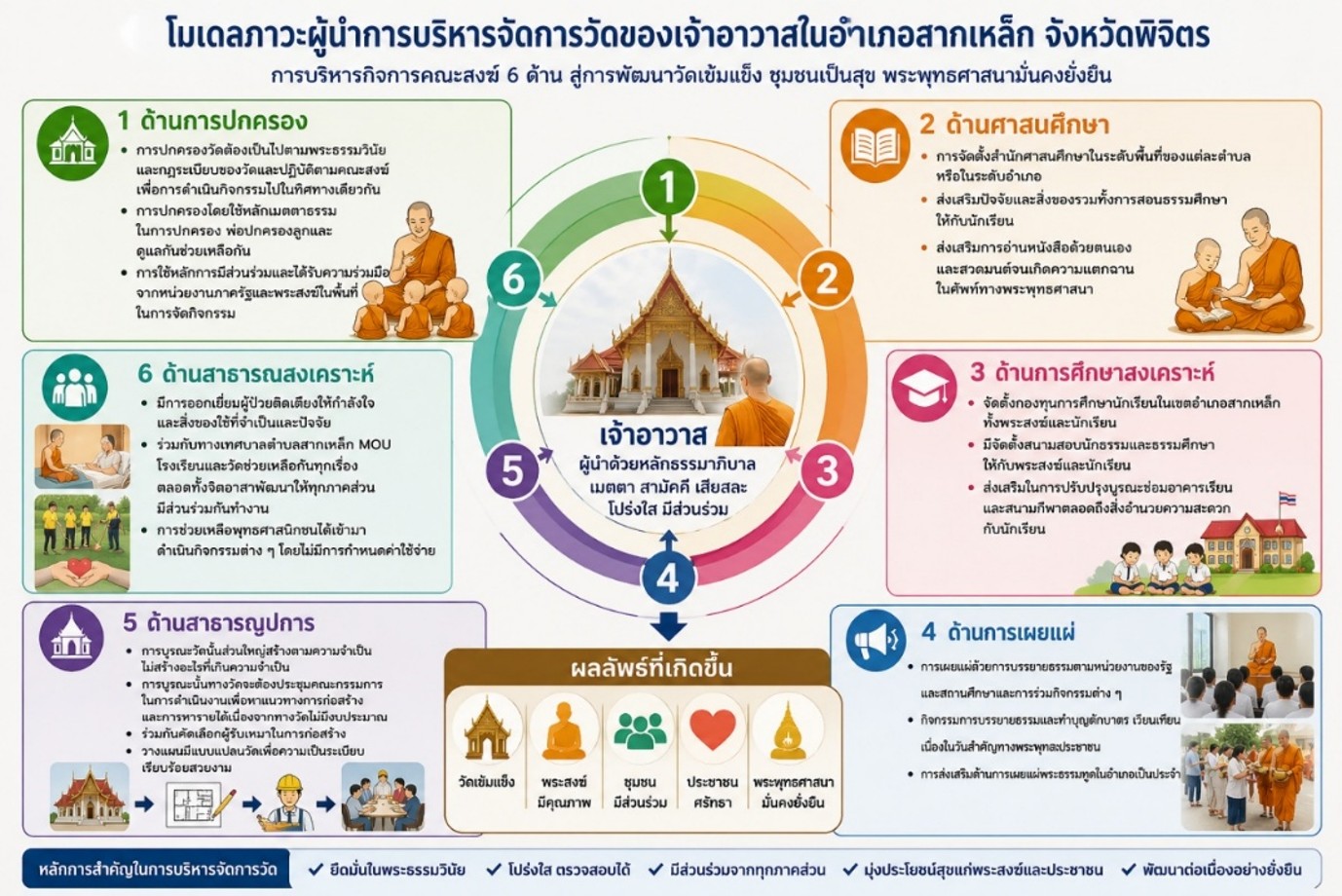
This research article aimed to: 1. study the leadership in temple management of abbots in Sak Lek District, Phichit Province; 2. compare the leadership in temple management of abbots in Sak Lek District, Phichit Province, classified by personal factors; and 3. propose guidelines for leadership in temple management of abbots in Sak Lek District, Phichit Province. This study employed a mixed-methods research design. For the quantitative research, the sample consisted of 100 monks in Sak Lek District. Data were collected using a questionnaire and analyzed using mean, standard deviation, t-test, F-test, and one-way analysis of variance. For the qualitative research, in-depth interviews were conducted with nine key informants. The synthesized findings were subsequently validated through a focus group discussion.
The findings revealed that 1. The overall administration of Sangha affairs in six aspects was at a high level ( = 4.07, S.D. = 0.55), while the overall practice of the four Brahmavihara principles was at the highest level (
= 4.36, S.D. = 0.57). 2. The comparison classified by personal factors revealed no significant differences overall or in any individual aspect. and 3. Leadership in temple management requires abbots to concurrently implement all six aspects of Sangha administration in accordance with the Dhamma and Vinaya and integrate the four Brahmavihara principles as essential virtues for leaders. Although temples differ in their contexts and conditions, resulting in different approaches to their activities, effective abbots should integrate the principles of Sangha administration with the Brahmavihara principles in their leadership. As temple administrators responsible for governing temples and supervising monks, abbots should also provide support and assistance to surrounding Buddhist communities. Such mutual support contributes to greater effectiveness in Sangha administration and temple management.
References
กองแผนงาน กรมการศาสนา กระทรวงศึกษาธิการ. (2542). คู่มือพระสังฆาธิการว่าด้วยพระราชบัญญัติ กฎ ระเบียบ และคำสั่งของคณะสงฆ์. กรุงเทพฯ: โรงพิมพ์การศาสนา.
พระครูโพธิกิตติคุณ (กิตติพงษ์ สุปญฺโญ). (2561). การบริหารกิจการคณะสงฆ์ตามหลักธรรมาภิบาลเชิงพุทธ ของคณะสงฆ์ภาค 3 (ดุษฎีนิพนธ์ปริญญาพุทธศาสตรดุษฎีบัณฑิต สาขาวิชาพระพุทธศาสนา). พระนครศรีอยุธยา: มหาวิทยาลัยมหาจุฬาลงกรณราชวิทยาลัย.
พระครูวินัยธรกมลเมธ กตปุญฺโญ (โค้วตระกูล). (2567). การบริหารกิจการคณะสงฆ์เพื่อความมั่นคงของพระพุทธศาสนา ในอำเภอเมือง จังหวัดนครนายก (สารนิพนธ์ปริญญาพุทธศาสตรมหาบัณฑิต สาขาวิชาการจัดการเชิงพุทธ). พระนครศรีอยุธยา: มหาวิทยาลัยมหาจุฬาลงกรณราชวิทยาลัย.
พระครูสถิตธรรมกิจ ติสฺสวโร (สัตยา). (2565). แนวทางการพัฒนาบทบาทพระสังฆาธิการในการบริหารกิจการคณะสงฆ์อำเภอประจันตคาม จังหวัดปราจีนบุรี (วิทยานิพนธ์ปริญญาพุทธศาสตรมหาบัณฑิต สาขาวิชาพระพุทธศาสนา. พระนครศรีอยุธยา: มหาวิทยาลัยมหาจุฬาลงกรณราชวิทยาลัย.
พระครูอุดมธรรมมงคล จนฺทวณฺโณ (ทัพธานี). (2567). แนวทางการบริหารกิจการคณะสงฆ์ด้วยหลักพุทธธรรมของพระสังฆาธิการจังหวัดบึงกาฬ (ดุษฎีนิพนธ์ปริญญาพุทธศาสตรดุษฎีบัณฑิต สาขาวิชาพระพุทธศาสนา). พระนครศรีอยุธยา: มหาวิทยาลัยมหาจุฬาลงกรณราชวิทยาลัย.
พระธรรมปิฎก (ป.อ. ปยุตฺโต). (2546). ภาวะผู้นำ: ความสำคัญต่อการพัฒนาคน พัฒนาประเทศ. กรุงเทพฯ: ธรรมสภาและสถาบันลือธรรม.
พระมหาวรเมธ เตชธมฺโม (ดีสุรกุล). (2561). การส่งเสริมการบริหารกิจการคณะสงฆ์ ด้านสาธารณสงเคราะห์ของอำเภอแก้งคร้อ จังหวัดชัยภูมิ (สารนิพนธ์ปริญญาพุทธศาสตรมหาบัณฑิต สาขาวิชาการจัดการเชิงพุทธ). พระนครศรีอยุธยา: มหาวิทยาลัยมหาจุฬาลงกรณราชวิทยาลัย.
พระราชปริยัติโมลี (ไพบูลย์ วิปุโล). (2554). การบริหารกิจการคณะสงฆ์ของเจ้าอาวาสในเขตปกครองคณะสงฆ์ จังหวัดสุพรรณบุรี (วิทยานิพนธ์ปริญญาพุทธศาสตรมหาบัณฑิต สาขาวิชาการจัดการเชิงพุทธ). พระนครศรีอยุธยา: มหาวิทยาลัยมหาจุฬาลงกรณราชวิทยาลัย.
มหาจุฬาลงกรณราชวิทยาลัย. (2539). พระไตรปิฎกฉบับภาษาไทย ฉบับมหาจุฬาลงกรณราชวิทยาลัย. กรุงเทพฯ: โรงพิมพ์มหาจุฬาลงกรณราชวิทยาลัย.
สำนักงานเจ้าคณะภาค 16. (2547). คู่มือปฏิบัติงานคณะสงฆ์. สุราษฎร์ธานี: สำนักงานเจ้าคณะภาค 16.
Yamane, T. (1973). Statistics: An introductory analysis (3rd ed.). New York: Harper & Row.