BUDDHIST INTEGRATION FOR PROMOTE CORRUPTION PREVENTION IN THE PUBLIC SECTOR BY OFFICE OF THE NATIONAL ANTI - CORRUPTION COMMISSION
Keywords:
Buddhist Integration, Anti-Corruption, Sammappadhana 4Abstract
This research article aimed to: 1. study corruption prevention in the public sector by the Office of the National Anti-Corruption Commission; 2. examine the factors affecting corruption prevention in the public sector by the Office of the National Anti-Corruption Commission; and 3. propose Buddhist integration for promoting corruption prevention in the public sector by the Office of the National Anti-Corruption Commission. This study employed a mixed-methods research design integrating qualitative and quantitative approaches. In-depth interviews were conducted with 18 key informants, and a focus group discussion was conducted with 10 participants. Quantitative data were collected using questionnaires from a sample of 354 respondents. Data were analyzed using descriptive content analysis, frequency, percentage, mean, standard deviation, and stepwise multiple regression analysis.
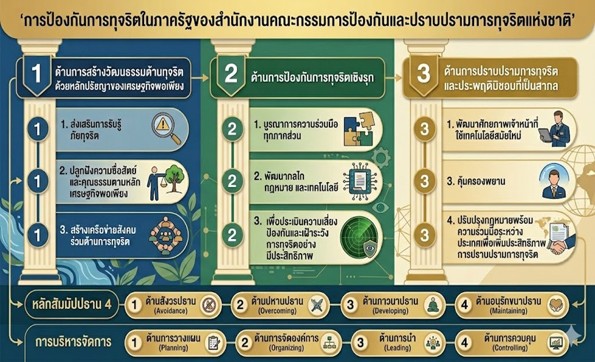
The findings revealed that 1. Corruption prevention in the public sector by the Office of the National Anti-Corruption Commission was at a high level in all aspects. Emphasis was placed on cultivating a sufficiency-oriented mindset and integrity among citizens, as well as enhancing the effectiveness of mechanisms, legal measures, and witness protection. 2. Regarding the factors affecting corruption prevention in the public sector, the management factors, ranked according to the regression equation, were leading, controlling, planning, and organizing, which jointly predicted corruption prevention at 60.1 percent. These factors emphasized promoting personnel performance, monitoring, and planning to ensure clarity, transparency, and independence. The four Sammappadhana principles, ranked according to the regression equation, were Anurakkhanapadhana (preserving wholesome states), Bhavanapadhana (developing wholesome states), Samvarapadhana (preventing unwholesome states), and Pahanapadhsna (abandoning unwholesome states), which jointly predicted corruption prevention at 25.4 percent. These principles encouraged integrity in work, ethical development, and psychological resilience among personnel. 3. Buddhist integration involved integrating the four Sammappadhana principles with modern public management to cultivate right effort and apply modern technology to enhance accountability, good governance, and transparency in public organizations.
References
ชนะพงษ์ กล้ากสิกิจ และคณะ. (2562). ประสิทธิผลการบริหารจัดการกองทุนหมู่บ้านและชุมชนเมืองในจังหวัดกำแพงเพชร. วารสารบัณฑิตศึกษามหาจุฬาขอนแก่น, 6(4), 786-802.
ดิฐภัทร บวรชัย. (2562). รูปแบบการป้องกันการทุจริตและประพฤติมิชอบของเจ้าหน้าที่ตำรวจ กรณีศึกษาระดับสถานีตำรวจ. วารสารบริหารการศึกษา มศว, 16(30), 50-62.
บงกช สุทัศน์ ณ อยุธยา. (2557). การสร้างจิตสำนึกของความเป็นไทย ค่านิยม เพื่อการต่อต้านป้องกันการทุจริต คอร์รัปชั่น. วารสารศรีนครินทรวิโรฒวิจัยและพัฒนา สาขามนุษยศาสตร์และสังคมศาสตร์, 6(11), 248-264.
ปิยะธิดา อภัยภักดิ์. (2561). แนวทางการป้องกันและปราบปรามการทุจริตคอรัปชั่นในหน่วยงานภาครัฐ. วารสารบัณฑิตวิทยาลัย มหาวิทยาลัยราชภัฏจันทรเกษม, 13(1), 1-12.
พรเทพ จันทรนิภ. (2558). การพัฒนารูปแบบการป้องกันการทุจริตคอร์รัปชั่นในภาครัฐเพื่อการบริหารจัดการบ้านเมืองที่ดีในสังคมไทย. วารสารเกษมบัณฑิต, 16(1), 88–101.
พระธนบูลย์ สุวณฺโณ (หันมนตรี). (2563). การนำหลักสาราณียธรรมมาส่งเสริมการอยู่ร่วมกันของชุมชนทุ่งละออง ตำบลบางวัน อำเภอคุระบุรี จังหวัดพังงา. วารสารมหาจุฬานาครทรรศน์, 7(1), 57–68.
พระสุจินตนินท หนูชูสีห์สกุล. (2568). วิเคราะห์สัมมัปปธาน 4 เพื่อการบรรลุธรรม. วารสารนวัตกรรมการจัดการศึกษาและการวิจัย, 7(1), 149–158.
มหาจุฬาลงกรณราชวิทยาลัย. (2539). พระไตรปิฎกฉบับภาษาไทย ฉบับมหาจุฬาลงกรณราชวิทยาลัย. กรุงเทพฯ: โรงพิมพ์มหาจุฬาลงกรณราชวิทยาลัย.
รินทอง แก้วทุม. (2560). การบริหารการพัฒนาเชิงพุทธขององค์กรปกครองส่วนท้องถิ่นในจังหวัดมหาสารคาม. วารสาร มจร สังคมศาสตร์ปริทรรศน์, 6(2-04), 539–552.
สำนักงานคณะกรรมการป้องกันและปราบปรามการทุจริตแห่งชาติ. (2560). แผนแม่บทบูรณาการป้องกัน ปราบปรามการทุจริตและประพฤติมิชอบ ระยะ 20 ปี (พ.ศ. 2560–2579). นนทบุรี: สำนักงานคณะกรรมการป้องกันและปราบปรามการทุจริตแห่งชาติ.
_____. (2567). สถานการณ์การทุจริตประเทศไทย ประจำปีงบประมาณ พ.ศ. 2567. นนทบุรี: สำนักงานคณะกรรมการป้องกันและปราบปรามการทุจริตแห่งชาติ.
สำนักงานสภาพัฒนาการเศรษฐกิจและสังคมแห่งชาติ สำนักนายกรัฐมนตรี. (2566). แผนพัฒนาเศรษฐกิจและสังคมแห่งชาติ ฉบับที่สิบสาม พ.ศ. 2566–2570. กรุงเทพฯ: สำนักงานสภาพัฒนาการเศรษฐกิจและสังคมแห่งชาติ.
สุขอุษา นุ่นทอง และคณะ. (2561). การพัฒนาคุณภาพการบริหารจัดการสถานศึกษานอกสถานที่ตั้งมหาวิทยาลัยมหาจุฬาลงกรณราชวิทยาลัย. วารสาร มจร สังคมศาสตร์ปริทรรศน์, 7(2), 86–98.
อำพล ปุญญา. (2560). รูปแบบการบริหารจัดการน้าตามหลักพุทธวิธีของจังหวัดพิจิตร. วารสาร มจร สังคมศาสตร์ปริทรรศน์, 6(2-04), 161–178.
Likert, R. (1967). The method of constructing an attitude scale. In M. Fishbein (Ed.), Readings in attitude theory and measurement (pp. 90–95). New York, NY: John Wiley & Sons.
United Nations Office on Drugs and Crime & World Bank. (2007). Stolen Asset Recovery (StAR) Initiative: Challenges, Opportunities, and Action Plan. Vienna, Austria & Washington, DC: United Nations Office on Drugs and Crime and World Bank.
Yamane, T. (1973). Statistics: An introductory analysis (3rd ed.). New York: Harper & Row.