MEDIA CHALLENGES TO PUBLIC GOVERNANCE IN THE ERA OF FAKE NEWS AND INFORMATION DISORDER
Keywords:
Data Governance, Digital Media, Disinformation, Post-TruthAbstract
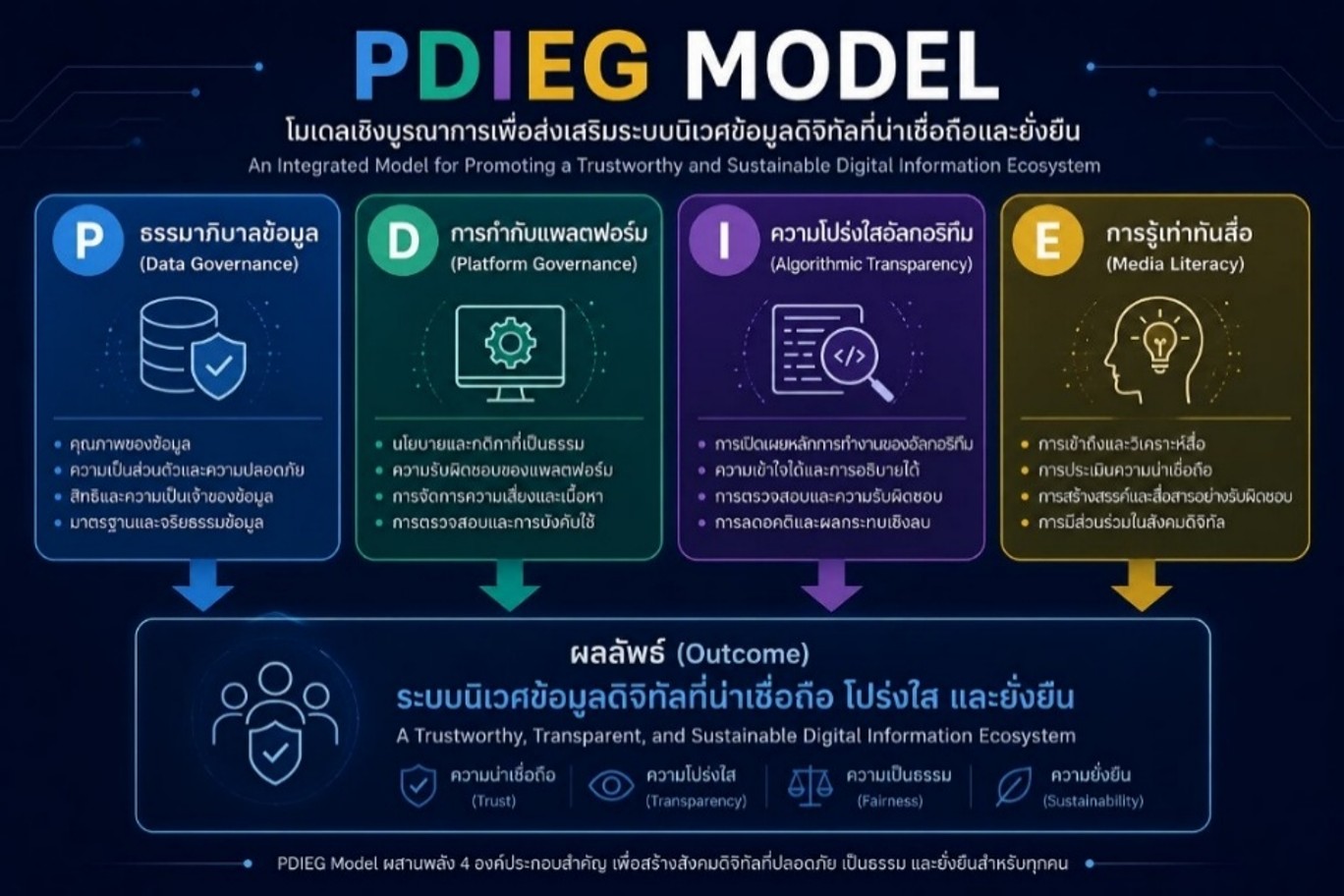
In the era of digital media, information can be produced and disseminated rapidly without spatial limitations. Society is facing a condition of information disorder, which is not limited only to inaccurate information but also includes distorted information intentionally designed to shape public perception. This reflects a structural transformation of the communication system in which the authority to define truth is no longer confined to the state or traditional media institutions, but has been distributed to digital platforms and algorithms that prioritize attention and engagement over the accuracy of information. Under the conditions of digital platforms and algorithms, misinformation can spread efficiently and, in some cases, exert greater influence than factual information, particularly when it aligns with the beliefs or biases of audiences. The emergence of echo chambers and the post-truth condition further cause public perception to be based not solely on facts, but also to be shaped by social and psychological contexts, leading to a widespread erosion of trust in information provided by the government and public institutions. Although governments have attempted to respond to these challenges through the development of data governance aimed at improving data quality in various dimensions such as accuracy, timeliness, and accessibility. Data quality alone cannot guarantee the influence of information in the digital environment. This is because the visibility and dissemination of information are primarily determined by platform mechanisms and user behavior. As a result, government information, despite being reliable in terms of content, may still fail to reach the public or play a significant role in shaping public perception. This indicates that the core problem does not lie in the absence of accurate information, but rather in the structure of the information system that determines the influence of information within the public sphere. Enhancing public governance in this context therefore requires expanding the scope from data quality management toward the design and regulation of the broader information ecosystem at the levels of platforms, algorithms, and users, in order to ensure that accurate information can compete, reach audiences, and genuinely influence public perception. This constitutes an essential condition for restoring public trust and the legitimacy of government in the digital society.
References
ราชบัณฑิตยสถาน. (2554). พจนานุกรม ฉบับราชบัณฑิตยสถาน พ.ศ. 2554. กรุงเทพฯ: ราชบัณฑิตยสถาน.
European Commission. (2020). A European Strategy for Data. Retrieved April 25, 2026, from https://eur-lex.europa.eu/legal-content/EN/TXT/?uri=CELEX%3A52020DC0066.
Freedom House. (2023). Freedom on the Net 2023: The Repressive Power of Artificial Intelligence. Retrieved April 25, 2026, from https://shorturl.asia/ApUfL.
Latzer, M. et al. (2016). The Economics of Algorithmic Selection on The Internet. In J. M. Bauer & M. Latzer (Eds.), Handbook on The Economics of The Internet. (pp. 395–425). Cheltenham, UK & Northampton, MA: Edward Elgar Publishing.
Lewandowsky, S. et al. (2017). Beyond Misinformation: Understanding and Coping with The “Post-Truth” Era. Journal of Applied Research in Memory and Cognition, 6(4), 353–369.
OECD. (2019). The Path to Becoming a Data-Driven Public Sector. Retrieved April 25, 2026, from https://doi.org/10.1787/059814a7-en.
OECD. (2021). Public Communication and The Fight Against Misinformation and Disinformation. Retrieved April 25, 2026, from https://www.oecd.org/gov/public-communication/.
Sunstein, C. R. (2001). Republic.com. Princeton, NJ: Princeton University Press.
Tandoc, E. C. et al. (2018). Defining “Fake News”: A Typology of Scholarly Definitions. Digital Journalism, 6(2), 137–153.
UNDP. (2019). Human Development Report 2019: Beyond Income, Beyond Averages, Beyond Today Inequalities in Human Development in the 21st Century. Retrieved April 25, 2026, from https://hdr.undp.org/content/human-development-report-2019.
UNESCO. (2021). Media and Information Literacy: Curriculum for Educators and Learners. Paris: UNESCO.
van Dijk, J. (2012). The Network Society (3rd ed.). London: SAGE Publications.
Vosoughi, S. et al. (2018). The Spread of True and False News Online. Science, 359(6380), 1146–1151.
Wardle, C. & Derakhshan, H. (2017). Information Disorder: Toward An Interdisciplinary Framework for Research and Policymaking. Retrieved April 25, 2026, from https://shorturl.asia/7jdLR.
World Bank. (2021). World Development Report 2021: Data for Better Lives. Retrieved April 25, 2026, from https://doi.org/10.1596/978-1-4648-1600-0.