DIGITAL TRANSFORMATION IN PUBLIC ADMINISTRATION: FROM TRADITIONAL BUREAUCRACY TO SMART GOVERNMENT AND PUBLIC VALUE CREATION
Keywords:
Public Administration, Digital Era, Smart Government, Public Value CreationAbstract
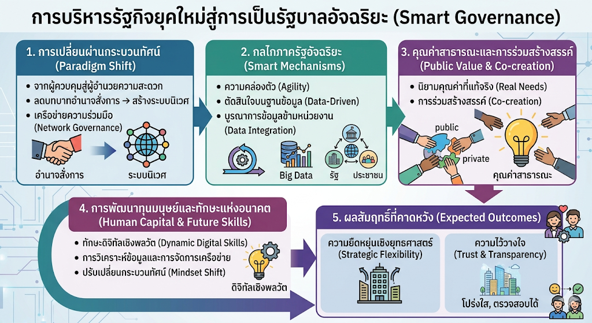
This academic article aims to study “Public Administration in the Digital Transformation Era: From Traditional Bureaucracy to Smart Government and the Creation of Public Value.” The study found that modern public administration towards smart government (Smart Governance) involves reforming the paradigm and mechanisms of the public sector to be flexible, agile, and data-driven in order to create true public value through five key components: Firstly, a paradigm shift is necessary to change the role of the state from a controller and authority-granting entity to a facilitator, emphasizing new approaches to public affairs management through collaborative networks instead of centralized power. This creates an ecosystem that allows all sectors to participate in solving complex public problems. Secondly, the mechanisms driving smart government include: 1. Agility in adapting work processes to keep pace with change; 2. Data-driven decision-making, using data as the core of policy and public service formulation for accuracy and proactive responsiveness; and 3. Cross-agency data integration, breaking down siloed work to seamlessly connect data between the government, private sector, and citizens. Thirdly, the heart of creating public value is not merely fulfilling legal obligations, but creating outcomes that meet the real needs of the people in the post-normal era, through collaborative processes that open opportunities for various sectors. Fourth, collaboratively defining problems and producing public innovations; and fourth, developing human capital and future skills, focusing on strengthening dynamic digital skills that go beyond the use of technological tools, encompassing data analytics, network management, and dynamic competencies ready to adapt to change, coupled with a paradigm shift among personnel to encourage them to experiment, learn, and adapt their thinking. Finally, the expected outcomes are: 1. strategic resilience, encompassing regulatory flexibility and the ability to detect and respond to problems in real-time; and 2. trust, achieved through building a transparent, accountable, and trustworthy government in the long term.
References
ทศพร ศิริสัมพันธ์. (2549). การบริหารราชการแนวใหม่ : บริบทและเทคนิควิธี (พิมพ์ครั้งที่ 2). กรุงเทพฯ: สำนักงานคณะกรรมการพัฒนาระบบราชการ.
วรเดช จันทรศร. (2552). ทฤษฎีการนำนโยบายสาธารณะไปปฏิบัติ (พิมพ์ครั้งที่ 4). กรุงเทพฯ: สมาคมนักวิจัยมหาวิทยาลัยไทย (TURA).
ศุภชัย ยาวะประภาษ และปิยากร หวังมหาพร. (2564). นโยบายสาธารณะระดับท้องถิ่นไทย (พิมพ์ครั้งที่ 2). สืบค้นเมื่อ 2 มีนาคม 2569 จาก https://elibrarycub.com/Sample_ebook/S_9020.pdf.
Janssen, M. & van der Voort, H. (2016). Adaptive governance: Towards a dynamic approach for managing complex IT projects. Government Information Quarterly, 33(1), 1-5.
Janssen, M. et al. (2020). Data-driven policy making: Capacity, epistemological, political and ethical challenges. Policy Design and Practice, 3(2), 101-113.
Mergel, I. (2016). Agile innovations in the public sector. Government Information Quarterly, 33(3), 515-523.
Mulgan, G. (2009). The Art of Public Strategy: Mobilizing Power and Knowledge for the Common Good. Oxford: Oxford University Press.
Osborne, S. P. (2010). The New Public Governance: Emerging Perspectives on the Theory and Practice of Public Governance. London: Routledge.
Rittel, H. W. J. & Webber, M. M. (1973). Dilemmas in a general theory of planning. Policy Sciences, 4(2), 155–169.
World Economic Forum. (2018). Agile Governance: Reimagining Policy-making in the Fourth Industrial Revolution. White Paper. Geneva: World Economic Forum.