ALGORITHMIC GOOD GOVERNANCE AND AUTOMATED DECISION MAKING IN THE PUBLIC SECTOR: CHALLENGES AND PATHWAYS IN THE 21ST CENTURY
Keywords:
Good Governance, Algorithmic, Automated Decision-Making, ChallengesAbstract
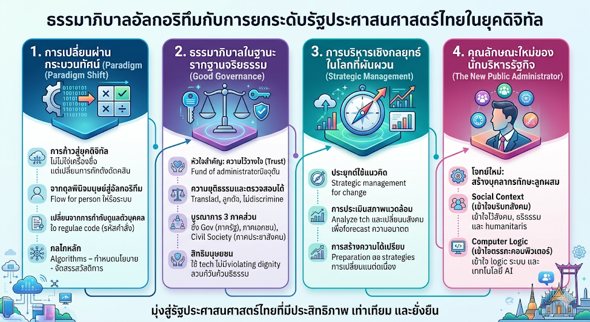
This academic article aimed to examine algorithmic governance and automated decision-making in the public sector, focusing on their challenges and approaches in the 21st century. The study found that algorithmic governance is essential for advancing Thailand’s public sector in the digital era. The key challenge is to establish algorithmic governance that balances technological efficiency with human ethics through four key principles: 1. Paradigm Shift: transitioning from human discretion to algorithmic decision-making and from governing individuals to governing code, as algorithms increasingly influence policymaking and welfare allocation. 2. Good Governance as an Ethical Foundation: building public trust through transparent, fair, accountable, and non-discriminatory systems while integrating collaboration among the public sector, private sector, and civil society to maintain socioeconomic balance and safeguard human rights and human dignity. 3. Strategic Management in a Volatile World: applying strategic management to analyze technological and social changes, anticipate future developments, enhance preparedness, and strengthen organizational knowledge and capabilities; and 4. The New Public Administrator: developing public personnel with hybrid competencies that integrate an understanding of social contexts and ethics with knowledge of the logic and operation of AI technologies. Algorithmic governance therefore represents a balance between innovation and humanity, providing a foundation for efficient, transparent, accountable, and sustainable digital public administration.
References
กระทรวงการอุดมศึกษา วิทยาศาสตร์ วิจัย และนวัตกรรม และกระทรวงดิจิทัลเพื่อเศรษฐกิจและสังคม. (2565). แผนปฏิบัติการด้านปัญญาประดิษฐ์แห่งชาติเพื่อการพัฒนาประเทศไทย (พ.ศ. 2565 – 2570). สืบค้นเมื่อ 16 เมษายน 2569 จาก https://www.shorturl.asia/gg7d1q.
นิพนธ์ นาชิน. (2568). AI Governance: กรอบธรรมาภิบาลปัญญาประดิษฐ์ที่ทุกองค์กรต้องรู้. สืบค้นเมื่อ 16 เมษายน 2569 จาก https://www.shorturl.asia/fkynze.
พระมหาลำพึง ธีรปญฺโญ (เพ็ญภู). (2554). การบริหารงานตามหลักธรรมาภิบาลของโรงเรียนนวมินทราชูทิศมัชฌิม จังหวัดนครสวรรค์ (วิทยานิพนธ์ปริญญาพุทธศาสตรมหาบัณฑิต สาขาวิชารัฐประศาสนศาสตร์). พระนครศรีอยุธยา: มหาวิทยาลัยมหาจุฬาลงกรณราชวิทยาลัย.
สำนักงานพัฒนาธุรกรรมทางอิเล็กทรอนิกส์ (ETDA). (2569). AI Governance Guideline for Executives แนวทางการประยุกต์ใช้ปัญญาประดิษฐ์อย่างมีธรรมาภิบาลสำหรับผู้บริหารองค์กร. สืบค้นเมื่อ 16 เมษายน 2569 จาก https://www.shorturl.asia/4dkdyu.
สำนักงานพัฒนารัฐบาลดิจิทัล (องค์การมหาชน) (สพร.). (2561). เปลี่ยนผ่านภาครัฐสู่ยุคดิจิทัล (Transform Government to The Digital Age). สืบค้นเมื่อ 16 เมษายน 2569 จาก https://www.dga.or.th/wp-content/uploads/2018/11/file_74d73af09053ed5071f9aa5c539ba74c.pdf.
_____. (2563). AI Government Framework กรอบการทำงานปัญญาประดิษฐ์ภาครัฐ. สืบค้นเมื่อ 16 เมษายน 2569 จาก https://bact.cc/f/2022/10/202012-ai-gov-framework-dga.pdf.
สำนักงานสถิติแห่งชาติ. (2566). สำนักงานสถิติแห่งชาติ เข้าร่วมงานสัมมนาเพื่อเผยแพร่ผลการศึกษาโครงการศึกษา Thailand Digital Outlook ประจำปี พ.ศ. 2566. สืบค้นเมื่อ 16 เมษายน 2569 จาก https://www.nso.go.th/nsoweb/storage/upload_file_pdf/2023/20230911115128_89675.pdf.
อัญชลี จวงจันทร์. (2566). เทคโนโลยีปัญญาประดิษฐ์ (AI) กับการบริหารงานภาครัฐ. สืบค้นเมื่อ 16 เมษายน 2569 จาก https://www.shorturl.asia/k16kza.
Binns, R. (2018). Algorithmic accountability and public reason. Philosophy & Technology, 31(4), 543–556.
Botsman, R. (2017). Who can you trust? How technology brought us together and why it might drive us apart. New York: PublicAffairs.
Eubanks, V. (2018). Automating inequality: How high-tech tools profile, police, and punish the poor. New York: St. Martin's Press.
International Organization for Standardization. (2023). ISO/IEC 42001:2023 Information technology — Artificial intelligence — Management system. Retrieved April 16, 2026, from https://www.iso.org/standard/81230.html.
Lipsky, M. (2010). Street-level bureaucracy: Dilemmas of the individual in public services (30th anniversary expanded ed.). New York: Russell Sage Foundation.
Margetts, H. & Dorobantu, C. (2019). Rethink government with AI. Nature, 568(7751), 163–165.
Margetts, H. Z. (2009). The Internet and public policy. Policy & Internet, 1(1), 1–21.
Mayer-Schönberger, V. & Cukier, K. (2013). Big data: A revolution that will transform how we live, work, and think. Boston, MA: Houghton Mifflin Harcourt.
Pasquale, F. (2015). The black box society: The secret algorithms that control money and information. Cambridge, MA: Harvard University Press.
Porter, M. E. (1985). Competitive advantage: Creating and sustaining superior performance. New York, NY: Free Press.