A BUDDHIST-INFORMED APPROACH TO HUMAN RESOURCE MANAGEMENT FOR SUSTAINABLE ORGANIZATIONAL ADAPTATION IN THE AGE OF ARTIFICIAL INTELLIGENCE
Keywords:
Human Resource Management, Buddhist Way, Age of Artificial Intelligence, Sustainable OrganizationAbstract
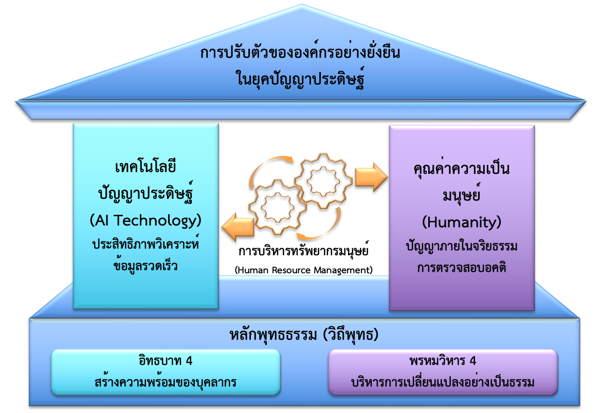
This academic article aims to analyze the ongoing digital transformation that has driven organizations to adopt Artificial Intelligence (AI) as a key tool for enhancing the efficiency of Human Resource Management (HRM). However, excessive reliance on such technology has created significant challenges and ethical crises affecting employees, including job insecurity leading to alienation, algorithmic bias resulting from biased data processing and discriminatory outcomes, and the opacity of black-box systems. These challenges directly undermine human value and dignity by reducing employees to mere resources that can be replaced by machines, highlighting the limitation that technology without inner wisdom cannot assume responsibility for the moral consequences of its decisions. To address these challenges, this article proposes an integrated approach that incorporates the “Buddhist Way” into modern Human Resource Management. The Iddhipada 4 principles are applied to foster positive attitudes and prepare employees to acquire new technological skills, while the Brahmavihara 4 principles provide an ethical foundation for leaders and human resource professionals to manage organizational change with compassion and fairness. The synthesis of these concepts leads to new knowledge in the form of the “Buddhist Human Resource Management Model for Adaptation in the Artificial Intelligence Era.” The model emphasizes the strategic role of human resource management in balancing the technological dimension, which prioritizes quantitative efficiency, with the human dimension, which relies on inner wisdom to guide ethical judgment. Ultimately, AI should serve as a supportive tool, while humans remain at the center of value-based judgment and decision-making. Such a balance enables organizations to navigate technological transformation with resilience and ethical integrity while achieving sustainable growth.
References
จำเนียร จวงตระกูล และคณะ. (2568). การนำปัญญาประดิษฐ์มาใช้ในงานบริหารทรัพยากรมนุษย์. วารสารสมาคมรัฐประศาสนศาสตร์แห่งประเทศไทย, 7(2), 4–19.
ชลธิชา ทักษิณาเวศน์. (2568). สังคมเหลื่อมล้ำทางเพศฉันใด เอไอก็มีอคติทางเพศฉันนั้น!. สืบค้นเมื่อ 29 เมษายน 2569 จาก https://www.the101.world/bias-in-artificial-intelligence/.
ธรรศพงศ์ วงษ์สวัสดิ์. (2569). ปัจจัยการยอมรับเทคโนโลยีปัญญาประดิษฐ์ที่ส่งผลต่อความพร้อมของหน่วยงาน ในการสนับสนุนและกำกับดูแล: กรณีศึกษาสำนักงานส่งเสริมการปกครองท้องถิ่น จังหวัดในเขตภาคเหนือตอนล่าง. JSDP: Journal of Spatial Development and Policy, 4(1), 1-16.
ธารทิพย์ พจน์สุภาพ และรุ่งอรุณ กระแสร์สินธุ์. (2564). การเปลี่ยนผ่านสู่ดิจิทัลและบทบาทที่เปลี่ยนแปลงในการจัดการทรัพยากรมนุษย์. สักทอง: วารสารมนุษยศาสตร์และสังคมศาสตร์ (สทมส.), 27(1), 1–19.
นันทยา รื่นกลิ่น. (2568). จริยธรรมในการใช้ปัญญาประดิษฐ์อย่างรับผิดชอบในการตัดสินใจด้านทรัพยากรมนุษย์. วารสารวิชาการรัฐศาสตร์และรัฐประศาสนศาสตร์, 7(2), 77–88.
พระธรรมปิฎก (ป.อ. ปยุตฺโต). (2546). พจนานุกรมพุทธศาสตร์ ฉบับประมวลธรรม (พิมพ์ครั้งที่ 12). กรุงเทพฯ: โรงพิมพ์มหาจุฬาลงกรณราชวิทยาลัย.
พระธีรพล ณฏฺฐิโก (บัวทอง) และคณะ. (2569). วิกฤตการณ์แห่งปัญญาภายในของมนุษย์ในยุคปัญญาประดิษฐ์. วารสารสหวิทยาการนวัตกรรมปริทรรศน์, 9(1), 331–344.
แพรวพัชร จิระเดชะ และอรพรรณ คงมาลัย. (2569). องค์ประกอบปัจจัยของการยอมรับเทคโนโลยีปัญญาประดิษฐ์นักสร้างมาใช้ในองค์กร: กรณีศึกษานิคมอุตสาหกรรมมาบตาพุด จังหวัดระยอง. วารสารวิชาการบัณฑิตวิทยาลัยสวนดุสิต, 22(1), 131–144.
มหาจุฬาลงกรณราชวิทยาลัย. (2539). พระไตรปิฎกฉบับภาษาไทย ฉบับมหาจุฬาลงกรณราชวิทยาลัย. กรุงเทพฯ: โรงพิมพ์มหาจุฬาลงกรณราชวิทยาลัย.
รุจ กสิวุฒิ และปนัดดา รักษาแก้ว. (2569). การพัฒนาทรัพยากรมนุษย์ตามหลักอิทธิบาทธรรมเพื่อเพิ่มสมรรถนะการปฏิบัติงานของบุคลากรเทศบาลเมืองบึงยี่โถ จังหวัดปทุมธานี. วารสารบัณฑิตศึกษาวิชาการ, 4(1), 53–63.
วัชรพล ยงวณิชย์. (2565). มนุษย์ ปัญญาประดิษฐ์และองค์การ: วัฒนธรรมและสมดุลของการอยู่ร่วมกัน. วารสารวิชาการมนุษยศาสตร์และสังคมศาสตร์ มหาวิทยาลัยราชภัฏธนบุรี, 5(3), 133–146.
Budhwar, P. et al. (2022). Artificial intelligence–challenges and opportunities for international HRM: A review and research agenda. The International Journal of Human Resource Management, 33(6), 1065–1097.
Schwab, K. (2016). The fourth industrial revolution. Geneva, Switzerland: World Economic Forum.