IDDHIPADA 4 AND POLICY IMPLEMENTATION OF THE ROYAL THAI AIR FORCE
Keywords:
Iddhipada 4, Policy Implementation, Royal Thai Air ForceAbstract
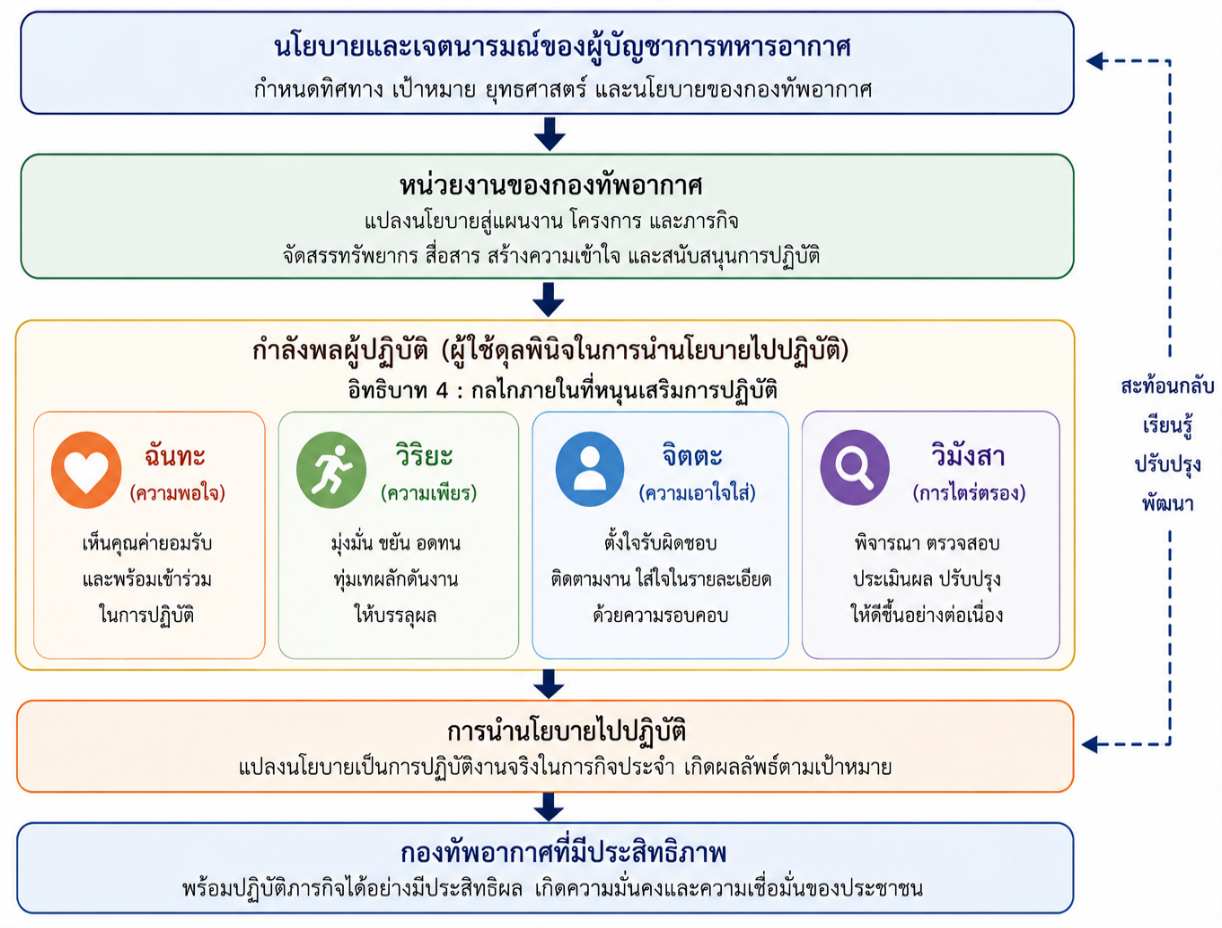
This academic article aims to explain policy implementation in the Royal Thai Air Force by integrating the Bureaucratic Process Model with Iddhipada 4. It proposes an approach that connects the policies and intentions of the Commander-in-Chief of the Royal Thai Air Force with the operations of organizational units and military personnel. The article argues that successful policy implementation does not depend solely on policy clarity, plans, budgets, performance indicators, or orders transmitted through the chain of command. Successful implementation also requires personnel to understand and accept the policies, assume responsibility, cooperate with one another, and translate them into routine missions that are consistent with actual operational conditions. The exercise of discretion by military personnel must remain within the framework of orders, regulations, commanders’ intentions, and assigned authority. Within these boundaries, personnel may adapt operational methods, prioritize tasks, coordinate joint efforts, resolve immediate problems, and provide feedback through the chain of command. Iddhipada 4 serves as an internal mechanism that supports the policy implementation process. Chanda enables personnel to recognize the value of and accept organizational policies; Viriya strengthens perseverance and continuity in carrying out missions; Citta promotes attentiveness and responsibility in performing duties; and Vimamsa supports the examination, analysis, and improvement of operational methods in response to actual circumstances. Accordingly, this article proposes an Iddhipada 4–based policy implementation process model for the Royal Thai Air Force. The model integrates strategic policies, organizational mechanisms, operational personnel, and the four principles of Iddhipada to ensure that policies are translated into practice continuously, prudently, and effectively. This process contributes to a Royal Thai Air Force that is well prepared in terms of personnel, organizational systems, and operational capabilities; capable of executing missions effectively; and capable of responding appropriately and promptly to changing circumstances and emerging threats.
References
กรมกิจการพลเรือนทหารอากาศ 2. (2566). ยุทธศาสตร์กองทัพอากาศ 20 ปี (พ.ศ. 2561 - 2580). สืบค้นเมื่อ 30 เมษายน 2569 จาก https://welcome-page.rtaf.mi.th/blog/e-ksaarephyaephr-11/yuththsaastrk-ngthaph-aakaas-20-pii-ph-s-2561-2580-38.
กองทัพอากาศ. (2567). นโยบายผู้บัญชาการทหารอากาศ พ.ศ.2567-2578. สืบค้นเมื่อ 30 เมษายน 2569 จาก https://welcome-page.rtaf.mi.th/blog/e-ksaarephyaephr-11/noybaayphuubaychaakaarthhaar-aakaas-ph-s-2567-2578-1607.
กองบัญชาการกองทัพไทย. (2566). แผนปฏิบัติราชการ ระยะ 5 ปี (พ.ศ. 2566 - 2570) กองบัญชาการกองทัพไทย (ฉบับแก้ไขเพิ่มเติม). สืบค้นเมื่อ 30 เมษายน 2569 จาก https://strapi.rtarf.mi.th/uploads/V13_180866_daeb267bdc.pdf.
จิรัตติกาล สุขสิงห์. (2565). การประยุกต์ใช้หลักอิทธิบาท 4 เพื่อพัฒนาประสิทธิภาพการปฏิบัติงานของบุคลากรในองค์กร. วารสารสหวิทยาการนวัตกรรมปริทรรศน์, 5(1), 211–219.
ชัยชนะ สนนอก. (2568). แรงจูงใจในการปฏิบัติงานของกำลังพลกองบริการ ศูนย์การทหารม้า อำเภอเมืองสระบุรี จังหวัดสระบุรี. วารสารรามคำแหง ฉบับรัฐประศาสนศาสตร์, 8(3), 126–155.
พระธรรมปิฎก (ป.อ. ปยุตฺโต). (2546). พจนานุกรมพุทธศาสตร์ ฉบับประมวลธรรม (พิมพ์ครั้งที่ 12). กรุงเทพฯ: โรงพิมพ์มหาจุฬาลงกรณราชวิทยาลัย.
มหาจุฬาลงกรณราชวิทยาลัย. (2539). พระไตรปิฎกฉบับภาษาไทย ฉบับมหาจุฬาลงกรณราชวิทยาลัย. กรุงเทพฯ: โรงพิมพ์มหาจุฬาลงกรณราชวิทยาลัย.
เรืองวิทย์ เกษสุวรรณ. (2550). นโยบายสาธารณะ. กรุงเทพฯ: บพิธการพิมพ์.
วรเดช จันทรศร. (2540). การนำนโยบายไปปฏิบัติ. กรุงเทพฯ: คณะกรรมการปฏิรูประบบราชการ.
_____. (2552). ทฤษฎีการนำนโยบายสาธารณะไปปฏิบัติ (พิมพ์ครั้งที่ 4). กรุงเทพฯ: สมาคมนักวิจัยมหาวิทยาลัยไทย (TURA).
วิจิตรา กุสุมภ์ และสถิตย์ นิยมญาติ. (2563). ประสิทธิผลการนำนโยบายไปปฏิบัติเพื่อส่งเสริมศักยภาพผู้สูงอายุในจังหวัดนครราชสีมา. วารสารชุมชนวิจัย มหาวิทยาลัยราชภัฏนครราชสีมา, 14(4), 226–238.
ศิรินันท์ หล่อตระกูล และวัชรินทร์ สุทธิศัย. (2560). รูปแบบการนำนโยบายไปปฏิบัติขององค์การบริหารส่วนจังหวัดกาฬสินธุ์. วารสารสังคมศาสตร์วิชาการ, 10(3), 9–25.
สมบัติ ธำรงธัญวงศ์. (2554). นโยบายสาธารณะ : แนวความคิด การวิเคราะห์และกระบวนการ (พิมพ์ครั้งที่ 22). กรุงเทพฯ: คณะรัฐประศาสนศาสตร์ สถาบันบัณฑิตพัฒนบริหารศาสตร์.
สมพร เฟื่องจันทร์. (2540). นโยบายสาธารณะ: ทฤษฎีและการปฏิบัติ. สงขลา: ภาควิชารัฐประศาสนศาสตร์ คณะวิทยาการจัดการ มหาวิทยาลัยสงขลานครินทร์.
อนัญญา นิตย์โชติ. (2566). หลักอิทธิบาท 4 : การเพิ่มประสิทธิภาพในการปฏิบัติงาน. วารสารพุทธนวัตกรรมปริทรรศน์, 4(1), 108–118.
Bardach, E. (1980). Implementation studies and the study of implements. Paper presented at the Annual Meeting of the American Political Science Association, Washington, DC: Washington Hilton Hotel.
Pressman, J. L. & Wildavsky, A. (1979). Implementation (2nd ed.). Berkeley, CA: University of California Press.
Van Horn, C. E. & Van Meter, D. S. (1976). The implementation of intergovernmental policy. In C. O. Jones & R. D. Thomas (Eds.), Public policy-making in a federal system (pp. 39–62). Beverly Hills, CA: Sage Publications.
Williams, W. (1971). Social policy research and analysis: The experience in the Federal social agencies. New York: American Elsevier Pub. Co.