
Development of Accounting Practices Using Freeware Applications for the Community Enterprise Group of Women Weaving Krajood Mats, Ban Khok Phayom, Khok Khian Subdistrict, Mueang District, Narathiwat Province
Article Sidebar
Main Article Content
Abstract
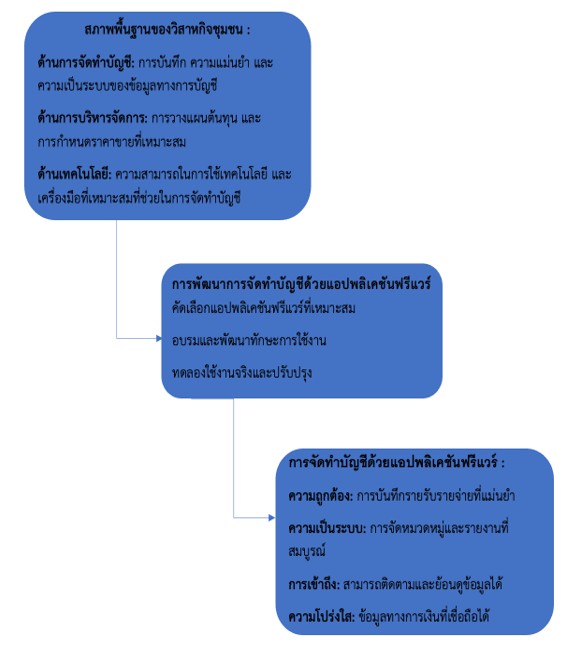
This research aimed to develop an accounting system for the women’s community enterprise group producing Krajood mats in Ban Khok Phayom, Khok Khian Subdistrict, Mueang District, Narathiwat Province, transforming the traditional handwritten recording method into the use of freeware applications on smartphones. The goal was to enhance accuracy, speed, and systematization in accounting. This study employed a qualitative approach using Action Research. The purposive sampling method was applied to select 9 participants, including group leaders, accounting assistants, and community enterprise members. Data were collected through structured interviews, structured observations, and daily recordkeeping. The research was conducted in four stages: (1) studying the background information and accounting practices, (2) selecting and analyzing 10 freeware applications from the App Store and Google Play Store, (3) conducting practical trials through workshop-based training, and (4) observing and evaluating application usage to identify the most suitable application capable of improving the financial management efficiency of the community enterprise group.
The findings revealed that the community enterprise group had a low level of proficiency in recording income and expenses, relying on handwritten records that lacked systemization, leading to errors and difficulty in auditing retrospectively. The selection and trial use of the freeware application Wallet Story, which was well-suited to the group’s context, improved the accuracy, completeness, and timeliness of accounting records. The application enabled convenient data storage and retrieval, as well as the generation of financial summary reports quickly. Its implementation also increased members’ awareness of the importance of bookkeeping, fostered consistent recording habits, and allowed them to utilize financial data for operational planning, cost calculation, and effective business decision-making. These results demonstrate that integrating digital technology as a bookkeeping tool can tangibly enhance the financial management of community enterprises.
Article Details
References
จิตรา โชติพันธุ์. (2563). การใช้แอปพลิเคชันเพื่อควบคุมการใช้จ่ายในกลุ่มผู้ประกอบการรายย่อย. วารสารวิชาการบริหารธุรกิจ มหาวิทยาลัยราชภัฏนครปฐม, 13(2), 44-59.
ณัฐธิดา ปานสังข์, อภิชาต คำอ่อน และสมหมาย สีสุธรรม. (2565). การพัฒนาทักษะการใช้แอปพลิเคชันทางการเงินสำหรับผู้ประกอบการรายย่อย. วารสารบริหารธุรกิจเพื่อสังคม, 4(2). 22–36.
ธิดารัตน์ สุขขี. (2562). การวิเคราะห์พฤติกรรมการจัดทำบัญชีของกลุ่มวิสาหกิจชุมชน: กรณีศึกษากลุ่มอาชีพ
ในจังหวัดพะเยา. วารสารวิชาการมหาวิทยาลัยราชภัฏเชียงราย, 10(1), 85–97.
นฤมล อริยพิมพ์. (2565). การจัดทำบัญชีด้วยแอปพลิเคชัน สำหรับผู้ประกอบการรุ่นใหม่ในยุคไทยแลนด์ 4.0
ของกลุ่มวิสาหกิจชุมชนประเภทอาหาร อำเภอเมือง จังหวัดขอนแก่น. วารสารวิชาการและวิจัย มหาวิทยาลัยภาคตะวันออกเฉียงเหนือ, 12(1). 303–314.
ปวันรัตน์ ดีวงษ์. (2560). แนวทางการพัฒนาการดำเนินของวิสาหกิจชุมชน ในเขตพื้นที่มาบตาพุดคอมเพล็กซ์ จังหวัดระยอง [วิทยานิพนธ์ปริญญามหาบัณฑิต]. มหาวิทยาลัยบูรพา.
เยาวพา กองเกตุ. (2567). มาตรการทางกฎหมายในการส่งเสริมวิสาหกิจชุมชนตามพระราชบัญญัติส่งเสริมวิสาหกิจชุมชน พ.ศ. 2548 กรณีศึกษา วิสาหกิจชุมชนในเขตอำเภอเมืองเลย จังหวัดเลย. วารสารนิติศาสตร์และสังคมท้องถิ่น, 8(1). 51–76.
สุปรียา เดชรักษา และทิพวิมล ชมพูคำ. (2560). การพัฒนาแอปพลิเคชันบัญชีรายรับ-รายจ่าย บนระบบปฏิบัติการแอนดรอยด์. วารสารโครงงานวิทยาการคอมพิวเตอร์และเทคโนโลยีสารสนเทศ, 3(1). 1–7.
สุพัตรา แสงวิมาน. (2564). การส่งเสริมการออมและวางแผนการเงินของแม่บ้านในชุมชนด้วยแอปพลิเคชันMoney Manager. วารสารวิจัยสังคมและพัฒนา, 8(1), 112-126.
สำนักงานสภาพัฒนาการเศรษฐกิจและสังคมแห่งชาติ. (2565). แผนพัฒนาเศรษฐกิจและสังคมแห่งชาติ ฉบับที่ 13 (พ.ศ. 2566—2570). สำนักงานสภาพัฒนาการเศรษฐกิจและสังคมแห่งชาติ. https://www.nesdc.go.th
สำนักงานส่งเสริมวิสาหกิจขนาดกลางและขนาดย่อม. (2567, 15 มกราคม). วิสาหกิจขนาดกลางและขนาดย่อม. สำนักงานส่งเสริมวิสาหกิจขนาดกลางและขนาดย่อม. https://www.sme.go.th
อนุสรณ์ สุขเกษม. (2565). ความพร้อมในการใช้เทคโนโลยีบัญชีของผู้ประกอบการรายย่อยในภาคตะวันออกเฉียงเหนือ. วารสารการพัฒนาชุมชนและคุณภาพชีวิต, 10(3), 14–26.
Ajzen, I. (1991). The theory of planned behavior. Organizational behavior and human decision
processes, 50(2), 179–211.
Bandura, A. (1991). Social cognitive theory of self regulation. Organizational Behavior and Human Decision Processes, 50(2), 248–287.
Creswell, J. W., & Poth, C. N. (2018). Qualitative inquiry and research design: Choosing among
five approaches (4th ed.). SAGE Publications.
Davis, F. D. (1989). Perceived Usefulness, Perceived Ease of Use, and User Acceptance of Information Technology. MIS Quarterly, 13(3), 319–340.
Drisko, J. W., & Maschi, T. (2016). Content analysis. Oxford university press.
Harwood, T. G., & Garry, T. (2003). An overview of content analysis. The marketing review, 3(4),
-498.
Laudon, K. C., & Laudon, J. P. (2020). Management Information Systems: Managing the Digital
Firm (16th ed.). Pearson.
Patton, M. Q. (2002). Qualitative research and evaluation methods (3rd ed.). SAGE Publications.
Rakhmawati, T., Prasetyo, A., & Nugraheni, R. (2020). The Effectiveness of Mobile Financial Applications in Improving Household Financial Behavior. International Journal of Scientific & Technology Research, 9(3), 4555–4560.
Widyastuti, U., & Suharti, L. (2023). Digital accounting applications and decision-making in small community enterprises: A case study in rural Indonesia. Journal of Small Business and Digital Innovation, 5(1), 33–47.
