
Factors Influencing Travel Decision-Making in Three Southern Border Provinces
Article Sidebar
Main Article Content
Abstract
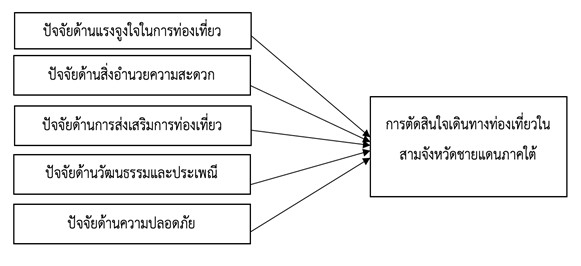
This research aims to 1) study the level of tourist opinions on factors used in making travel decisions in the three southern border provinces; 2) study tourists' opinions on travel decision-making in the three southern border provinces; and 3) study the factors influencing travel decision-making in the three southern border provinces of Thailand. A quantitative research method was employed. The sample consisted of 384 residents and travelers in the three southern border provinces. Data were collected using a questionnaire, with a reliability coefficient of 0.834. Data analysis included descriptive statistics such as frequency, percentage, mean, and standard deviation, as well as multiple regression analysis.
The results showed that most respondents were female, aged between 21 and 30 years, single, and undergraduate students. Research indicated that tourists consider a variety of factors to be very important when choosing to travel to the three southern border provinces, including travel motivation, facilities, tourism promotion, cultural traditions, and safety. Among these factors, tourism promotion received the highest mean score ( = 4.00, SD = 0.789). Regarding tourists’ opinions on travel decision-making in the three southern border provinces, all factors were rated at a high level: 1) the comfort experienced during travel to the region, 2) influence from reviews by influencers, 3) information searching and comparison indicating that the tourist destinations met their needs, 4) scenic views of the tourist attractions, 5) safety in tourist areas, and 6) reasonable costs of traveling. The influence from reviews by influencers obtained the highest mean score ( = 4.17, SD = 0.853). Furthermore, hypothesis testing demonstrated that these five factors significantly influenced travel decision-making in the three southern border provinces at the 0.05 significance level. Collectively, they explained 33.90% of the variance in travel decision-making (R² = .339).
Article Details
References
การท่องเที่ยวแห่งประเทศไทย (ททท.). (2566, 25 กรกฎาคม). จุดเด่น สถานที่ท่องเที่ยวแต่ละภาค. https://thai.tourismthailand.org/Destinations
ชลพลกฤต รัตน์นราทร. (2562). ปัจจัยที่มีผลต่อการตัดสินใจของนักท่องเที่ยวชาวไทยในการท่องเที่ยวเมืองรอง [สารนิพนธ์ปริญญามหาบัณฑิต, มหาวิทยาลัยศรีนครินทรวิโรฒ]. http://ir-ithesis. swu.ac.th/dspace/handle/123456789/706
ธนวัฒน์ สกุณาธวงค์. (2564). ปัจจัยเสริมสร้างการตัดสินใจในการท่องเที่ยววและแรงจูงใจในการท่องเที่ยวของคนพิการทางการเคลื่อนไหวที่อยู่อาศัยในเขตกรุงเทพมหานคร [วิทยานิพนธ์ปริญญามหาบัณฑิต, มหาวิทยาลัยธุรกิจบัณฑิตย์]. https://libdoc.dpu.ac.th/thesis/Tanawat.Sak.pdf
นิจพร แสงสุขเอี่ยม. (2565). การส่งเสริมการท่องเที่ยวชุมชนโดยวิสาหกิจเพื่อสังคม กรณีศึกษาชุมชนท่าฉลอม จังหวัดสมุทรสาคร [สารนิพนธ์ปริญญามหาบัณฑิต, มหาวิทยาลัยธรรมศาสตร์]. http://ethesisarchive.library.tu.ac.th/thesis/2022/TU_2022_6405036069_17732_27638.pdf
พงศกร โค้วไพโรจน. (2562). การเปิดรับ ความเชื่อมั่น และการใช้ประโยชน์ข้อมูล ข่าวสารผ่านสื่อดิจิทัลของการท่องเที่ยวแห่งประเทศไทย [วิทยานิพนธ์ปริญญามหาบัณฑิต, จุฬาลงกรณ์มหาวิทยาลัย]. https://digital.car.chula.ac.th/chulaetd/7127/
พัชรวรรณ วรพล. (2565, 7 สิงหาคม). TAT Review การท่องเที่ยวโดยชุมชน. https://www.tatreviewmagazine.com/article/community-based-tourism/
เพียงธาร ผลิพืช. (2563). การศึกษาแรงจูงใจในการท่องเที่ยวและส่งผลต่อนักท่องเที่ยวชาวไทยที่เดินทางมาท่องเที่ยวเกาะเกร็ด จังหวัดนนทบุรี [วิทยานิพนธ์ปริญญามหาบัณฑิต, มหาวิทยาลัยสุโขทัยธรรมาธิราช]. http://dspace.bu.ac.th/handle/123456789/4775
มันทนา รังษีกุล และธนากร รัชตกุลพัฒน์. (2561, 16 สิงหาคม). การสร้างความได้เปรียบทางการแข่งขันของธุรกิจการท่องเที่ยวในกลุ่มผู้สูงอายุในประเทศไทย [เอกสารนำเสนอ]. การประชุมนำเสนอผลงานวิจัยระดับบัณฑิตศึกษา ครั้งที่ 13: เรื่อง Digital Transformation for Achieving Thailand 4.0, มหาวิทยาลัยรังสิต. https://rsujournals.rsu.ac.th/Index.Php/rgrc/artIcle/download/618/392/
วนัสนันทน์ โพธิ์เพชร. (2562). ปัจจัยที่มีอิทธิพลต่อการตัดสินใจท่องเที่ยวแหล่งท่องเที่ยวเชิงประวัติศาสตร์ของผู้เยี่ยมเยือนชาวไทย: กรณีศึกษาอุทยานประวัติศาสตร์พระนครศรีอยุธยา [การค้นคว้าอิสระปริญญามหาบัณฑิต, มหาวิทยาลัยกรุงเทพ]. http://dspace.bu.ac.th/jspui/bitstream/1234567 89/4548/3/wanasnan_phop.pdf
วรรัฏฐ์ แก้วไพรินทร์. (2564). พฤติกรรมและความพึงพอใจของนักท่องเที่ยวที่มีต่อวัดในตำบลคลองสระบัว จังหวัดพระนครศรีอยุธยา [วิทยานิพนธ์ปริญญามหาบัณฑิต, มหาวิทยาลัยกรุงเทพ]. http://dspace.bu.ac.th/handle/123456789/4978
วิคิเนีย มาเยอร์. (2562). การศึกษาแรงจูงใจการท่องเที่ยวและความพึงพอใจของนักท่องเที่ยวชาวไทยที่เดินทางมาท่องเที่ยวบ่อน้ำร้อนพรรั้ง จังหวัดระนอง [วิทยานิพนธ์ปริญญามหาบัณฑิต, มหาวิทยาลัยราชภัฏสุราษฎร์ธานี]. https://libdoc.dpu.ac.th/thesis/149668.pdf
ศุภาวิณี โลหะประเสริฐ และวัชระ ขาวสังข์. (2556) รูปแบบการจัดการท่องเที่ยวในสามจังหวัดชายแดนภาคใต้. (รายงานวิจัยฉบับสมบูรณ์, มหาวิทยาลัยราชภัฏยะลา). http://202.29.32.238/medias/รูปแบบการจัดการการท่องเที่ยวในสามจังหวัดชายแดนภาคใต้%20%20ศุภาวิณี%20โลหะประเสริฐ.pdf
สำนักบริหารการทะเบียน กรมการปกครอง (2566). สำนักบริหารการทะเบียน กรมการปกครอง ณ เดือน ส.ค.2566. https://narathiwat.nso.go.th/images/Explore_within_the_province/35.pdf
Bitner, M. J. (1992). Servicescapes: The Impact of Physical Surroundings on Customers and Employees. Journal of Marketing, 56(2), 57-71. https://eli.johogo.com/Class/jm-1992. pdf
Cohen, E. (1988). Authentic tourism and cultural heritage. Annals of Tourism Research, 15(3), 371-386. https://moscow.sci-hub.se/1309/16f6c515d7110a71389db8612ececc97/cohe n2012.pdf
Crompton, J. L. (1979). Motivations for pleasure vacation. Annals of Tourism Research, 6(4), 408–424. https://doi.org/10.1016/0160-7383(79)90004-5
Dann, G. M. S. (1977). Anomie, ego-enhancement and tourism. Annals of Tourism Research, 4(4), 184-194. https://www.sciencedirect.com/science/article/pii/0160738377900378
Geertz, C. (1973). The interpretation of cultures: Selected essays. Basic Books. https://indiach inainstitute.org/wp-content/uploads/2017/05/8A-Geertz-1973.pdf
Iso-Ahola, S. E. (1982). Toward a social psychology of recreational travel motivation: A rejoin der. Leisure Sciences, 5(1), 1-13. https://so05.tci-thaijo.org/index.php/pimjournal/arti cle/download/107131/84771/272611
Kim, K., Lee, H., & Klenosky, D. B. (2003). The influence of motivation and satisfaction on the revisit intention of tourists to Charlotte, North Carolina, USA. Journal of Travel & Tourism Marketing, 15(4), 19–40. https://uwspace.uwaterloo.ca/bitstreams/5adce82e-7d68-4e5b-8782-e86a81e7291e/download
Kotler, P., & Keller, K. L. (2016). Marketing management (15th ed.). Pearson. https://gnindia. dronacharya.info/MBA/1stSem/Downloads/MarketingManagement/Books/Marketing-Management-text-book-1.pdf
Kotler, P., Bowen, J., & Makens, J. (2017). Marketing for hospitality and tourism (7th ed.). Pearson. https://www.slithm.edu.lk/wp-content/uploads/2022/02/marketing_for_hospitalitytouris m.pdf
Kozak, M., Crotts, J. C., & Law, R. (2007). The impact of the perception of risk on international travellers. International Journal of Tourism Research, 9(4), 233-242. https://onlinelibr ary.wiley.com/doi/10.1002/jtr.607
Krejcie, R. V., & Morgan, D. W. (1970). Determining sample size for research activities. Educational and Psychological Measurement, 30(3), 607–610. https://doi.org/10.1177 /001316447003000308
Liu, A. (2006). Tourist safety and security: A review of the literature. Journal of Tourism Studies, 17(2), 45-54. https://ejtr.vumk.eu/index.php/about/article/download/2871/590/6648
Maslow, A. H. (1943). A theory of human motivation. Psychological Review, 50(4), 370–396. https://www.academia.edu/7657195/A_THEORY_OF_HUMAN_MOTIVATION
Medlik, S., & Middleton, V. (1973). Marketing in Travel and Tourism. Heinemann. https://uma yalwomenscollege.co.in/wp-content/uploads/aqar2020-2021/criteria-2/e-content/33. pdf
Middleton, V., & Clarke, J. (2001). Marketing in travel and tourism (3rd ed.). Butterworth-Heinemann. https://now.acs.org/public/browse/HomePages/Marketing_In_Travel_And _Tourism.pdf
Pearce, P. L. (1982). The social psychology of tourist behaviour. Pergamon Press. https://dok umen.pub/download/tourist-behaviour-themes-and-conceptual-schemes-9781845410 247.html
Pizam, A., & Mansfeld, Y. (1999). Tourism, security and safety: From theory to practice. Wiley.
https://nibmehub.com/opac-service/pdf/read/Tourism-%20Security%20and%20Safety %20_%20from%20theory%20to%20practice.pdf
Poria, Y., Reichel, A., & Biran, A. (2006). Heritage site management: Motivations and expectations. Annals of Tourism Research, 33(1), 162-178. https://dacemirror.sci-hub. st/journal-article/a176a2c52b99bb4f74f59e023c5b5816/poria2006.pdf
Reisinger, Y., & Mavondo, F. (2005). Travel anxiety and intentions to travel internationally: Implications of travel risk perception. Journal of Travel Research, 43(3), 212-225. http s://doi.org/10.1177/0047287504272017
Richards, G. (1996). Cultural tourism in Europe. CAB International. https://pure.uvt.nl/ws/portal
files/portal/85264950/Cultural_tourism_in_europe_edited.pdf
UNWTO. (2018). Cultural heritage and tourism. United Nations World Tourism Organization. https://www.e-unwto.org/doi/pdf/10.18111/9789284418978
UNWTO. (2020). Tourism and COVID-19: Understanding the impact and sustainable recovery. United Nations World Tourism Organization. https://www.unwto.org/tourism-covid-19
World Tourism Organization. (2012). Tourism in the green economy: Background report. United Nations Environment Programme. https://www.cbd.int/financial/doc/tourism-greenec onomy.pdf
Yoon, Y., & Uysal, M. (2005). An examination of the effects of motivation and satisfaction on destination loyalty: A structural model. Tourism Management, 26(1), 45-56. https://www.econstor.eu/bitstream/10419/190577/1/01_1_p25-44.pdf
