
Technology Acceptance and Brand Equity Influencing the iPads Purchase Intention of Undergraduate Students in Songkhla Province
Article Sidebar
Main Article Content
Abstract
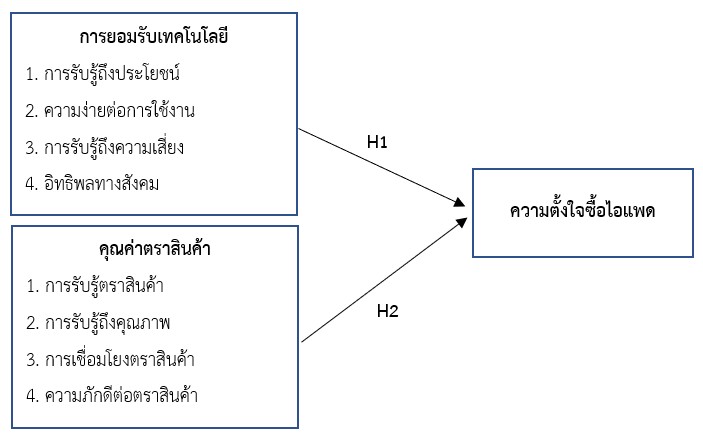
This study aimed to (1) examine technology acceptance factors influencing the purchase intention of iPads among undergraduate students in Songkhla Province and (2) investigate brand equity factors affecting the purchase intention of iPads among undergraduate students in Songkhla Province. The sample consisted of 400 undergraduate students in Songkhla Province, selected using multi-stage sampling. The research instrument was a questionnaire comprising multiple-choice items and five-point Likert-scale questions. The statistical methods used for data analysis included descriptive statistics (percentages) and multiple regression analysis. The results revealed that technology acceptance had a statistically significant positive effect on undergraduate students’ purchase intention toward iPads in Songkhla Province. Among the technology acceptance factors, perceived usefulness exerted the strongest influence, followed by perceived risk, perceived ease of use, and social influence, respectively. The model accounted for 61 percent of the variance in purchase intention. In addition, brand equity was found to have a significant positive effect on purchase intention. Perceived quality and brand loyalty were the most influential factors, followed by brand associations and brand awareness. The model explained 68 percent of the variance in purchase intention. These findings indicate that students’ intention to purchase iPads is driven by the combined evaluation of technological attributes and brand-related value.
Article Details
References
มหาวิทยาลัยสงขลานครินทร์. (2567). รายงานสถิตินักศึกษาระดับอุดมศึกษา. ผู้แต่ง.
มหาวิทยาลัยทักษิณ. (2568). สถิตินิสิตปัจจุบัน วิทยาเขตสงขลา. ผู้แต่ง.
มหาวิทยาลัยหาดใหญ่. (2567). รายงานข้อมูลนักศึกษา. ผู้แต่ง.
มหาวิทยาลัยราชภัฏสงขลา. (2567). ข้อมูลนักศึกษา ปีการศึกษา 2567. ผู้แต่ง.
มหาวิทยาลัยเทคโนโลยีราชมงคลศรีวิชัย. (2567). ฐานข้อมูลสารสนเทศอุดมศึกษา. ผู้แต่ง.
สำนักงานคณะกรรมการกิจการกระจายเสียง กิจการโทรทัศน์ และกิจการโทรคมนาคมแห่งชาติ. (2567). รายงานการสำรวจการมีการใช้และการเข้าถึงโทรคมนาคมของประชาชน พ.ศ. 2567. https://www .nbtc.go.th
สำนักงานสภาพัฒนาการเศรษฐกิจและสังคมแห่งชาติ. (2564). รายงานความเหลื่อมล้ำทางดิจิทัลของประเทศไทย. ผู้แต่ง.
Aaker, D. A. (1991). Managing brand equity: Capitalizing on the value of a brand name. Free Press.
Canalys. (2022). Worldwide PC and tablet market share: Q1 2022. https://www.canalys.com
Cochran, W. G. (1977). Sampling techniques (3rd ed.). John Wiley & Sons.
Davis, F. D. (1989). Perceived usefulness, perceived ease of use, and user acceptance of information technology. MIS Quarterly, 13(3), 319–340.
Dodds, W. B., Monroe, K. B., & Grewal, D. (1991). Effects of price, brand, and store information on buyers’ product evaluations. Journal of Marketing Research, 28(3), 307–319.
Fishbein, M., & Ajzen, I. (1975). Belief, attitude, intention and behavior: An introduction to theory and research. Reading, MA: Addison-Wesley.
Keller, K. L. (2013). Strategic brand management: Building, measuring, and managing brand equity (4th ed.). Pearson Education.
Lim, L., Ong, C., Teo, P., & Theresa, H. (2024). Online purchase intention of digital products among university students. Business Management and Strategy. https://doi.org/10.5296/bms.v15i1.21869
OECD. (2021). Education at a glance 2021: OECD indicators. OECD Publishing.
Rakib, M., Pramanik, S., Amran, M., Islam, M., & Sarker, M. (2022). Factors affecting young customers’ smartphone purchase intention during Covid-19 pandemic. Heliyon, 8. https://doi.org/10.1016/j.heliyon.2022.e10599
Risdayanti, R., Titing, A., & Ismanto, I. (2025). The influence of brand image and product quality perception on consumer purchase intention for Axioo Laptops. Jurnal Manajemen, Bisnis dan Kewirausahaan. https://doi.org/10.55606/jumbiku.v5i1.5469
UNESCO. (2020). Education in a post-COVID world: Nine ideas for public action. Author.
Venkatesh, V., & Davis, F. D. (2000). A theoretical extension of the technology acceptance model: Four longitudinal field studies. Management Science, 46(2), 186–204.
Wang, F., Wijaya, T., Habibi, A., & Liu, Y. (2022). Predictors influencing urban and rural area students to use tablet computers as learning tools: A combination of UTAUT and TTF models. Sustainability. https://doi.org/10.3390/su142113965
Wu, L., & Chen, J. (2017). Purchase intention of mobile devices: The role of perceived value and technology acceptance. Telematics and Informatics, 34(2), 153–163.
Yoo, B., & Donthu, N. (2001). Developing and validating a multidimensional consumer-based brand equity scale. Journal of Business Research, 52(1), 1–14.
