
A Conceptual Framework on Entrepreneurs’ Innovative Capabilities within a Specific Context: A Literature Review
Article Sidebar
Main Article Content
Abstract
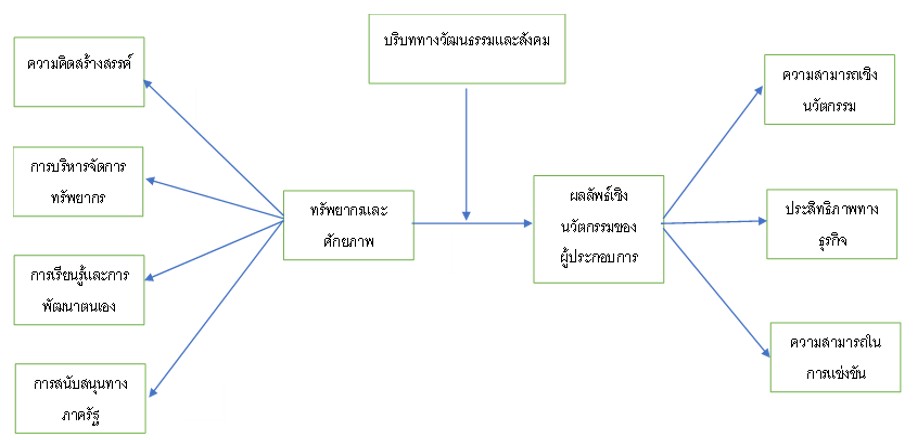
This conceptual academic article aims to synthesize a body of knowledge regarding the factors influencing the development of innovative capability among entrepreneurs in Thailand’s three southern border provinces: Narathiwat, Pattani, and Yala. These provinces are characterized by complex socio-cultural dynamics and face multifaceted economic and political challenges. The study employs a systematic literature review and conceptual synthesis of relevant research with a view to integrate existing knowledge into a conceptual framework that aligns with the specific contextual conditions of the area. The synthesis indicates that key factors contributing to the development of entrepreneurial innovative capability include effective resource management, self-directed learning and development, and government support. At the same time, the socio-cultural context functions as a contextual determinant that may either enhance or constrain such capability. Entrepreneurs who are able to adapt strategically and develop a deep understanding of the local context are more likely to generate innovations that respond effectively to market needs and contribute to long-term business sustainability.
Accordingly, this article proposes a conceptual framework that can serve as a foundation for future empirical research, as well as provide policy and strategic guidance to promote sustainable growth of entrepreneurs in the three southernmost border provinces of Thailand.
Article Details
References
บุญฑริกา วงษ์วานิช และกฤษดา เชียรวัฒนสุข (2564). ผลกระทบเชิงสาเหตุของความสามารถเชิงพลวัตและคุณภาพของระบบสารสนเทศต่อผลการดำเนินงานของบริษัทผู้ประกอบการวิสาหกิจขนาดกลางและขนาดย่อมในยุคดิจิทัล: การศึกษาตัวแปรคั่นกลางด้านนวัตกรรมผลิตภัณฑ์ กระบวนการ และการตลาด. วารสารวิทยาการจัดการ มหาวิทยาลัยราชภัฏนครปฐม, 8(2), 422–444. https://doi.org /10.14456/jmsnpru.2021.56
ศรีวิเชียร พรดาหยันกุล (2568). ความสามารถด้านนวัตกรรมโลจิสติกส์มีอิทธิพลต่อสมรรถนะโลจิสติกส์และผลการดำเนินงานของผู้ให้บริการโลจิสติกส์ในประเทศไทย. วารสารมนุษยศาสตร์และสังคมศาสตร์มหาวิทยาลัยราชภัฏพิบูลสงคราม, 19(2), 571–585. https://doi.org/10.14456/psruhss.2025. 38
Abdulrab, M., Al-Mamary, Y. H. S., Alwaheeb, M. A., Alshammari, N. G. M., Balhareth, H., & Al-Shammari, S. A. (2021). Mediating role of strategic orientations in the relationship between entrepreneurial orientation and performance of Saudi SMEs. Brazilian Journal of Operations and Production Management, 18(1), 1–15. https://doi.org/10.14488/bjo pm.2021.029
Abid, N., Ceci, F., & Aftab, J. (2024). Attaining sustainable business performance under resource constraints: Insights from an emerging economy. Sustainable Development, 32(3), 20 31–2048. https://doi.org/10.1002/sd.2763
Amabile, T. M. (1997). Motivating creativity in organizations: On doing what you love and loving what you do. California Management Review, 40(1), 39–58.
Audretsch, D. B. (2003). Innovation and spatial externalities. International Regional Science Review, 26(2), 167–174.
Barney, J. B. (1991). Firm resources and sustained competitive advantage. Journal of Management, 17(1), 99–120.
Damanpour, F. (1991). Organizational innovation: A meta-analysis of effects of determinants and moderators. Academy of Management Journal, 34(3), 555–590.
García-Granero, A., Duréndez, A. V., & Urbano, D. (2022). Linkages between entrepreneurial capabilities and firm performance: A systematic literature review using topic modeling. Journal of Business Research, 150, 29–43. https://doi.org/10.1016/j.jbusres.2022.06.018
García-Aliaga, M. I., Prados Castillo, J. F., Guaita Martínez, J. M., & Ribeiro-Soriano, D. (2025). The Influence of Hofstede’s cultural dimensions on innovation- and sustainability-oriented project adoption by cooperatives. Contemporary Economics, 19(4), 397–416. https://doi.org/10.5709/ce.1897-9254.574
Grant, R. M. (1991). The resource-based theory of competitive advantage: Implications for strategy formulation. California Management Review, 33(3), 114–135.
Halim, F., Kusuma, R. C. S. D., Sherly, S., Loist, C., & Sudirman, A. (2023). The influence of Social capital and innovation capability on creative industry business performance. International Journal of Business, Law and Education, 4(2), 971–978. https://doi.org/10.56442/ijble.v4i2.267
Helfat, C. E., & Martin, J. A. (2020). Dynamic managerial capabilities in innovation-driven firms: Linking micro processes to performance. Strategic Management Journal, 41(10), 1795–1815. https://doi.org/10.1002/smj.3113
Hofstede, G. (2001). Culture’s consequences: Comparing values, behaviors, institutions and organizations across nations (2nd ed.). Sage Publications.
Islam, M. A., Jantan, M. D., & Hashim, N. (2017). The role of resource management in innovation and firm performance: A study of SMEs in the southern border provinces of Thailand Asian Journal of Technology Innovation, 25(2), 198–216.
Maharani, I. A. K., Sukoco, B. M., Usman, I., & Ahlstrom, D. (2024). Learning-driven strategic renewal: Systematic literature review. Management Research Review, 47(5), 708–743. https://doi.org/10.1108/MRR-05-2023-0377
Makhloufi, L., Laghouag, A. A., Ali Sahli, A., & Belaid, F. (2021). Impact of entrepreneurial orientation on innovation capability: The mediating role of absorptive capability and organizational learning capabilities. Sustainability, 13(10), 5399. https://doi.org/10 .3390/su13105399
McCargo, D. (2010). Autonomy for southern Thailand: Thinking the unthinkable? Pacific Affairs, 83(2), 261–281. https://doi.org/10.5509/2010832261
Mezghani, I., & Barki, E. (2023). Culture and innovation: How societal cultural values influence firms’ innovation capability. Technological Forecasting and Social Change, 187, 122514. https://doi.org/10.1016/j.techfore.2023.122514
Noman, A., & Hossain, M. (2023). Innovation capability, dynamic capabilities and firm performance: A review and future research agenda. European Management Journal, 41(4), 549–566. https://doi.org/10.1016/j.emj.2023.04.003
Nonaka, I., & Takeuchi, H. (1995). The knowledge-creating company: How Japanese companies create the dynamics of innovation. Oxford University Press.
Nuryakin, & Qamari, I. N. (2025). The mediating role of innovation capability and technological capability in the relationship between absorptive capacity and SMEs’ business performance. International Journal of Innovation Studies, 10(1), 65–79. https://doi. org/10.1016/j.ijis.2025.09.004
Osiyevskyy, O., Sinha, K., Shirokova, G., & Shtepa, S. (2025). Innovation capabilities decoded: Risks and rewards in small and medium enterprise performance. European Management Journal. Advance online publication. https://doi.org/10.1016/j.emj.2025 .01.011
Page, M. J., McKenzie, J. E., Bossuyt, P. M., Boutron, I., Hoffmann, T. C., Mulrow, C. D., … & Moher, D. (2021). The PRISMA 2020 statement: An updated guideline for reporting systematic reviews. BMJ, 372, n71. https://doi.org/10.1136/bmj.n71
Paovangsa, S., Kamil, M., Aaqil, M., & Xing, K. (2025). Assessing innovation capability, innovation types, and its impact on innovation performance in FDI enterprises: Configurational recipes for Laos. SAGE Open, 15(3), 1–20. https://doi.org/10.1177/21582440251365311
Sanz-Torro, V., Calafat-Marzal, C., Guaita-Martinez, J. M., & Marti, L. (2025). An integrated approach to resource efficiency, green markets and support measures in SMEs. International Entrepreneurship and Management Journal, 21(1), 84. https://doi .org/10.1007/s11365-025-01098-1
Satha-Anand, C. (2015). The impact of Islamic and cultural identity on social relations insouthern Thailand. Asian Journal of Social Science, 43(4), 451–476. https://doi.org/ 10.11 63/15685314-04304003
Schumpeter, J. A. (1934). The theory of economic development. Harvard University Press.
Shen, T., & Badulescu, A. (2025). Managerial Capabilities and the Internationalization Process of Small and Medium Enterprises: The Sustainable Role of Risk and Resource Management. Sustainability, 17(15), 6943. https://doi.org/10.3390/su17156943
Teece, D. J., Pisano, G., & Shuen, A. (1997). Dynamic capabilities and strategic management. Strategic Management Journal, 18(7), 509–533.
Tidd, J., Bessant, J., & Pavitt, K. (2005). Managing innovation: Integrating technological, market and organizational change (3rd ed.). John Wiley & Sons.
Van Knippenberg, D., De Dreu, C. K. W., & Homan, A. C. (2004). Work group diversity and Group performance: An integrative model and research agenda. Journal of Applied Psychology, 89(6), 1008–1022.
Wang, C. L., & Wang, J. (2021). Entrepreneurial ecosystem and innovative capabilities: A configurational perspective. Journal of Business Venturing Insights, 16, e00252. https://doi.org/10.1016/j.jbvi.2021.e00252
