
Development of a Mobile Application to Enhance Thai Language Skills Using a Microlearning Approach for Primary School Students
Article Sidebar
Main Article Content
Abstract
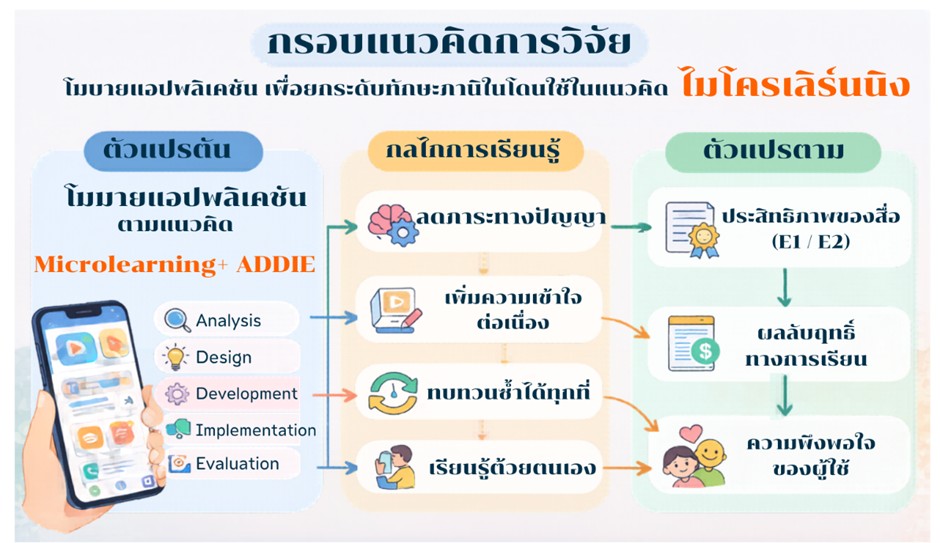
In the digital era, learning technologies play a crucial role in developing language skills. Particularly, the concept of microlearning, which focuses on organizing content into short learning units with clear objectives. This approach can help reduce content complexity and improve learning engagement, particularly among primary school students with limited attention spans. This study aimed to develop a mobile application based on the microlearning approach to enhance Thai language skills among Grade 3 students and to evaluate the effectiveness of the developed application while comparing students' academic performance before and after usage. The sample consisted of 30 Grade 3 students from Ban Lubodato School in Narathiwat Province, Thailand, selected through purposive sampling. The research instruments included the developed mobile application, a Thai language achievement test, and a user satisfaction questionnaire. The instruments were validated by three experts for content validity, yielding an Index of Item–Objective Congruence (IOC) of 0.86, indicating acceptable validity. Data were analyzed using descriptive statistics, a dependent samples t-test, and instructional media efficiency evaluation according to the E1/E2 standard criterion. The findings revealed that the developed mobile application achieved an efficiency level of E1/E2 = 0.82/0.89, which exceeded the standard criterion of 80/80. The post-test mean score was significantly higher than the pre-test mean score at the significance level of p < .001, indicating a significant improvement in students’ Thai language skills after using the application. In addition, the overall user satisfaction with the application was high (mean = 4.30) These findings suggest that integrating the microlearning approach into a mobile learning application can effectively enhance Thai language learning among primary school students. The results also highlight the potential of microlearning-based mobile applications as an innovative learning tool, particularly in multilingual contexts where students have diverse linguistic backgrounds.
Article Details
References
กระทรวงศึกษาธิการ. (2551). หลักสูตรการศึกษาขั้นพื้นฐาน พุทธศักราช 2551. สำนักพิมพ์คุรุสภา.
กฤษฎา บุญราช. (2564, 29 กรกฎาคม). ปัญหาอ่านไม่ออกเขียนไม่ได้ของเด็กไทย. ไทยรัฐ. https://www.thairath.co.th/news/education/2137897
เจนจิรา ศรีวิลัย, ชุติมา วัฒนะคีรี และสุดาพร พงษ์พิษณุ. (2566). การพัฒนาสื่อมัลติมีเดีย การสื่อสารและการนําเสนอ สําหรับนักเรียนชั้นมัธยมศึกษาปีที่ 2. วารสารวัดผลการศึกษา, 40(107), 109-120.
ชลํา อรระธรรม. (2562, 30 มีนาคม). สช. เร่งแก้ไขปัญหาการใช้ภาษาไทยรายบุคคล เพื่อยกระดับผลสัมฤทธิ์ภาษาไทยนักเรียนในพื้นที่ชายแดนภาคใต้. https://shorturl.asia/RQxHn
ธีรภัทร์ สุขสบาย. (2561). การพัฒนาชุดการสอนรายวิชาการสอนการเขียนภาษาไทยสำหรับนิสิตปริญญาตรีชั้นปีที่ 4 คณะศึกษาศาสตร์ มหาวิทยาลัยบูรพา. วารสารบัณฑิตวิทยาลัย พิชญทรรศน์, 13(2), 115–125.
ศยามน อินสะอาด. (2564). ไมโครเลิร์นนิง: รูปแบบการเรียนรู้ในยุคดิจิทัล. วารสารเทคโนโลยีการศึกษา, 34(2), 23–35.
ศิวานิพัทน์ ปัญญาธิติพงศ์ และพลหาญ พลอยกระจ่าง. (2565). การพัฒนาทักษะการเขียนภาษาไทยเพื่อการสื่อสารโดยใช้แบบฝึกการเขียนเชิงสร้างสรรค์ตามรูปแบบการสอนซินเนคติกส์. วารสารวิจัยและพัฒนาอนุภูมิภาคลุ่มน้ำโขง, 4(2), 49–58.
ศิริลักษณ์ บุญมาพันธุ์, ศยามน อินสะอาด และสุพจน์ อิงอาจ. (2564). โซเชียลไมโครเลิร์นนิง: แนวทางใหม่ของการเรียนรู้ในศตวรรษที่ 21. วารสารการวิจัยและพัฒนาการเรียนรู้, 13(1), 51–67.
วิษณุ ทรัพย์สมบัติ. (2564). รายงานผลการประเมินคุณภาพผู้เรียน (NT) ปีการศึกษา 2564. สถาบันทดสอบทางการศึกษาแห่งชาติ.
อัมพร พินะสา. (2565). นโยบายการจัดการเรียนรู้ภาษาไทยในโรงเรียน. กระทรวงศึกษาธิการ. https://www.moe.go.th
อิทธิพล คุณปลื้ม. (2564). รายงานผลสำรวจปัญหาการใช้ภาษาไทยในวันภาษาไทยแห่งชาติ 2564. กรมส่งเสริมวัฒนธรรม.
Branch, R. M. (2009). Instructional design: The ADDIE approach. Springer. https://doi.org/10.10 07/978-0-387-09506-6
Choenarom, C., & Samputtanon, J. (2025). The effectiveness of a question-embedded movie clips learning program in nursing students: A quasi-experimental pretest–posttest study. JMIR Nursing, 8, e71111. https://doi.org/10.2196/71111
Crompton, H., & Burke, D. (2018). The use of mobile learning in higher education: Asystematic review. Computers & Education, 123, 53–64. https://doi.org/10.1016/j.compedu.2018. 04.007
Hug, T. (2017). Didactics of microlearning: Concepts, discourses, and examples. Waxmann. https://www.waxmann.com/index.php?eID=download&buchnr=3708
Kobsiripat, W. (2015). Effects of the media to promote the Scratch programming capabilities creativity of elementary school students. Procedia – Social and Behavioral Sciences, 174, 227–232. https://doi.org/10.1016/j.sbspro.2015.01.651
Leong, K. E., Sung, A., Au, D., & Blanchard, C. (2021). A review of the trend of microlearning. Journal of Work-Applied Management, 13(1), 88–102. https://doi.org/10.1108/JWAM-10-2020-0044
Sweller, J. (2011). Cognitive load theory. Psychology of Learning and Motivation, 55, 37–76. https://doi.org/10.1016/B978-0-12-387691-1.00002-8
Thanyathamrongkul, R., Singhasiri, W., & Keyuravong, S. (2018). Language literacy, language education policy and classroom practices in a Thai primary school context. Issues in Educational Research, 28(4), 1060–1079.
Traxler, J. (2018). Learning with mobiles in developing countries. Technology, Knowledge and
Learning, 23(1), 1–18. https://doi.org/10.1007/s10758-017-9322-9
