
Employment status of graduates in the public administration field, Management Science Faculty, Princess of Naradhiwas University
Article Sidebar
Main Article Content
Abstract
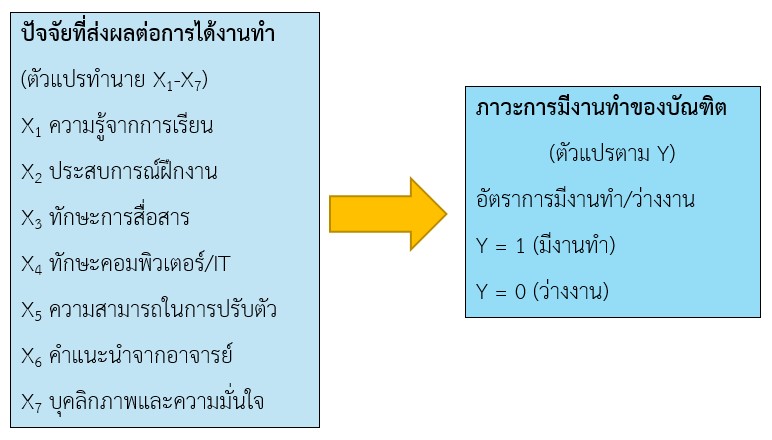
This research has the following objectives: 1. To examine the employment status of graduates in the public administration program, Princess of Naradhiwas University, for the academic year 2024. 2. To study the factors affecting the employment status of graduates in the public administration program at Princess of Naradhiwas University for the academic year 2024. This study employed a quantitative research method, collecting data from 84 graduates; an online questionnaire was used. Data were analyzed using frequency, percentage, mean, standard deviation, and binary logistic regression analysis.
The findings revealed that 88.1% of graduates of the public administration program were employed, while 11.9% remained unemployed. Regarding job-search duration, the largest proportion of graduates (29.8%) found employment within 1–2 months, followed by 27.4% within 3–6 months, 15.5% who secured employment immediately after graduation, 14.3% took more than one year, and 13.1% took 7–9 months. In terms of field relevance, only 17.9% of graduates were employed in positions directly related to their field of study, whereas 70.2% worked in unrelated fields, reflecting a mismatch between the curriculum and labor market demands. The logistic regression analysis indicated that the model explained 12.4% of the variance in employment status (Nagelkerke R² = .124), with academic knowledge (X1) showing the variable most likely to predict employment (B = −1.145, OR = 0.318, p = .056). The findings suggest curriculum revision emphasizing digital skills, expanded internship opportunities, and foreign language development.
Article Details
References
กฤษดา กฤตเมธกุล. (2565). การติดตามภาวะมีงานทำของบัณฑิตระดับปริญญาตรีของมหาวิทยาลัยราชภัฏบ้านจอมบึง ปีการศึกษา 2563. มหาวิทยาลัยราชภัฏบ้านจอมบึง. https://rdi.mcru.ac.th/file/1-2563.pdf
กระทรวงการอุดมศึกษา วิทยาศาสตร์ วิจัยและนวัตกรรม. (2565, 31 มีนาคม). กฎกระทรวง มาตรฐานคุณวุฒิระดับอุดมศึกษา พ.ศ. 2565 ราชกิจจานุเบกษา. เล่ม 139 ตอนที่ 20 ก. หน้า 28–30.
กระทรวงการอุดมศึกษา วิทยาศาสตร์ วิจัยและนวัตกรรม. (2567, 3 ธันวาคม). แผนด้านการอุดมศึกษาเพื่อผลิตและพัฒนากำลังคนของประเทศ พ.ศ. 2564–2570 ฉบับปรับปรุง พ.ศ. 2566–2570. https://www.mhesi.go.th
ครุศิลป์ อวนศรี, นิษรา พรสุริวงษ์ และสุวรรณา ยุทธภิรัตน์. (2567). ปัจจัยด้านลักษณะของงานที่ส่งผลต่อความผูกพันของพนักงานในองค์การบริหารส่วนจังหวัดราชบุรี. วารสารวิจัยมหาวิทยาลัยเวสเทิร์น มนุษยศาสตร์และสังคมศาสตร์, 10(1), 259–272. https://so04.tci-thaijo.org/index.php/WTU RJ/article/view/271724/183561
ชมพูนุท ด้วงจันทร์, สุรินทร์ ชุมแก้ว, กรุณา พุ่มเอี่ยม, ชนน พ่วงจินดา, ชนภัทร เขาทอง และปรีดา พรมน้อย. (2568). ปัจจัยที่ส่งผลต่อความสามารถในการได้งาน: การศึกษาจากมุมมองของบัณฑิตบริหารธุรกิจ มหาวิทยาลัยสงขลานครินทร์. วารสารบริหารศาสตร์ มหาวิทยาลัยอุบลราชธานี, 14(2), 70–94. https://so03.tci-thaijo.org/index.php/jms_ubu/article/view/282470/190538
ปริญญา สังข์โคตร, ประทีป กาลเขว้า และเบญญาภา กาลเขว้า. (2564). ภาวะการมีงานทำของบัณฑิตหลักสูตรสาธารณสุขศาสตรบัณฑิต สาขาวิชาสาธารณสุขชุมชน วิทยาลัยการสาธารณสุขสิรินธร จังหวัดขอนแก่น. วารสารวิทยาศาสตร์สุขภาพและการสาธารณสุขชุมชน, 4(1), 96–104. https://he01.tci-thaijo.org/index.php/jhscph/article/view/244470
ปุณยนุช เรือนโนวา และศิรรัตน์ จิตรนพรัตน์. (2568). ภาวะการมีงานทำของบัณฑิตระดับปริญญาตรี คณะบริหารธุรกิจเพื่อสังคม มหาวิทยาลัยศรีนครินทรวิโรฒ ปีการศึกษา 2564. วารสารวิชาการนอร์ทเทิร์น, 12(1), 63–77. https://so09.tci-thaijo.org/index.php/AJntc/article/view/7068
มหาวิทยาลัยแม่ฟ้าหลวง. (2565). รายงานภาวะการมีงานทำของบัณฑิต ประจำปีการศึกษา 2565. ผู้แต่ง.
สาขาวิชารัฐประศาสนศาสตร์ คณะวิทยาการจัดการ มหาวิทยาลัยนราธิวาสราชนครินทร์. (2565). มคอ.2 รายละเอียดของหลักสูตรรัฐประศาสนศาสตรบัณฑิต สาขาวิชารัฐประศาสนศาสตร์. มหาวิทยาลัยนราธิวาสราชนครินทร์.
สำนักงานปลัดกระทรวงการอุดมศึกษา วิทยาศาสตร์ วิจัยและนวัตกรรม. (2567). แผนด้านการอุดมศึกษาเพื่อผลิตและพัฒนากำลังคนของประเทศ พ.ศ. 2564–2570 ฉบับปรับปรุง พ.ศ. 2566–2570. https://www.mhesi.go.th
สุนันทา มาวัน, กิตติพงษ์ น้อยนวล, จิรายุ บัวด้วง, ธนพล อินทรสกูล, ประสพโชค สุวรรณโฉม, ศิริชัย โยมกระโทก และธนัสถา โรจนตระกูล. (2565). ทักษะที่สำคัญของบัณฑิตในอนาคต. วารสารการจัดการและพัฒนาท้องถิ่น มหาวิทยาลัยราชภัฏพิบูลสงคราม, 2(2), 87–99. https://so06.tci-thaijo.org/ index.php/jclmd_psru/article/view/259553/175588
Aničić, K. P., Gusić Munđar, J., & Šimić, D. (2022). Generic and digital competences for employability—Results of a Croatian national graduates survey. Higher Education, 84 (5), 1037–1058. https://doi.org/10.1007/s10734-022-00940-7
Best, J. W. (1977). Research in education (3rd ed.). Prentice Hall.
Chen, W., & Xuan, X. (2025). Methodological concerns in the feasibility study on ultrasound pelvimetry for breech birth. Acta Obstetricia et Gynecologica Scandinavica. https://doi.org/10.1111/aogs.70118
Hien, H. T., & Khanh, N. P. G. (2021). Graduate employability in double challenge of post-covid labor market and digital transformation: The role of graduate’s capitals, 4.0 skills, attributes and perceived labor market. Ho Chi Minh City Open University Journal of Science - Social Sciences, 11(2), 94–115. https://doi.org/10.46223/HCMCOUJS
Jackson, D. (2023). The relationship between student employment, employability-building activities and graduate outcomes. Journal of Further and Higher Education, 47(9), 1230–1246. https://doi.org/10.1080/0309877X.2023.2253426
Khan, N., Sarwar, A., Chen, T., & Khan, S. (2022). Connecting digital literacy in higher education to the 21st century workforce. Knowledge Management & E-Learning, 14(1), 46–61. https://doi.org/10.34105/j.kmel.2022.14.004
Kholifah, N., Nurtanto, M., Sutrisno, V. L. P., Majid, N., Subakti, H., Daryono, R. W., & Achmadi, A. (2025). Unlocking workforce readiness through digital employability skills in vocational education graduates: A PLS-SEM analysis based on human capital theory. Social Sciences & Humanities Open, 11, 101234. https://doi.org/10.1016/j.ssaho.2025.101625
Knight, P. T., & Yorke, M. (2004). Learning, employability and higher education. Society for Research into Higher Education & Open University Press.
Luchinskaya, D., & Tzanakou, C. (2025). Under (employability and financial) pressure: The unequal effects of work experience on graduate earnings. Studies in Higher Education, 50(5), 955–973. https://doi.org/10.1080/03075079.2025.2490801
Mirzaei, S., Bogus, S. M., & Bunt, S. (2026). A human-centered approach to reframing job satisfaction in the BIM-enabled construction industry. Journal of Information Technology in Construction (ITcon), 31, 439–460. https://doi.org/10.36680/j.itcon.2026.020
Moloto, A., Ramasimu, N., & Motsei, L. L. (2025). Graduate unemployment, skills mismatch, and the dynamics of labour mobility in South Africa: A systematic literature review. International Journal of Applied Research in Business and Management, 6(2), 1–17. https://doi.org/10.51137/wrp.ijarbm.369
Soproni, Z. (2023). Employability skills. GiLE Journal of Skills Development, 3(2), 37–55. https://doi.org/10.52398/gjsd.2023.v3.i2.pp53-65
Uzoamaka, I. G., & Okpuzor, V. (2025). Digital skills required for business education graduates: Employer perceptions in Delta State, Nigeria. African Journal of Management and Business Research, 12(1), 45–58. https://doi.org/10.62154/ajmbr.2025.018.010681
