Synthesis of Integrated Learning Process Based on Bhāvanā 4 for Developing Students in the Digital Age
Article Sidebar
Main Article Content
Abstract
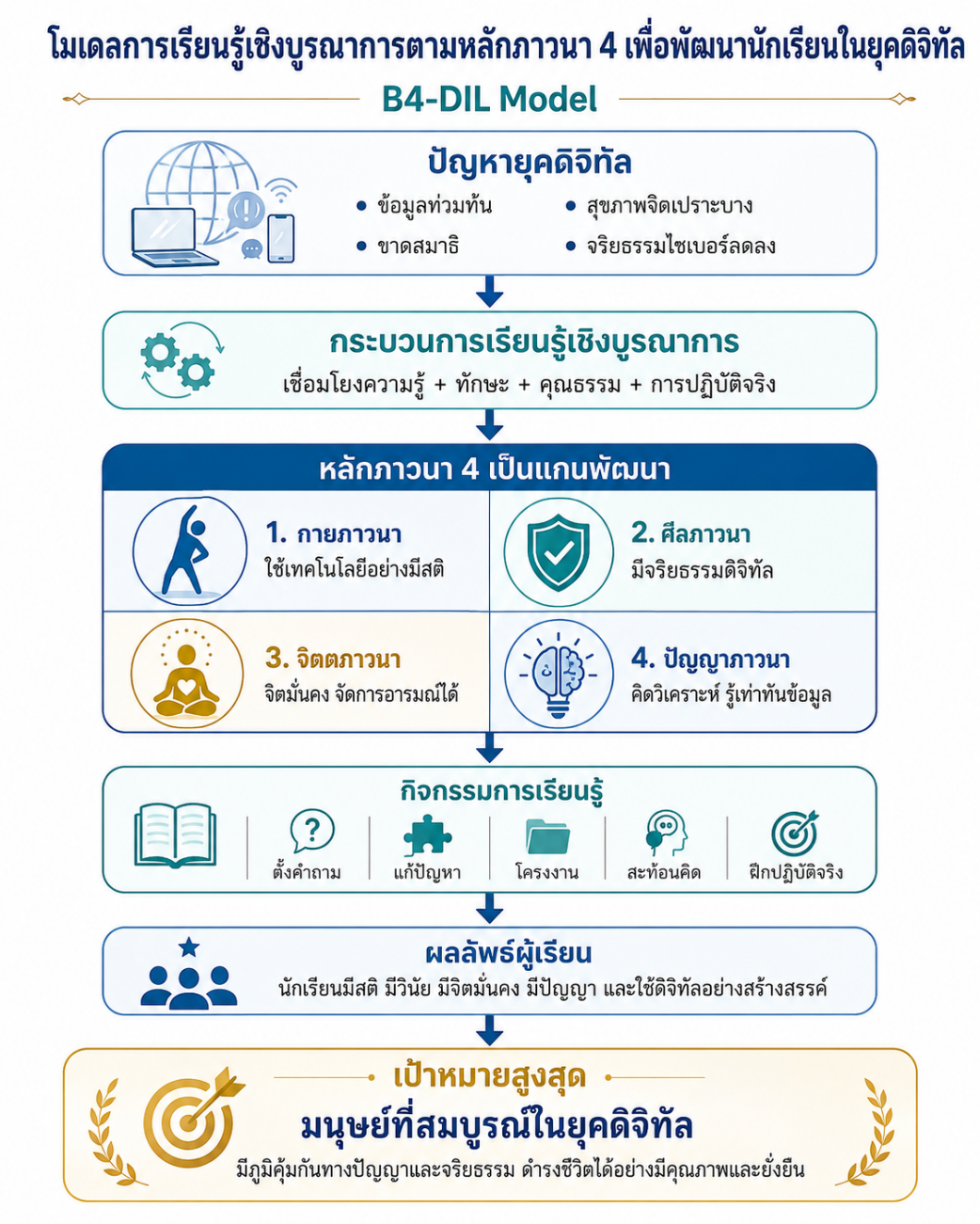
This academic article entitled “Synthesis of Integrated Learning Process Based on Bhāvanā 4 for Developing Students in the Digital Age” addresses the multifaceted challenges confronting contemporary education systems arising from the pervasive influx of digital technology, which profoundly impacts learners' developmental trajectories across multiple dimensions, including attention deficits, superficial information processing, mental health deterioration, and ethical lapses in cyberspace. These phenomena illuminate the inherent limitations of educational paradigms that prioritize unidimensional academic knowledge transmission. Consequently, this article proposes a synthesized integrated learning process grounded in the Buddhist pedagogical framework of Bhāvanā 4, encompassing Kāyabhāvanā (physical development), Sīlabhāvanā (ethical cultivation), Cittabhāvanā (mental discipline), and Paññābhāvanā (wisdom cultivation), systematically adapted to the digital educational context. The synthesis emphasizes the holistic and systematic integration of these four dimensions, culminating in the cultivation of holistically developed individuals endowed with intellectual and ethical immunity. Such individuals demonstrate mindful technological engagement, psychological resilience, ethical comportment in virtual environments, and discerning knowledge management capabilities. This framework constitutes a pivotal mechanism for nurturing fully developed human beings capable of sustaining qualitative and meaningful existence amid the epoch of rapid technological transformation.
Article Details

This work is licensed under a Creative Commons Attribution-NonCommercial-NoDerivatives 4.0 International License.
References
กรมวิชาการ. หลักสูตรการเรียนการสอนแบบบูรณาการ. กรุงเทพมหานคร : โรงพิมพ์คุรุสภา, 2539.
จตุพร นามเย็น. “ผลกระทบของพฤติกรรมการใช้อุปกรณ์หน้าจอต่อจิตใจ พฤติกรรม กระบวนการรู้คิด และความเสี่ยงต่ออาการภาวะสมาธิสั้นในเด็กและวัยรุ่น”. วารสารราชพฤกษ์. ปีที่ 22 ฉบับที่ 2 (พฤษภาคม – สิงหาคม 2024) : 1–18.
ฌาน ตรรกวิจารณ์. การพัฒนาทรัพยากรมนุษย์. กรุงเทพมหานคร : มหาวิทยาลัยรามคำแหง, 2544.
ธำรง บัวศรี. ทฤษฎีหลักสูตร : การออกแบบและพัฒนา. กรุงเทพมหานคร : โรงพิมพ์คุรุสภา, 2532.
ธีรโชติ เกิดแก้ว. พุทธปรัชญา : มิติการมองโลกและชีวิตตามความจริง. กรุงเทพมหานคร : สำนักพิมพ์มหาวิทยาลัยหัวเฉียวเฉลิมพระเกียรติ, 2553.
บูรชัย ศิริมหาสาคร. แผนการจัดการเรียนรู้ รายวิชาพื้นฐาน : กลุ่มสาระการเรียนรู้ศิลปะ. กรุงเทพมหานคร : อักษรเจริญทัศน์, 2554.
มหาจุฬาลงกรณราชวิทยาลัย. พระไตรปิฎกภาษาไทย ฉบับมหาจฬาลงกรณราชวิทยาลัย. กรุงเทพมหานคร : โรงพิมพ์มหาจุฬาลงกรณราชวิทยาลัย, 2539.
พระเทพเวที (ป.อ. ปยุตฺโต). พุทธศาสนากับการพัฒนามนุษย์. กรุงเทพมหานคร : สถาบันวิจัยพฤติกรรมศาสตร์ มหาวิทยาลัยศรีนครินทรวิโรฒ, 2536. (หมายเหตุ: แหล่งข้อมูลไม่ได้ระบุสถานที่พิมพ์)
พระธรรมปิฎก (ป.อ. ปยุตฺโต). การศึกษาเครื่องมือพัฒนาที่ยังต้องพัฒนา. พิมพ์ครั้งที่ 2. กรุงเทพมหานคร : สหธรรมิก, 2541.
___________. ทศวรรษธรรมทัศน์พระปิฎก หมวดศึกษาศาสตร์. กรุงเทพมหานคร : ธรรมสภา, 2543.
___________. ทุกข์สำหรับเห็น สุขสำหรับเป็น. กรุงเทพมหานคร : อมรินทร์, 2548.
___________. หลักแม่บทของการพัฒนาตน. พิมพ์ครั้งที่ 15. กรุงเทพมหานคร : มหาจุฬาลงกรณราชวิทยาลัย, 2546.
พระพรหมคุณาภรณ์ (ป.อ. ปยุตฺโต). พจนานุกรมพุทธศาสตร์ ฉบับประมวลธรรม. พิมพ์ครั้งที่ 12. นนทบุรี : บริษัท เอส. อาร์. พริ้นติ้งแมสโปรดักส์ จำกัด, 2553.
___________. ICT ก้าวหน้า คนต้องพัฒนาปัญญาและวินัย. กรุงเทพมหานคร: คณะเทคโนโลยีสารสนเทศและการสื่อสาร มหาวิทยาลัยมหิดล, 2553.
รัตติยา จันทร์สว่าง และคณะ. “การบริหารงานวิชาการในยุคดิจิทัลตามหลักภาวนา 4 ของผู้บริหารสถานศึกษา”. วารสารการบริหารการศึกษา มมร.วิทยาเขตร้อยเอ็ด. ปีที่ 3 ฉบับที่ 2 (พฤษภาคม – สิงหาคม 2566) : 105 – 116.
สมเด็จพระมหาสมณเจ้า กรมพระยาวชิรญาณวโรรส. เบญจศีล เบญจธรรม. พิมพ์ครั้งที่ 19. กรุงเทพมหานคร : โรงพิมพ์มหามกุฏราชวิทยาลัย, 2515.
สิริพัชร์ เจษฎาวิโรจน์. การจัดการเรียนการสอนแบบบูรณาการ. กรุงเทพมหานคร : บุ๊ค พอยท์, 2546.
___________. “เกาะติดหลักสูตร : การจัดการเรียนรู้แบบบูรณาการ”. วารสารวิชาการ. 9 (มกราคม - มีนาคม 2549) : 63 – 71.
อดิศร หนันคำจร และคณะ. “คุณลักษณะที่เอื้อต่อการเรียนรู้ตามวิถีพุทธของนักศึกษา”. วารสารบริหารการศึกษา มศว. ปีที่ 12 ฉบับที่ 22 (มกราคม – มิถุนายน 2558) : 110 – 116.
Beane, James A. Curriculum Planning and Development. Boston : Allyn and Bacon, 1991.
Drisya K K. “The Impact of Online Information Overload on College Students' Ability to Critically Evaluate Digital Content”. International Journal for Multidisciplinary Research (IJFMR). 7(2) (March-April 2025) : 1-13.
Educatly Admin Team, Unpacking the Disadvantages of Technology in Education. [ออนไลน์]. แหล่งที่มา: https://www.educatly.com/blog/477/unpacking-the-disadvantages-of-technology-in-education [20 ธันวาคม 2568].
Fogarty, Robin. “Ten Ways to Integrate Curriculum”. Educational Leadership. 49(2) (October 1991) : 61-65.
Imjai, N., Aujirapongpan, S., Jutidharabongse, J., & Usman, B. “Impacts of digital connectivity on Thailand’s Generation Z undergraduates’ social skills and emotional intelligence”. Contemporary Educational Technology. Vol. 16, No. 1 (2024) : 1-21.
Moonsun Choi. “A Concept Analysis of Digital Citizenship for Democratic Citizenship Education in the Internet Age”. Theory & Research in Social Education. Vol. 44 (2016) : 565–607.
U.S. Surgeon General, Social Media and Youth Mental Health. [ออนไลน์]. แหล่งที่มา: https://www.hhs.gov/sites/default/files/sg-youth-mental-health-social-media-advisory.pdf [20 ธันวาคม 2568].
