The application of buddhamma for public mind As appeared in tripitaka
Article Sidebar
Main Article Content
Abstract
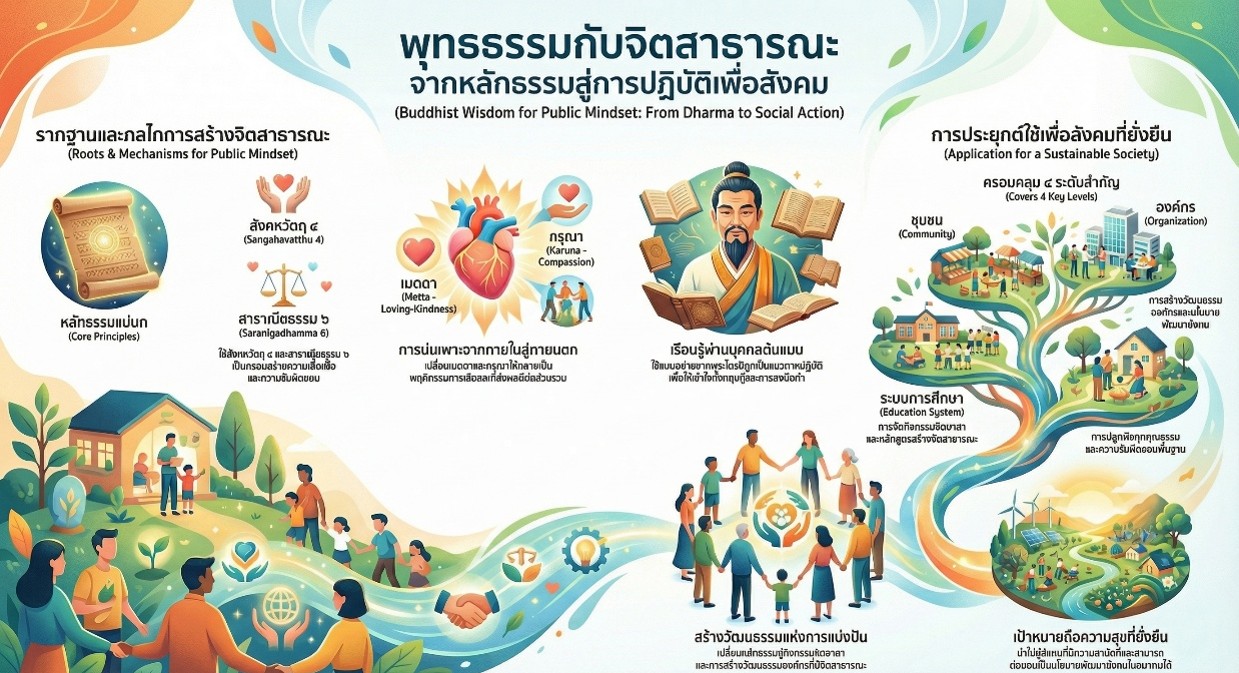
This research article has 2 objectives: (1) study the Buddhist principles that play a role in enhancing public mind as appearing in the Tipitaka and 2) study the application of the said Buddhist principles to enhance public mind in the context of Thai society. This research is a qualitative research in the form of documentary research using primary sources from the Tipitaka and the Thai-language commentary of Mahachulalongkornrajavidyalaya University as well as related academic documents. The data analysis uses the content analysis process to synthesize the principles related to the development of public mind.
The research results found that the Buddhist principles that appear in the Tripitaka, such as the four Sanghavatthu, namely Dana (giving), Piya Vachā (beloved speech), Atthachariya (beneficial conduct), and Samānattata (constant behavior), as well as the six Saraniya Dhamma, consisting of Metta-kāyakamma, Metta-vācīkamma, Metta-manokamma, Sa-thāra-nāya, Bhokita, Sila-samanyata, and Ditthi-samanyata, systematically develop society. The Tripitaka has the potential to promote public consciousness of individuals and to apply the Buddhist principles to enhance public consciousness that appear in, especially when integrated with modern knowledge such as community psychology, social development, and the use of role models who put the principles into practice. It should begin with the development of individuals' minds, behaviors, and social responsibility in the long term. This research has generated integrated knowledge between "Buddhist principles" and "the process of fostering civic responsibility," resulting in a model for applying Buddhist principles to cultivate civic responsibility.
Article Details

This work is licensed under a Creative Commons Attribution-NonCommercial-NoDerivatives 4.0 International License.
References
ประมูล สารพันธ์. “ความรู้เบื้องต้นเกี่ยวกับพระไตรปิฎก: ความสำคัญของพระไตรปิฎก”. [ออนไลน์]. แหล่งที่มา: http://oldweb.mcu.ac.th/mcutrai/menu2/menu2_2.htm. [2 เมษายน 2568].
พระพรหมคุณาภรณ์ (ป.อ. ปยุตฺโต). พุทธธรรม. กรุงเทพมหานคร: โรงพิมพ์มหาจุฬาลงกรณราชวิทยาลัย, 2559.
พระมหาหรรษา ธมฺมหาโส. พุทธธรรมกับการพัฒนาสังคม. กรุงเทพมหานคร: โรงพิมพ์มหาจุฬาลงกรณราชวิทยาลัย, 2562.
มหาจุฬาลงกรณราชวิทยาลัย. พระไตรปิฎกภาษาไทย ฉบับมหาจุฬาลงกรณราชวิทยาลัย. กรุงเทพมหานคร: โรงพิมพ์มหาจุฬาลงกรณราชวิทยาลัย, 2539.
Charoensiri, P. Buddhist Ethical Principles in Community Development. Bangkok: Dhamma for Society Press, 2025.
Phrom-in, T. “Buddhist Virtues and Citizenship: Integrating Dhamma into Educational Systems”. Journal of Buddhist Education Studies. Vol. 11 No. 2 (2024): 44–59.
Sirikul, A. and Jaroensuk, K. “Youth Ethics and Public Consciousness in Contemporary Thai Society”. Journal of Social and Cultural Studies. Vol. 9 No. 1 (2014): 25–41.
