An Analysis of Right View in Enhancing the Quality of Life of Older Persons in Thai Society
Article Sidebar
Main Article Content
Abstract
This research article has two objectives: (1) to study Right View (Sammā-diṭṭhi) in Buddhist scriptures and the quality of life of older adults in Thai society, and (2) to analyze the role of Right View in enhancing the quality of life of older adults in Thai society. This study employed a qualitative research design using a documentary research method. The research methodology involved collecting data from both primary and secondary sources, followed by data analysis, synthesis of findings, and descriptive presentation.
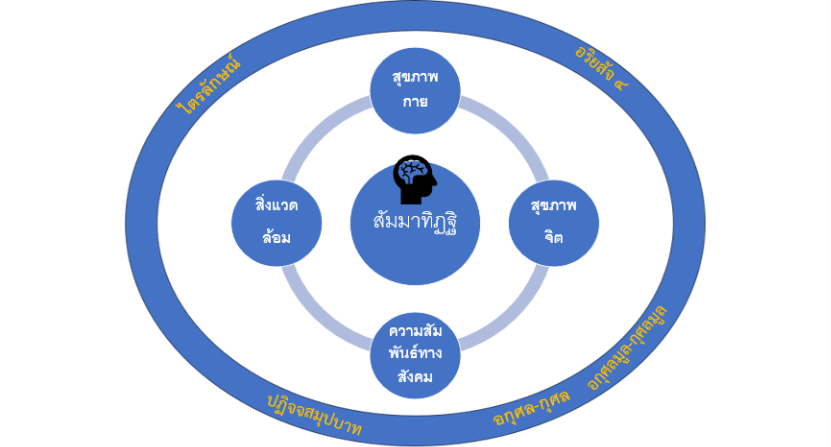
The findings revealed that Right View (Sammā-diṭṭhi) refers to correct understanding and is a fundamental principle in Buddhism, widely discussed in the Tipiṭaka. In particular, within the Noble Eightfold Path, Right View is regarded as the first element, comparable to the dawn that leads to proper learning and practice of the Dhamma. The comprehensive meaning of Right View encompasses wisdom that correctly understands the Four Noble Truths, the Three Characteristics (Tilakkhaṇa), and Dependent Origination (Paṭiccasamuppāda), as well as knowledge of unwholesome states (akusala) and their roots, and wholesome states (kusala) and their roots. These elements represent the core doctrines of Buddhism. In the Tipiṭaka, Right View is classified into two levels: mundane right view (lokiya sammā-diṭṭhi) and supramundane right view (lokuttara sammā-diṭṭhi). Right View can be applied in accordance with an individual’s experience, knowledge, and understanding. The effects of Right View on enhancing the quality of life of older adults in Thai society can be categorized into four main domains: physical health, mental health, social relationships, and environment. Regarding physical health, Right View enables older adults to accept physical decline with an understanding of impermanence and encourages appropriate health care practices. In terms of mental health, Right View fosters acceptance of change and reduces attachment to the past, allowing older adults to live happily in the present moment. In the domain of social relationships, Right View acts as a bridge that strengthens connections within families and communities. Concerning the environment, Right View promotes responsibility toward the environment and natural resources, as well as appropriate management of personal assets, enabling older adults to maintain self-reliance. This ultimately leads to stability and happiness in life.
Article Details

This work is licensed under a Creative Commons Attribution-NonCommercial-NoDerivatives 4.0 International License.
References
กนกวรรณ เหลืองมงคลเลิศ. “สังคมสูงวัย คนแก่รวย-จนมีเท่าไร อยู่ที่ไหน”. [ออนไลน์]. แหล่งที่มา: https://thaipublica.org/2024/03/infographic-aged-society/. [11 มิถุนายน 2569].
กรมกิจการผู้สูงอายุ. สถานการณ์ผู้สูงอายุไทย พ.ศ. 2565. กรุงเทพมหานคร: บริษัท อมรินทร์ คอร์เปอเรชั่นส์ จำกัด (มหาชน), 2566.
จารุวรรณ ศรีภักดี. “การขับเคลื่อนมาตรการรองรับสังคมสูงวัยคนไทยอายุยืนของประเทศไทยไปสู่การปฏิบัติอย่างมีประสิทธิภาพ”. [ออนไลน์]. แหล่งที่มา: https://www.dop.go.th/th/know/3/1649. [11 มิถุนายน 2569].
ประพันธ์ ศุภษร. พระพุทธศาสนาเถรวาท. พิมพ์ครั้งที่ 1. พระนครศรีอยุธยา: โรงพิมพ์มหาจุฬาลงกรณราชวิทยาลัย, 2564.
พระไพศาล วิสาโล. อยู่กับความทุกข์อย่างเข้าใจ. กรุงเทพมหานคร: เครือข่ายพุทธิกา, 2556.
พระพรหมคุณาภรณ์ (ป.อ. ปยุตฺโต). พุทธธรรม (ฉบับปรับปรุงและขยายความ). กรุงเทพมหานคร: มหาจุฬาลงกรณราชวิทยาลัย, 2546.
สมเด็จพระญาณสังวร (เจริญ สุวัฑฒนมหาเถระ). สัมมาทิฏฐิ ตามพระเถราธิบายของท่านพระสารีบุตรเถระ. พิมพ์ครั้งที่ 7. นครปฐม: โรงพิมพ์มหามกุฏราชวิทยาลัย, 2553.
สำนักงานคณะกรรมการพัฒนาการเศรษฐกิจและสังคมแห่งชาติ และคณะทำงานจัดทำรายงานสุขภาพคนไทย. “อนาคตของผู้สูงอายุไทย”. [ออนไลน์]. แหล่งที่มา: https://www.thaihealthreport.com/th/articles_detail.php?id=155. [11 มิถุนายน 2569].
World Health Organization (WHO). WHOQOL: Measuring Quality of Life. Geneva: World Health Organization, 1997.
