An empowerment of universal love based on the Buddhist principles
Article Sidebar
Main Article Content
Abstract
This research article aims to: 1) to study the universal love in a modern society and Buddhism, and 2) to study the empowerment of universal love based on the Buddhist principles. This is a qualitative research done by studying related documentaries, Tipitฺaka, Commentaries and Sub-commentaries. In this research the descriptive method was used to provide the research findings.
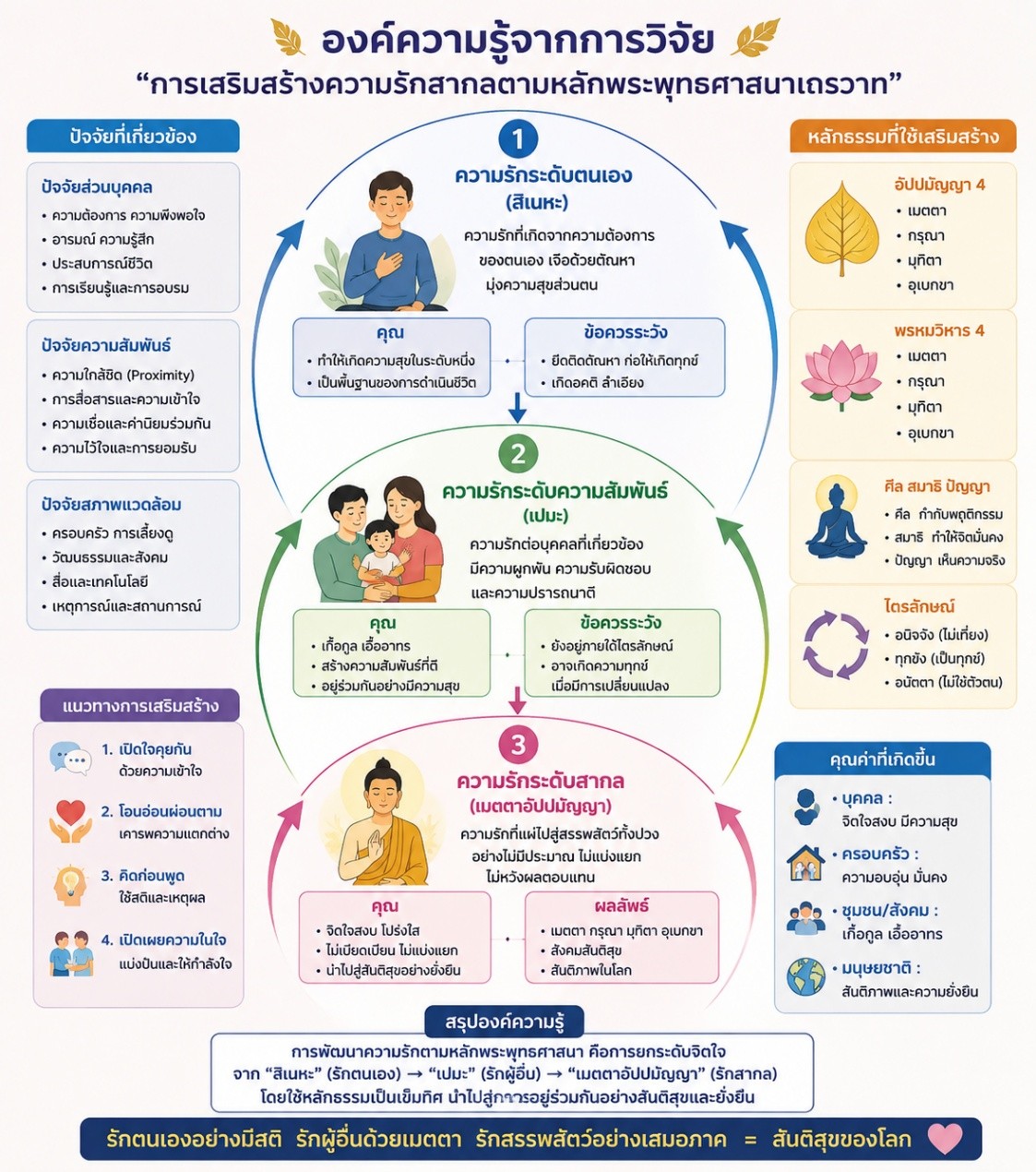
In the research, it was found that the universal love in a modern society is obviously caused by various factors, especially proximity; such a love varies in terms of passionate love, lust, companionship, and friendship. Such love, if it needs to be the forever one, must be promoted through four kinds of conditions: 1) openness, 2) flexibility, 3) thinking before speaking, and 4) no inner secrecy. In strengthening it, both minds need to follow the principle of loving kindness. As regards the universal love in Buddhism, it appears that there are many types of virtues where love can be cultivated; love is regarded as the impermanent phenomena arising depending upon the cause and effect, here it points to ‘Metta’ as the proof of love comprising of: 1) passion, 2) love, 3) will, and 4) loving kindness. They become important to love in Buddhism.
As far as an empowerment of universal love based on the Buddhist principles is concerned, it shows that since human beings come to live together as a community, then the universal love plays a crucial role in human society especially general youths and people; it needs certain principles to be used as guidelines where body and speech can be morally controlled so that it can leads to the good value called “love”. Here the sublime states of mind are required to be applied into the love: 1) self-love; it embraces the passion, 2) other-love; it refers to love where they used to stay together in the past and thereby supporting one another in the present, and 3) love as the loving kindness; this kind of love is unlimited, unconditioned and undivided or called ‘Mettaappamañña’.
Article Details

This work is licensed under a Creative Commons Attribution-NonCommercial-NoDerivatives 4.0 International License.
References
กอตต์แมน, จอห์น เอ็ม. และ นาน ซิลเวอร์. หลัก 7 ประการเพื่อชีวิตคู่ที่มีความสุข. แปลโดย ศิริลักษณ์ ตันศิริ. กรุงเทพมหานคร: อมรินทร์, 2547.
จำนงค์ ทองประเสริฐ (ศ.พิเศษ, ป.ธ.9, ราชบัณฑิต), ปรัชญาตะวันตกสมัยโบราณ, พิมพ์ครั้งที่ 3, (กรุงเทพมหานคร: โรงพิมพ์มหาจุฬาลงกรณราชวิทยาลัย, 2546), หน้า 231.
พระเทพเวที (ประยุทธ์ ปยุตฺโต). พุทธธรรม ฉบับปรับขยาย. พิมพ์ครั้งที่ 11. กรุงเทพมหานคร: มหาจุฬาลงกรณราชวิทยาลัย, 2546.
พระพรหมคุณาภรณ์ (ป.อ. ปยุตฺโต). พจนานุกรมพุทธศาสตร์ ฉบับประมวลธรรม. พิมพ์ครั้งที่ 34. กรุงเทพมหานคร: ผลิธัมม์, 2559.
พระมหาสมบูรณ์ วุฑฺฒิกโร. “การประยุกต์ใช้หลักพรหมวิหาร 4 เพื่อการอยู่ร่วมกันอย่างสันติในสังคมไทย.” วารสารพุทธศาสตร์ศึกษา 8, ฉบับที่ 2 (2560): 45–58.
พระมหาหรรษา ธมฺมหาโส. “พุทธสันติวิธีกับการสร้างสันติสุขในสังคมไทย.” วารสารสันติศึกษาปริทรรศน์ มจร 3, ฉบับที่ 1 (2558): 1–15.
มหาวิทยาลัยมหาจุฬาลงกรณราชวิทยาลัย. พระไตรปิฎกภาษาไทย ฉบับมหาจุฬาลงกรณราชวิทยาลัย. กรุงเทพมหานคร: โรงพิมพ์มหาจุฬาลงกรณราชวิทยาลัย, 2539.
มหาวิทยาลัยมหาจุฬาลงกรณราชวิทยาลัย. อรรถกถาภาษาบาลี ฉบับบมหาจุฬาอฏฺกถา. การุงเทพมหานคร: โรงพิมพ์มหาจุฬาลงกรณราชวิทยาลัย. โรงพิมพ์วิญญาณ, 2532-2534.
วศิน อินทสระ, ธรรมและชีวิต, พิมพ์ครั้งที่ 2, กรุงเทพมหานคร: กมลการพิมพ์, 2527.
Hatfield, Elaine, and Richard L. Rapson. Love, Sex, and Intimacy: Their Psychology, Biology, and History. New York: HarperCollins College Publishers, 1993.
Sternberg, Robert J. “A Triangular Theory of Love.” Psychological Review. 93, no. 2 (1986): 119–135.
