
การยอมรับเทคโนโลยีและคุณค่าตราสินค้าที่ส่งผลต่อความตั้งใจซื้อไอแพด (iPad) ของนักศึกษาระดับอุดมศึกษาในจังหวัดสงขลา
Article Sidebar
Main Article Content
บทคัดย่อ
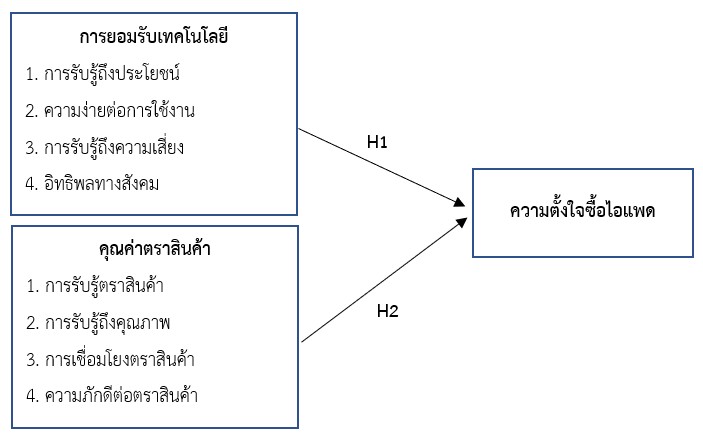
งานวิจัยฉบับนี้มีวัตถุประสงค์เพื่อ (1) ศึกษาการยอมรับเทคโนโลยีที่ส่งผลต่อความตั้งใจซื้อไอแพด (iPad) ของนักศึกษาระดับอุดมศึกษา ในจังหวัดสงขลา และ (2) ศึกษาคุณค่าตราสินค้าที่ส่งผลต่อความตั้งใจซื้อไอแพดของนักศึกษาระดับอุดมศึกษา ในจังหวัดสงขลา กลุ่มตัวอย่าง คือ นักศึกษาของมหาวิทยาลัยในพื้นที่จังหวัดสงขลา จำนวน 400 คน โดยการสุ่มตัวอย่างแบบหลายขั้นตอน เครื่องมือที่ใช้ในการวิจัยเป็นแบบสอบถาม ซึ่งมีข้อคำถามแบบเลือกตอบและแบบวัดประมาณค่า 5 ระดับ สถิติที่ใช้ในการวิเคราะห์ข้อมูล ประกอบด้วย ค่าความถี่ ค่าร้อยละ ค่าสัมประสิทธิ์สหสัมพันธ์ และการวิเคราะห์การถดถอยพหุคูณ ผลการวิจัยพบว่า การยอมรับเทคโนโลยีมีอิทธิพลเชิงบวกต่อความตั้งใจซื้อไอแพดของนักศึกษาระดับอุดมศึกษาในจังหวัดสงขลาอย่างมีนัยสำคัญทางสถิติ โดยตัวแปรที่มีอิทธิพลสูงสุด ได้แก่ การรับรู้ถึงประโยชน์ รองลงมาคือ การรับรู้ถึงความเสี่ยง ความง่ายต่อการใช้งาน และอิทธิพลทางสังคม ตามลำดับ โดยแบบจำลองสามารถอธิบายความแปรปรวนของความตั้งใจซื้อได้ร้อยละ 61 ขณะเดียวกัน คุณค่าตราสินค้าพบว่ามีอิทธิพลเชิงบวกต่อความตั้งใจซื้ออย่างมีนัยสำคัญเช่นเดียวกัน โดยการรับรู้ถึงคุณภาพเป็นปัจจัยที่มีอิทธิพลสูงสุด รองลงมาคือ ความภักดีต่อตราสินค้า การเชื่อมโยงตราสินค้า และการรับรู้ตราสินค้า ตามลำดับ โดยแบบจำลองสามารถอธิบายความแปรปรวนของความตั้งใจซื้อได้ร้อยละ 68 ผลการวิจัยสะท้อนให้เห็นว่า ความตั้งใจซื้อไอแพดของนักศึกษาเกิดจากการประเมินร่วมกันระหว่างปัจจัยด้านเทคโนโลยีและคุณค่าทางตราสินค้าอย่างเป็นระบบ
DOI: https://doi.org/10.14456/iaj.2026.2
Article Details
เอกสารอ้างอิง
มหาวิทยาลัยสงขลานครินทร์. (2567). รายงานสถิตินักศึกษาระดับอุดมศึกษา. ผู้แต่ง.
มหาวิทยาลัยทักษิณ. (2568). สถิตินิสิตปัจจุบัน วิทยาเขตสงขลา. ผู้แต่ง.
มหาวิทยาลัยหาดใหญ่. (2567). รายงานข้อมูลนักศึกษา. ผู้แต่ง.
มหาวิทยาลัยราชภัฏสงขลา. (2567). ข้อมูลนักศึกษา ปีการศึกษา 2567. ผู้แต่ง.
มหาวิทยาลัยเทคโนโลยีราชมงคลศรีวิชัย. (2567). ฐานข้อมูลสารสนเทศอุดมศึกษา. ผู้แต่ง.
สำนักงานคณะกรรมการกิจการกระจายเสียง กิจการโทรทัศน์ และกิจการโทรคมนาคมแห่งชาติ. (2567). รายงานการสำรวจการมีการใช้และการเข้าถึงโทรคมนาคมของประชาชน พ.ศ. 2567. https://www .nbtc.go.th
สำนักงานสภาพัฒนาการเศรษฐกิจและสังคมแห่งชาติ. (2564). รายงานความเหลื่อมล้ำทางดิจิทัลของประเทศไทย. ผู้แต่ง.
Aaker, D. A. (1991). Managing brand equity: Capitalizing on the value of a brand name. Free Press.
Canalys. (2022). Worldwide PC and tablet market share: Q1 2022. https://www.canalys.com
Cochran, W. G. (1977). Sampling techniques (3rd ed.). John Wiley & Sons.
Davis, F. D. (1989). Perceived usefulness, perceived ease of use, and user acceptance of information technology. MIS Quarterly, 13(3), 319–340.
Dodds, W. B., Monroe, K. B., & Grewal, D. (1991). Effects of price, brand, and store information on buyers’ product evaluations. Journal of Marketing Research, 28(3), 307–319.
Fishbein, M., & Ajzen, I. (1975). Belief, attitude, intention and behavior: An introduction to theory and research. Reading, MA: Addison-Wesley.
Keller, K. L. (2013). Strategic brand management: Building, measuring, and managing brand equity (4th ed.). Pearson Education.
Lim, L., Ong, C., Teo, P., & Theresa, H. (2024). Online purchase intention of digital products among university students. Business Management and Strategy. https://doi.org/10.5296/bms.v15i1.21869
OECD. (2021). Education at a glance 2021: OECD indicators. OECD Publishing.
Rakib, M., Pramanik, S., Amran, M., Islam, M., & Sarker, M. (2022). Factors affecting young customers’ smartphone purchase intention during Covid-19 pandemic. Heliyon, 8. https://doi.org/10.1016/j.heliyon.2022.e10599
Risdayanti, R., Titing, A., & Ismanto, I. (2025). The influence of brand image and product quality perception on consumer purchase intention for Axioo Laptops. Jurnal Manajemen, Bisnis dan Kewirausahaan. https://doi.org/10.55606/jumbiku.v5i1.5469
UNESCO. (2020). Education in a post-COVID world: Nine ideas for public action. Author.
Venkatesh, V., & Davis, F. D. (2000). A theoretical extension of the technology acceptance model: Four longitudinal field studies. Management Science, 46(2), 186–204.
Wang, F., Wijaya, T., Habibi, A., & Liu, Y. (2022). Predictors influencing urban and rural area students to use tablet computers as learning tools: A combination of UTAUT and TTF models. Sustainability. https://doi.org/10.3390/su142113965
Wu, L., & Chen, J. (2017). Purchase intention of mobile devices: The role of perceived value and technology acceptance. Telematics and Informatics, 34(2), 153–163.
Yoo, B., & Donthu, N. (2001). Developing and validating a multidimensional consumer-based brand equity scale. Journal of Business Research, 52(1), 1–14.
