
ความพร้อมด้านเทคโนโลยีดิจิทัลต่อความได้เปรียบทางการแข่งขัน ของสถานประกอบการยานยนต์สมัยใหม่
Article Sidebar
Main Article Content
บทคัดย่อ
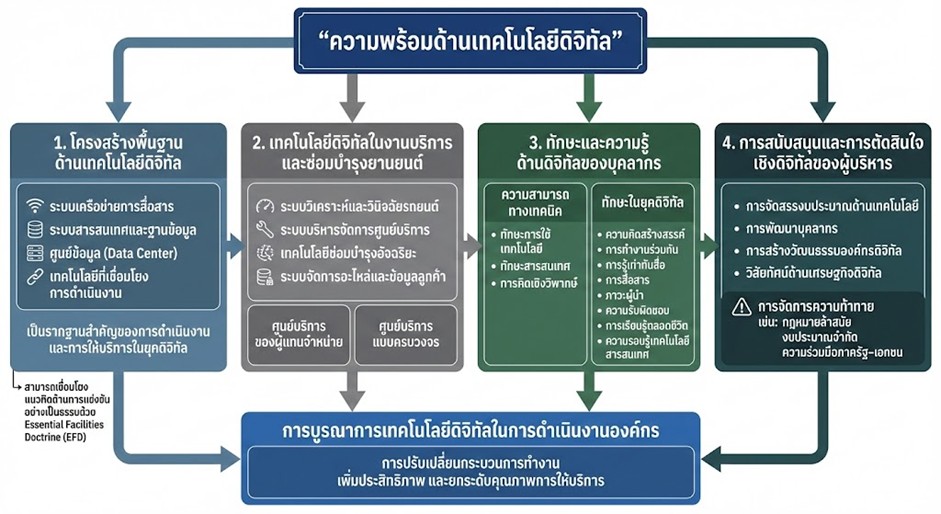
บทความวิชาการนี้มีวัตถุประสงค์เพื่อศึกษาระดับความพร้อมด้านเทคโนโลยีดิจิทัลต่อความได้เปรียบทางการแข่งขันของสถานประกอบการยานยนต์สมัยใหม่ ท่ามกลางการเปลี่ยนแปลงสู่ยุคดิจิทัลและยานยนต์ไฟฟ้า (EV) การศึกษาได้ทำการสังเคราะห์แนวคิดและทฤษฎีที่เกี่ยวข้องได้แก่ ทฤษฎีมุมมองฐานทรัพยากร ทฤษฎีความได้เปรียบทางการแข่งขัน และแนวคิดความพร้อมด้านเทคโนโลยีดิจิทัล เพื่อสร้างกรอบแนวคิดในการวิเคราะห์ ผลการศึกษาพบว่า ระดับความพร้อมด้านเทคโนโลยีดิจิทัล ซึ่งประกอบด้วยความพร้อมด้านโครงสร้างพื้นฐานด้านเทคโนโลยีดิจิทัล ความพร้อมด้านเทคโนโลยีดิจิทัลที่ใช้ในงานบริการและซ่อมบำรุงยานยนต์ ความพร้อมด้านทักษะและความรู้ด้านดิจิทัลของบุคลากร และความพร้อมด้านการสนับสนุนและการตัดสินใจเชิงดิจิทัลของผู้บริหาร เป็นทรัพยากรเชิงกลยุทธ์ที่สำคัญอย่างยิ่ง การมีทรัพยากรเหล่านี้จะนำไปสู่การสร้างความได้เปรียบทางการแข่งขันที่ยั่งยืนให้แก่องค์กร โดยช่วยเพิ่มประสิทธิภาพในการดำเนินงานและคุณภาพการบริการสร้างความแตกต่างจากคู่แข่ง และทำให้สามารถตอบสนองต่อความต้องการของตลาดที่เปลี่ยนแปลงไปอย่างรวดเร็วได้ นอกจากนี้ พบว่าองค์กรที่มีระดับความพร้อมสูงสามารถเพิ่มประสิทธิภาพการดำเนินงาน ยกระดับคุณภาพบริการ และตอบสนองความต้องการของลูกค้าได้อย่างรวดเร็ว ส่งผลให้เกิดความได้เปรียบทางการแข่งขันอย่างยั่งยืน ดังนั้น ระดับความพร้อมด้านเทคโนโลยีดิจิทัลจึงเป็นปัจจัยเชิงกลยุทธ์ที่สำคัญต่อการพัฒนาและความสามารถในการแข่งขันของสถานประกอบการยานยนต์สมัยใหม่
DOI: https://doi.org/10.14456/iaj.2026.6
Article Details
เอกสารอ้างอิง
กฤษณดล ชุมสาย ณ อยุธยา, จักรพันธ์ เอี่ยมศิริ, วรเชษฐ สมปานวัง, วุฒินันท์ วงมิ่ง, อาทิตย์ แทนคำ และจุฑามาศ ทวีไพบูลย์วงษ์. (2567). ปัจจัยความพร้อมด้านเทคโนโลยีที่มีผลต่อความตั้งใจในการใช้งานเทคโนโลยีการประชุมทางไกลของพนักงานในกลุ่มอุตสาหกรรมยานยนต์ จังหวัดชลบุรี. วารสาร วิทยาการจัดการ มหาวิทยาลัยเกษตรศาสตร์, 3(1), 20-36.
จันทิมา บุญอนันต์วงศ์. (2568). ความพร้อมด้านเทคโนโลยีดิจิทัลเพื่อการบริหารจัดการขององค์การบริหารส่วนจังหวัดนครราชสีมา. วารสารวิชาการรัฐศาสตร์และรัฐประศาสนศาสตร์, 7(6), 29-43.
ณัฐ สุขเวชชวรกิจ. (2567). หลักการการเข้าถึงโครงสร้างพื้นฐานในบริบทเศรษฐกิจดิจิตอล: แนวทางในอนาคตของกฎหมายแข่งขันทางการค้าไทย. วารสารวิชาการนิติศาสตร์ มหาวิทยาลัยทักษิณ, 12(1), 218-236.
นัฐกาน นัยนานนท์ และธิติยา ทองเกิน. (2567). การศึกษาความเป็นไปได้ในการลงทุนธุรกิจศูนย์บริการซ่อมบำรุงรถยนต์ไฟฟ้า ในอำเภอเมือง จังหวัดนครสวรรค์. วารสารนวัตศาสตร์สหวิทยาการ, 2(3), 27-45.
ปวริศร์ ดํารงพุฒิเมธา, พงศ์นเรศ แจ้งพรมมา, ผกาภรณ์ บุสบง และนพดล ไชยวัง. (2566). กระบวนการให้บริการและเพิ่มประสิทธิภาพเพื่อการตัดสินใจใช้บริการกิจการประเภทบำรุงรักษาและซ่อมแซมยานยนต์ ในเขตพื้นที่ภาคเหนือตอนบน. วารสารวิชาการสถาบันวิทยาการจัดการแห่งแปซิฟิค, 9(1), 524-538.
พระมหาอำพล ธนปญฺโญ (ชัยสารี), พระกฤษฎา ปญฺญาวโร (รูปดี), พระมหานิธิชัย ธมฺมปาโล (สุวรรณชาติ), สามเณรปิยะวัฒน์ วงคำจันทร์ และไตรวิทย์ เทษะนอก. (2567). ความเหลื่อมล้ำทางดิจิทัลในสังคมไทย. วารสารสหศาสตร์การพัฒนาสังคม, 2(5), 19-29.
ภัททิยา ชาญชัยธานนท์ และบริษัท สมาร์ทวันดิสทริบิวเตอร์ จํากัด. (2568). นโยบายเศรษฐกิจดิจิทัลกับการพัฒนาเมืองอัจฉริยะในประเทศไทย. วารสารสหวิทยาการนวัตกรรมปริทรรศน์, 8(6), 404-418.
วิจัยกรุงศรี. (2567, 10 กรกฎาคม ). แนวโน้มธุรกิจ/อุตสาหกรรม ปี 2567-2569: อุตสาหกรรมรถยนต์ไฟฟ้า. ธนาคารกรุงศรีอยุธยา. https://www.krungsri.com/th/research/industry/industryoutlook/hi-tech-industries/electric-vehicle/io/electric-vehicle-2024
สำนักงานส่งเสริมเศรษฐกิจดิจิทัล. (2566). ยานยนต์ไฟฟ้า (Electric Vehicle: xEV) กับอุตสาหกรรมดิจิทัล. depa.or.th.
สุกานดา สุขสมัคร, ประยงค์ มีใจซื่อ และนรพล จินันท์เดช. (2567). ผลกระทบของการปรับประยุกต์ใช้เทคโนโลยีดิจิทัลและบุพปัจจัยต่อการรับรู้ผลการดำเนินงานขององค์การในอุตสาหกรรมชิ้นส่วนยานยนต์ไทย. วารสารดุษฎีบัณฑิตทางสังคมศาสตร์, 14(2), 396-407.
Agustian, K., Mubarok, E. S., Zen, A., Wiwin, W., & Malik, A. J. (2023). The impact of digital transformation on business models and competitive advantage. Technology and Society Perspectives (TACIT), 1(2), 79–93. https://doi.org/10.61100/tacit.v1i2.55
Anning-Dorson, T. (2018). Innovation and competitive advantage creation. International Marketing Review, 35(4), 580-600.
Arbelo, A., Arbelo-Pérez, M., & Pérez-Gómez, P. (2020) . Profit efficiency as a measure of performance and frontier models: A resource-based view. BRQ Business Research Quarterly, 24(2), 143-159.
Asa, R. A., Nauk, J. P. W., & Hyelvet, J. N. (2026). Digital literacy for workforce readiness: Bridging the skills gap in the 21st century with Fs and Ts. International Journal of Innovation and Economic Development, 11(1), 7–22. https://doi.org/10.18775/ijied.1849-7551-7020.2015.311.2001
Barney, J. C. (1991). Firm Resources and Sustained Competitive Advantage. Journal of Management, 17(1), 99-120.
Bechchar, A., Soulhi, A., & Akourri, O. (2025). Digital transformation of manufacturing processes in the automotive industry. International Journal of Advanced Engineering and Management Research, 10(1), 31–47. https://doi.org/10.51505/ijaemr.2025.1002
Brix, J. (2017). Exploring knowledge creation processes as a source of organizational learning: A longitudinal case study of a public innovation project. Scandinavian Journal of Management, 33, 113-127.
Carvalho, A. M., Sampaio, P., Rebentisch, E., & Saraiva, P. (2022). Operational excellence, organizational culture and agility: The missing link. Total Quality Management & Business Excellence, 33(1-2), 142–165.
Chishamba, J. (2024). Conceptualizing sustainable competitive advantage: Theories, themes, and varying perspectives. Acta Universitatis Danubius Economica, 20(6), 191–215.
Chu, T. H., Chao, C. M., Liu, H. H., & Chen, D. F. (2022). Developing an Extended Theory of UTAUT2 Model to Explore Factors Influencing Taiwanese Consumer Adoption of Intelligent Elevators. SAGE Open, 12(4). https://doi.org/10.1177/21582440221142209
Deloitte. (2022). Global Automotive Consumer Study. https://www2.deloitte.com/global/en/pages/consumer-business/articles/global-automotive-consumer-study.html
Fabrizio, C., Kaczam, F., Moura, G., Silva, L., Silva, W., & Veiga, C. (2021). Competitive advantage and dynamic capability in small and medium-sized enterprises: A systematic literature review and future research directions. Review of Managerial Science, 16, 617-648.
Gruenewald, H., & Mueller, M. (2025). Challenges and Opportunities in Reskilling and Upskilling. Reskilling and Upskilling in a Globalized Economy: Essential Strategies for Workforce Transformation, 167-201.
Gupta, G. (2025). The revolutionary impact of AI in the automotive industry. International Journal of Science and Research Archive, 14(1), 1506–1512. https://doi.org/10.30574/ijsra.2025.14.1.0237
Jaroenwisan, K. & Thanasiri, J. (2017). The study of environmental factors of the venue for MICE industry in Southern Thailand. Journal of Management Sciences, 34(2), 109-133.
Komakech, R. A., Ombati, T. O., Kikwatha, R. W., & Wainaina, M. G. (2025). Resource-based view theory and its applications in supply chain management: A systematic literature review. Management Science Letters, 15, 261–272. https://doi.org/10.5267/j.msl.2024.6.004
Leong, M. Y., Kwan, J. H., & Ming, L. M. (2021). Technology readiness and UTAUT2 in e-wallet adoption in a developing country. F1000Res. 2021 Aug 27;10:863. https://doi.org/10.12688/f1000research.72853.1.
Liu, H., Zhang, B., Wu, V., Yang, X., & Wang, L. (2025). Review of digital twin in the automotive industry on products, processes and systems. International Journal of Automotive Manufacturing and Materials, 4(1), 6.
Nurjaman, R., Rahayu, A., Wibowo, L. A., Widjajani, & Mujiarto. (2021). The relationship between strategic agility and resource base view of the firm performance in manufacturing industry: The research framework. Journal of Physics: Conference Series, 2021, 1-7.
Porter, M. (1990). The Competitive Advantage of Nations. Free Press.
Priyamedha, A. A. H., Supartha, I. W. G., Dewi, I. G. A. M., & Riana, I. G. (2025). Mediate of digital organizational culture: Digital leadership on organizational performance. World Journal of Advanced Research and Reviews, 25(2), 1072–1084.
Siswadhi, F., Karimi, K., Kurdi, M., Widyastuti, E., & Koesmariadi, F. A. (2025). Leadership styles and organizational readiness in the era of digital transformation: A narrative review. Journal of Management Technology and Innovation, 3(3), 144–158.
Vuorikari, R., Punie, Y., Carretero Gomez, S., & Van den Brande, G. (2017). DigComp 2.1: The digital competence framework for citizens with eight proficiency levels and examples of use. Publications Office of the European Union.
Zhan, Y. (2025). Digital transformation in China: BYD as a case study for technological and strategic evolution. International Conference on Financial Risk and Investment Management, 628-638. https://doi.org/10.2991/978-94-6463-748-9_70
