
When Ikigai Fails to Converge: An Ethics of Incompleteness in Late-Capitalist Working Life
Article Sidebar
Main Article Content
Abstract
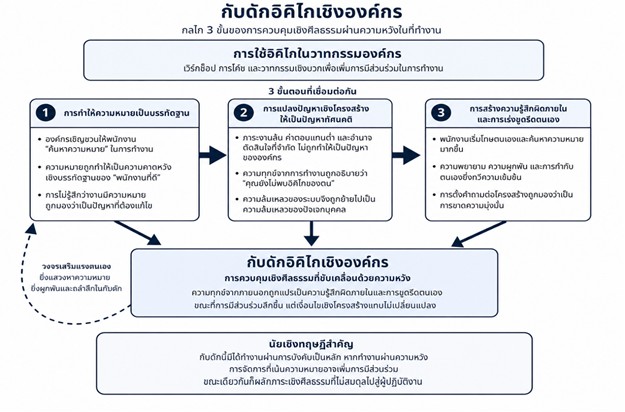
This theoretical article analyzes the moral tensions that emerge when ikigai—long understood in Japanese culture as the quiet sense that one's existence remains worth living—fails to align with the material conditions of work, organizational life, and economic survival under late capitalism. I argue that ikigai's migration from its ethical and communal moorings in Japanese thought into the discourse of neoliberal management has not been a simple act of cross-cultural translation. It has been a process of technologization, in which the meaning of life is reconfigured as an organizational resource. Drawing on Weberian account of vocational ethics (Calling), Durkheim's diagnosis of anomie, and Foucault's analysis of governmentality. This article synthesizes two new theoretical frameworks: the Non-Convergent Ikigai Framework, which explains lives where meaning, work, and survival move in a state of enduring tension; and the Organizational Ikigai Trap, which critiques the ethical limits of purpose-driven management. The theoretical proposal of the article is to reclaim ikigai as a humanistic ethic—not through demands for harmonious alignment of life, but through the acceptance of incompleteness, vulnerability, and values that lie beyond the logic of the market, positioning these as fundamental components of dignity in contemporary working life.
Article Details
References
Allan, B. A., Batz-Barbarich, C., Sterling, H. M., & Tay, L. (2019). Outcomes of meaningful work: A meta-analysis. Journal of Management Studies, 56(3), 500–528. https://doi.org/10.11 11/joms.12406
Arendt, H. (1998). The human condition (2nd ed., with introduction by M. Canovan). University of Chicago Press.
Bailey, C., Yeoman, R., Madden, A., Thompson, M., & Kerridge, G. (2019). A review of the empirical literature on meaningful work: Progress and research agenda. Human Resource Development Review, 18(1), 83–113. https://doi.org/10.1177/1534484318804 653
Bauman, Z. (2000). Liquid modernity. Polity Press.
Beck, U. (1992). Risk society: Towards a new modernity (M. Ritter, Trans.). Sage.
Berger, P. L. (1967). The sacred canopy: Elements of a sociological theory of religion. Doubleday.
Berger, P. L., & Luckmann, T. (1966). The social construction of reality: A treatise in the sociology of knowledge. Doubleday.
Chakrabarty, D. (2000). Provincializing Europe: Postcolonial thought and historical difference. Princeton University Press.
Durkheim, É. (1951). Suicide: A study in sociology (J. A. Spaulding & G. Simpson, Trans.). Free Press.
Fleming, P. (2017). The death of homo economicus: Work, debt and the myth of endless accumulation. Pluto Press.
Foucault, M. (2008). The birth of biopolitics: Lectures at the Collège de France, 1978–79 (G. Burchell, Trans.; M. Senellart, Ed.). Palgrave Macmillan.
Frankl, V. E. (2006). Man's search for meaning (I. Lasch, Trans.). Beacon Press.
Fraser, N. (2022). Cannibal capitalism: How our system is devouring democracy, care, and the planet—and what we can do about it. Verso.
García, H., & Miralles, F. (2017). Ikigai: The Japanese secret to a long and happy life (H. Cleary, Trans.). Penguin Books.
Han, B.-C. (2015). The burnout society (E. Butler, Trans.). Stanford University Press.
Imai, T., Osada, H., & Nishimura, Y. (2012). The reliability and validity of a new scale for measuring the concept of ikigai (Ikigai-9). Nihon Koshu Eisei Zasshi (Japanese Journal of Public Health), 59(7), 433–439. https://doi.org/10.11236/jph.59.7_433
Kamiya, M. (1966). Ikigai ni tsuite [On the meaning of life]. Misuzu Shobo.
Lips-Wiersma, M., & Wright, S. (2012). Measuring the meaning of meaningful work: Development and validation of the Comprehensive Meaningful Work Scale (CMWS). Group & Organization Management, 37(5), 655–685. https://doi.org/10.1177/10596011 12461578
Mathews, G. (1996). What makes life worth living? How Japanese and Americans make sense of their worlds. University of California Press.
Mogi, K. (2017). The little book of ikigai: The essential Japanese way to finding your purpose in life. Quercus.
Petriglieri, G., Ashford, S. J., & Wrzesniewski, A. (2019). Agony and ecstasy in the gig economy: Cultivating holding environments for precarious and personalized work identities. Administrative Science Quarterly, 64(1), 124–170. https://doi.org/10.1177/00018392187 59646
Sennett, R. (1998). The corrosion of character: The personal consequences of work in the new capitalism. W. W. Norton.
Standing, G. (2011). The precariat: The new dangerous class. Bloomsbury Academic.
Steger, M. F., Dik, B. J., & Duffy, R. D. (2012). Measuring meaningful work: The Work and Meaning Inventory (WAMI). Journal of Career Assessment, 20(3), 322–337. https://doi.org/10.1177/1069072711436160
Taylor, C. (2007). A secular age. Belknap Press of Harvard University Press.
Tronto, J. C. (2013). Caring democracy: Markets, equality, and justice. New York University Press.
Vallas, S. P., & Christin, A. (2018). Work and identity in an era of precarious employment: How workers respond to "personal branding" discourse. Work and Occupations, 45(1), 3–37. https://doi.org/10.1177/0730888417735662
Weber, M. (2001). The Protestant ethic and the spirit of capitalism (T. Parsons, Trans.). Routledge.
