
เมื่ออิคิไกไม่บรรจบ: จริยศาสตร์แห่งความไม่สมบูรณ์ในชีวิตการทำงาน ยุคทุนนิยมตอนปลาย
Article Sidebar
Main Article Content
บทคัดย่อ
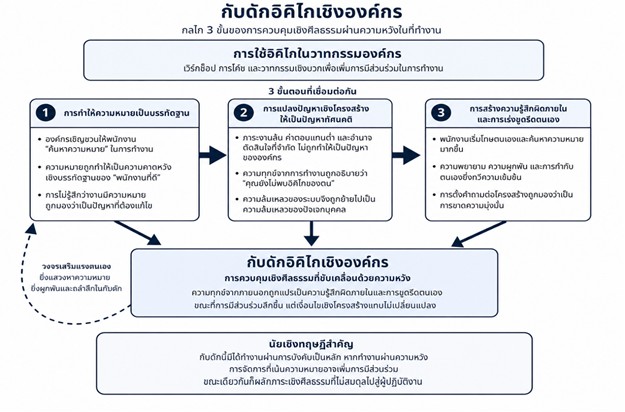
บทความวิชาการเชิงทฤษฎีนี้วิเคราะห์ความตึงเครียดเชิงศีลธรรมที่ปรากฏขึ้น เมื่อ "อิคิไก" (ikigai) ในฐานะอุดมคติของชีวิตที่มีความหมาย ไม่อาจบรรจบกับเงื่อนไขจริงของงาน องค์กร และการดำรงชีพในสังคมทุนนิยมตอนปลาย ผู้เขียนเสนอข้อโต้แย้งว่า การที่อิคิไกถูกเคลื่อนย้ายจากบริบทเชิงจริยศาสตร์และชุมชนญี่ปุ่นเข้าสู่วาทกรรมการจัดการแบบเสรีนิยมใหม่ มิได้เป็นเพียงการแปลข้ามวัฒนธรรม หากเป็นการ "ทำให้กลายเป็นเทคโนโลยี" ที่แปรความหมายของชีวิตให้กลายเป็นทรัพยากรเชิงองค์กร โดยอาศัยกรอบ Weberian ว่าด้วยจริยธรรมแห่งหน้าที่ (Calling) ผสานกับแนวคิดภาวะไร้บรรทัดฐาน (Anomie) ของ Durkheim และวิจารณญาณของ Foucault ว่าด้วยการกำกับตนเอง (Governmentality) บทความสังเคราะห์ขึ้นเป็น กรอบทฤษฎีใหม่สองชุด ได้แก่ Non-Convergent Ikigai Framework สำหรับอธิบายชีวิตที่ความหมาย งาน และการอยู่รอดเคลื่อนตัวในความตึงเครียดอย่างถาวร และ Organizational Ikigai Trap สำหรับวิพากษ์ข้อจำกัดเชิงจริยธรรมของการบริหารแบบเน้นเป้าหมาย (Purpose-driven Management) ข้อเสนอเชิงทฤษฎีของบทความคือ การคืนอิคิไกสู่จริยศาสตร์แห่งความเป็นมนุษย์ มิใช่ผ่านการเรียกร้องให้ชีวิตต้องลงตัว หากแต่ผ่านการยอมรับความไม่สมบูรณ์ ความเปราะบาง และคุณค่าที่อยู่นอกตรรกะตลาด ในฐานะองค์ประกอบสำคัญของศักดิ์ศรีในชีวิตการทำงานร่วมสมัย
Article Details
เอกสารอ้างอิง
Allan, B. A., Batz-Barbarich, C., Sterling, H. M., & Tay, L. (2019). Outcomes of meaningful work: A meta-analysis. Journal of Management Studies, 56(3), 500–528. https://doi.org/10.11 11/joms.12406
Arendt, H. (1998). The human condition (2nd ed., with introduction by M. Canovan). University of Chicago Press.
Bailey, C., Yeoman, R., Madden, A., Thompson, M., & Kerridge, G. (2019). A review of the empirical literature on meaningful work: Progress and research agenda. Human Resource Development Review, 18(1), 83–113. https://doi.org/10.1177/1534484318804 653
Bauman, Z. (2000). Liquid modernity. Polity Press.
Beck, U. (1992). Risk society: Towards a new modernity (M. Ritter, Trans.). Sage.
Berger, P. L. (1967). The sacred canopy: Elements of a sociological theory of religion. Doubleday.
Berger, P. L., & Luckmann, T. (1966). The social construction of reality: A treatise in the sociology of knowledge. Doubleday.
Chakrabarty, D. (2000). Provincializing Europe: Postcolonial thought and historical difference. Princeton University Press.
Durkheim, É. (1951). Suicide: A study in sociology (J. A. Spaulding & G. Simpson, Trans.). Free Press.
Fleming, P. (2017). The death of homo economicus: Work, debt and the myth of endless accumulation. Pluto Press.
Foucault, M. (2008). The birth of biopolitics: Lectures at the Collège de France, 1978–79 (G. Burchell, Trans.; M. Senellart, Ed.). Palgrave Macmillan.
Frankl, V. E. (2006). Man's search for meaning (I. Lasch, Trans.). Beacon Press.
Fraser, N. (2022). Cannibal capitalism: How our system is devouring democracy, care, and the planet—and what we can do about it. Verso.
García, H., & Miralles, F. (2017). Ikigai: The Japanese secret to a long and happy life (H. Cleary, Trans.). Penguin Books.
Han, B.-C. (2015). The burnout society (E. Butler, Trans.). Stanford University Press.
Imai, T., Osada, H., & Nishimura, Y. (2012). The reliability and validity of a new scale for measuring the concept of ikigai (Ikigai-9). Nihon Koshu Eisei Zasshi (Japanese Journal of Public Health), 59(7), 433–439. https://doi.org/10.11236/jph.59.7_433
Kamiya, M. (1966). Ikigai ni tsuite [On the meaning of life]. Misuzu Shobo.
Lips-Wiersma, M., & Wright, S. (2012). Measuring the meaning of meaningful work: Development and validation of the Comprehensive Meaningful Work Scale (CMWS). Group & Organization Management, 37(5), 655–685. https://doi.org/10.1177/10596011 12461578
Mathews, G. (1996). What makes life worth living? How Japanese and Americans make sense of their worlds. University of California Press.
Mogi, K. (2017). The little book of ikigai: The essential Japanese way to finding your purpose in life. Quercus.
Petriglieri, G., Ashford, S. J., & Wrzesniewski, A. (2019). Agony and ecstasy in the gig economy: Cultivating holding environments for precarious and personalized work identities. Administrative Science Quarterly, 64(1), 124–170. https://doi.org/10.1177/00018392187 59646
Sennett, R. (1998). The corrosion of character: The personal consequences of work in the new capitalism. W. W. Norton.
Standing, G. (2011). The precariat: The new dangerous class. Bloomsbury Academic.
Steger, M. F., Dik, B. J., & Duffy, R. D. (2012). Measuring meaningful work: The Work and Meaning Inventory (WAMI). Journal of Career Assessment, 20(3), 322–337. https://doi.org/10.1177/1069072711436160
Taylor, C. (2007). A secular age. Belknap Press of Harvard University Press.
Tronto, J. C. (2013). Caring democracy: Markets, equality, and justice. New York University Press.
Vallas, S. P., & Christin, A. (2018). Work and identity in an era of precarious employment: How workers respond to "personal branding" discourse. Work and Occupations, 45(1), 3–37. https://doi.org/10.1177/0730888417735662
Weber, M. (2001). The Protestant ethic and the spirit of capitalism (T. Parsons, Trans.). Routledge.
