
Artificial Intelligence-Driven Local Administration: A Synthesis of Key Components and Application Approaches
Article Sidebar
Main Article Content
Abstract
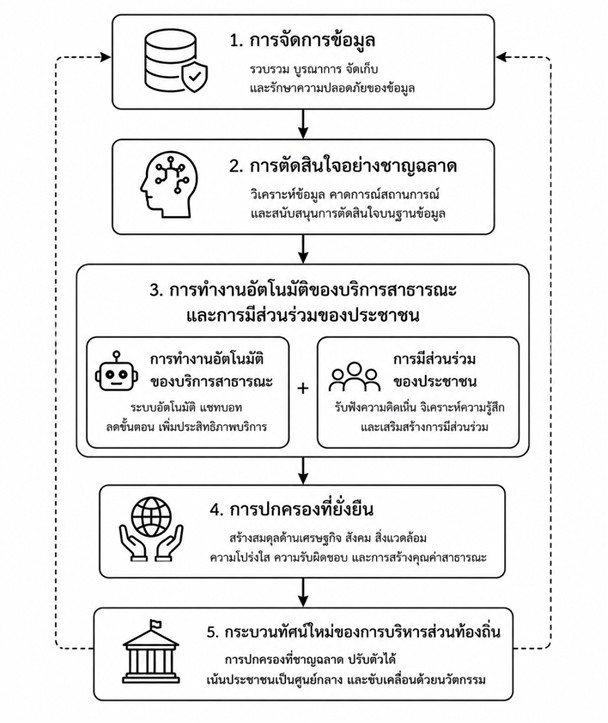
Artificial Intelligence (AI) is reshaping public administration by enabling data-driven decision-making, service automation, predictive management, and more responsive citizen engagement. This study aimed to (1) examine the role of artificial intelligence in driving a new paradigm shift in local governance, (2) synthesize the key components of artificial intelligence-driven local governance, and (3) develop a conceptual framework for applying artificial intelligence to local administration. A qualitative research approach was employed through a review and synthesis of literature on artificial intelligence, public administration, digital transition, smart governance, and local government management. The collected literature was analyzed using thematic statement analysis to identify recurring concepts, application areas, enabling conditions, governance risks, and implications for local administration. The findings are organized into five interrelated dimensions: data governance, intelligent decision-making, public service automation, citizen engagement, and sustainable governance. Together, these dimensions show how AI can enhance administrative efficiency, policy effectiveness, resource allocation, service accessibility, transparency, responsiveness, and evidence-based governance. The analysis also indicates that successful implementation depends on reliable data systems, organizational readiness, digital capabilities, ethical safeguards, privacy protection, algorithmic decision-making, and human oversight. The proposed framework links AI capability with public value creation, responsible governance, and sustainable local development. It provides a structured basis for policymakers and local officials to plan, evaluate, and govern AI deployment while maintaining accountability and citizen-centered governance.
Article Details
References
Barredo Arrieta, A., Díaz-Rodríguez, N., Del Ser, J., Bennetot, A., Tabik, S., Barbado, A., García, S., Gil-López, S., Molina, D., Benjamins, R., Chatila, R., & Herrera, F. (2020). Explainable artificial intelligence (XAI): Concepts, taxonomies, opportunities and challenges toward responsible AI. Information Fusion, 58, 82–115. https://doi.org/10.1016/j.inffus .2019.12.012
Bullock, J. B., Young, M. M., & Wang, Y. F. (2020). Artificial intelligence, bureaucratic form, and discretion in public service. Information Polity, 25(4), 491–506. https://doi.org/10.323 3/IP-200223
Criado, J. I., & Gil-Garcia, J. R. (2019). Creating public value through smart technologies and strategies: From digital services to artificial intelligence and beyond. International Journal of Public Sector Management, 32(5), 438–450. https://doi.org/10.1108/IJPSM-0 7-2019-0178
Hood, C. (1991). A public management for all seasons? Public Administration, 69(1), 3–19. https://doi.org/10.1111/j.1467-9299.1991.tb00779.x
Janssen, M., Brous, P., Estevez, E., Barbosa, L. S., & Janowski, T. (2020). Data governance: Organizing data for trustworthy artificial intelligence. Government Information Quarterly, 37(3), Article 101493. https://doi.org/10.1016/j.giq.2020.101493
Meijer, A., & Bolívar, M. P. R. (2016). Governing the smart city: A review of the literature on smart urban governance. International Review of Administrative Sciences, 82(2), 392–408. https://doi.org/10.1177/0020852314564308
Mergel, I., Edelmann, N., & Haug, N. (2019). Defining digital transformation: Results from expert interviews. Government Information Quarterly, 36(4), Article 101385. https://doi.org/10.1016/j.giq.2019.06.002
Osborne, S. P. (Ed.). (2010). The new public governance? Emerging perspectives on the theory and practice of public governance. Routledge.
Russell, S., & Norvig, P. (2021). Artificial intelligence: A modern approach (4th ed.). Pearson.
Sun, T. Q., & Medaglia, R. (2019). Mapping the challenges of artificial intelligence in the public sector: Evidence from public healthcare. Government Information Quarterly, 36(2), 368–383. https://doi.org/10.1016/j.giq.2018.09.008
Valle-Cruz, D., Criado, J. I., Sandoval-Almazan, R., & Ruvalcaba-Gomez, E. A. (2020). Assessing the public policy-cycle framework in the age of artificial intelligence: From agenda-setting to policy evaluation. Government Information Quarterly, 37(4), Article 101509. https://doi.org/10.1016/j.giq.2020.101509
Wirtz, B. W., & Müller, W. M. (2019). An integrated artificial intelligence framework for public management. Public Management Review, 21(7), 1076–1100. https://doi.org/10.1080/ 14719037.2018.1549268
Wirtz, B. W., Weyerer, J. C., & Geyer, C. (2019). Artificial intelligence and the public sector—Applications and challenges. International Journal of Public Administration, 42(7), 596–615. https://doi.org/10.1080/01900692.2018.1498103
Yigitcanlar, T., Kankanamge, N., Regona, M., Ruiz Maldonado, A., Rowan, B., Ryu, A., Desouza, K. C., Corchado, J. M., Mehmood, R., & Li, R. Y. M. (2020). Artificial intelligence technologies and related urban planning and development concepts: How are they perceived and utilized in Australia?. Journal of Open Innovation: Technology, Market, and Complexity, 6(4), Article 187. https://doi.org/10.3390/joitmc6040187
