
การบริหารส่วนท้องถิ่นที่ขับเคลื่อนด้วยปัญญาประดิษฐ์: การสังเคราะห์องค์ประกอบและแนวทางการประยุกต์ใช้
Article Sidebar
Main Article Content
บทคัดย่อ
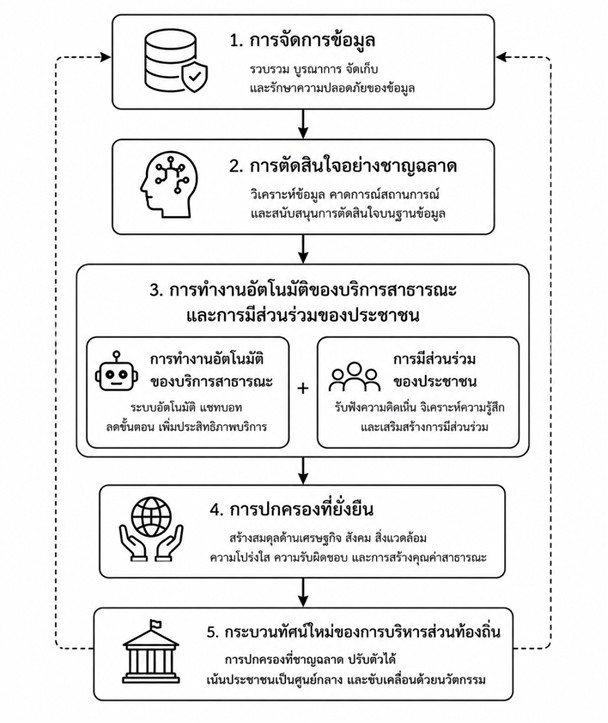
ปัญญาประดิษฐ์ (AI) กำลังเปลี่ยนแปลงการบริหารราชการแผ่นดินโดยการสนับสนุนการตัดสินใจบนพื้นฐานของข้อมูล การให้บริการเป็นไปโดยอัตโนมัติ การจัดการเชิงคาดการณ์ และการมีส่วนร่วมของประชาชนที่ตอบสนองได้ดียิ่งขึ้น การศึกษาครั้งนี้มีวัตถุประสงค์เพื่อ (1) ศึกษาบทบาทของปัญญาประดิษฐ์ในการขับเคลื่อนกระบวนทัศน์ใหม่ของการบริหารส่วนท้องถิ่น (2) สังเคราะห์องค์ประกอบสำคัญของการบริหารส่วนท้องถิ่นที่ขับเคลื่อนด้วยปัญญาประดิษฐ์ และ (3) พัฒนากรอบแนวคิดการประยุกต์ใช้ปัญญาประดิษฐ์สำหรับการบริหารส่วนท้องถิ่น การศึกษาครั้งนี้ใช้วิธีการวิจัยเชิงคุณภาพโดยการทบทวนและสังเคราะห์วรรณกรรมเกี่ยวกับปัญญาประดิษฐ์ การบริหารราชการแผ่นดิน การเปลี่ยนผ่านสู่ดิจิทัล การกำกับดูแลอัจฉริยะ และการบริหารส่วนท้องถิ่น วิเคราะห์วรรณกรรมที่รวบรวมได้โดยใช้การวิเคราะห์เนื้อหาเชิงธีมเพื่อระบุแนวคิดที่เกิดขึ้นซ้ำ ๆ พื้นที่การใช้งาน เงื่อนไขที่เอื้ออำนวย ความเสี่ยงด้านการกำกับดูแล และผลกระทบต่อการบริหารส่วนท้องถิ่น ผลการวิจัยจัดเรียงเป็นห้ามิติที่เกี่ยวข้องกัน ได้แก่ การกำกับดูแลข้อมูล การตัดสินใจอย่างชาญฉลาด การให้บริการสาธารณะเป็นไปโดยอัตโนมัติ การมีส่วนร่วมของประชาชน และการกำกับดูแลที่ยั่งยืน มิติเหล่านี้แสดงให้เห็นว่า AI สามารถปรับปรุงประสิทธิภาพการบริหาร ประสิทธิผลของนโยบาย การจัดสรรทรัพยากร การเข้าถึงบริการ ความโปร่งใส การตอบสนอง และการกำกับดูแลบนพื้นฐานของหลักฐานได้อย่างไร การวิเคราะห์ยังชี้ให้เห็นว่า การนำไปใช้ที่ประสบความสำเร็จขึ้นอยู่กับระบบข้อมูลที่เชื่อถือได้ ความพร้อมขององค์กร ความสามารถทางดิจิทัล การคุ้มครองด้านจริยธรรม การคุ้มครองความเป็นส่วนตัว ความรับผิดชอบต่อผลการตัดสินใจของอัลกอริทึม และการกำกับดูแลโดยมนุษย์ กรอบแนวคิดที่เสนอเชื่อมโยงความสามารถของ AI กับการสร้างคุณค่าสาธารณะ การบริหารการปกครองที่รับผิดชอบ และการพัฒนาท้องถิ่นอย่างยั่งยืน โดยให้พื้นฐานที่มีโครงสร้างสำหรับผู้กำหนดนโยบายและเจ้าหน้าที่ท้องถิ่นในการวางแผน ประเมิน และกำกับดูแลการนำ AI มาใช้ ในขณะที่ยังคงรักษาความรับผิดชอบและการบริหารที่เน้นประชาชนเป็นศูนย์กลาง
Article Details
เอกสารอ้างอิง
Barredo Arrieta, A., Díaz-Rodríguez, N., Del Ser, J., Bennetot, A., Tabik, S., Barbado, A., García, S., Gil-López, S., Molina, D., Benjamins, R., Chatila, R., & Herrera, F. (2020). Explainable artificial intelligence (XAI): Concepts, taxonomies, opportunities and challenges toward responsible AI. Information Fusion, 58, 82–115. https://doi.org/10.1016/j.inffus .2019.12.012
Bullock, J. B., Young, M. M., & Wang, Y. F. (2020). Artificial intelligence, bureaucratic form, and discretion in public service. Information Polity, 25(4), 491–506. https://doi.org/10.323 3/IP-200223
Criado, J. I., & Gil-Garcia, J. R. (2019). Creating public value through smart technologies and strategies: From digital services to artificial intelligence and beyond. International Journal of Public Sector Management, 32(5), 438–450. https://doi.org/10.1108/IJPSM-0 7-2019-0178
Hood, C. (1991). A public management for all seasons? Public Administration, 69(1), 3–19. https://doi.org/10.1111/j.1467-9299.1991.tb00779.x
Janssen, M., Brous, P., Estevez, E., Barbosa, L. S., & Janowski, T. (2020). Data governance: Organizing data for trustworthy artificial intelligence. Government Information Quarterly, 37(3), Article 101493. https://doi.org/10.1016/j.giq.2020.101493
Meijer, A., & Bolívar, M. P. R. (2016). Governing the smart city: A review of the literature on smart urban governance. International Review of Administrative Sciences, 82(2), 392–408. https://doi.org/10.1177/0020852314564308
Mergel, I., Edelmann, N., & Haug, N. (2019). Defining digital transformation: Results from expert interviews. Government Information Quarterly, 36(4), Article 101385. https://doi.org/10.1016/j.giq.2019.06.002
Osborne, S. P. (Ed.). (2010). The new public governance? Emerging perspectives on the theory and practice of public governance. Routledge.
Russell, S., & Norvig, P. (2021). Artificial intelligence: A modern approach (4th ed.). Pearson.
Sun, T. Q., & Medaglia, R. (2019). Mapping the challenges of artificial intelligence in the public sector: Evidence from public healthcare. Government Information Quarterly, 36(2), 368–383. https://doi.org/10.1016/j.giq.2018.09.008
Valle-Cruz, D., Criado, J. I., Sandoval-Almazan, R., & Ruvalcaba-Gomez, E. A. (2020). Assessing the public policy-cycle framework in the age of artificial intelligence: From agenda-setting to policy evaluation. Government Information Quarterly, 37(4), Article 101509. https://doi.org/10.1016/j.giq.2020.101509
Wirtz, B. W., & Müller, W. M. (2019). An integrated artificial intelligence framework for public management. Public Management Review, 21(7), 1076–1100. https://doi.org/10.1080/ 14719037.2018.1549268
Wirtz, B. W., Weyerer, J. C., & Geyer, C. (2019). Artificial intelligence and the public sector—Applications and challenges. International Journal of Public Administration, 42(7), 596–615. https://doi.org/10.1080/01900692.2018.1498103
Yigitcanlar, T., Kankanamge, N., Regona, M., Ruiz Maldonado, A., Rowan, B., Ryu, A., Desouza, K. C., Corchado, J. M., Mehmood, R., & Li, R. Y. M. (2020). Artificial intelligence technologies and related urban planning and development concepts: How are they perceived and utilized in Australia?. Journal of Open Innovation: Technology, Market, and Complexity, 6(4), Article 187. https://doi.org/10.3390/joitmc6040187
