
The Effectiveness of the 3Rs Concept in Reducing Waste Quantity Among Residents in Mueang Narathiwat District, Narathiwat Province
Article Sidebar
Main Article Content
Abstract
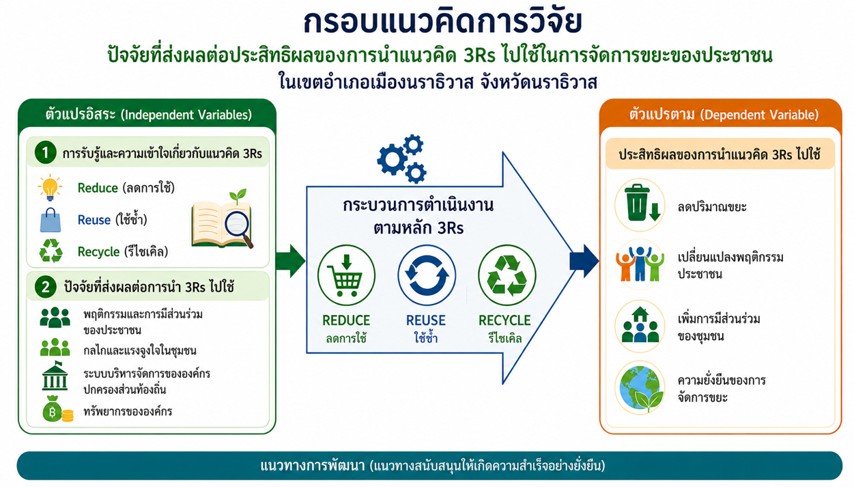
This research aimed to: 1) evaluate the effectiveness of applying the 3Rs concept, 2) examine the level of awareness and understanding of residents in Mueang Narathiwat District, Narathiwat Province, regarding the 3Rs concept, 3) analyze the factors affecting the application of the 3Rs concept among residence, and 4) propose guidelines and recommendations for developing the implementation of the 3Rs concept. This mixed-methods study collected quantitative data from 399 residents in Mueang Narathiwat District, with the sample size determined using the Taro Yamane formula and selected through multistage sampling, and qualitative data from in-depth interviews with 7 local government administrators. Quantitative data were analyzed using descriptive statistics while qualitative data were analyzed through content analysis.
The findings revealed that, from the perspective of local government administrators, the implementation of the 3Rs concept demonstrated a good level of effectiveness, although this varied according to the specific context of each area. Some areas achieved a concrete waste reduction of up to 50-60%. The determining factors for success were the level of community participation and the continuity of monitoring and evaluation. Residents' overall level of awareness and understanding of the 3Rs concept was high, and factors affecting the application of the 3Rs concept were also rated at a high level overall, with local regulations and measures exerting the strongest influence. In addition, local government administrators proposed four key development guidelines: 1) continuous education, particularly on recycling; 2) individual-level behavior change; 3) raising awareness and personal responsibility for one's own waste; and 4) expanding collaborative learning activities with other agencies or model communities. In conclusion, the 3Rs concept was effective in reducing waste quantity generated by residents in the study area. This success did not depend solely on residents' knowledge and understanding but was the result of a combination of structural factors, area-specific context, and continuity of monitoring and evaluation.
Article Details
References
กรมการเปลี่ยนแปลงสภาพภูมิอากาศและสิ่งแวดล้อม. (2567). Save โลกด้วยวิถี 3Rs: Reduce Reuse Recycle. https://www.dcce.go.th/3686/
กรมควบคุมมลพิษ. (2561). คู่มือปฏิบัติการ 3 ใช้ (3R) เพื่อจัดการขยะชุมชน. https://www.pcd.go.th/garbage/คู่มือปฏิบัติการ-3-ใช้-3r-เพ/
กรมควบคุมมลพิษ. (2563). ระบบสารสนเทศด้านการจัดการขยะมูลฝอยชุมชน จังหวัดนราธิวาส. https://thaimsw.pcd.go.th/provincedetail.php?id=96
กรมควบคุมมลพิษ. (2565). ระบบสารสนเทศด้านการจัดการขยะมูลฝอยชุมชน รายจังหวัด ปี 2565. https://thaimsw.pcd.go.th/report_country.php
กองสาธารณสุขและสิ่งแวดล้อม เทศบาลเมืองพังงา. (2562). ห้ามทิ้งขยะในที่สาธารณะ ฝ่าฝืนมีโทษปรับไม่เกิน 2,000 บาท. https://www.phangngacity.go.th/news/detail/6121
ไทยพีบีเอส. (2566, 20 กันยายน). อบต.ดอนแก้ว ชุมชนไร้ รถเก็บขยะ-ถังขยะ ต้นแบบท้องถิ่นจัดการขยะอย่างยั่งยืน. https://www.thaipbs.or.th/news/content/331844
เทศบาลเมืองวารินชำราบ. (2568). การให้บริการของเทศบาลเมืองวารินชำราบ. https://www.warincity. go.th/index.php?option=com_content&view=article&id=1132&Itemid=389
นพรัตน์ ชูโสด. (2567, 5 มิถุนายน). ขยะล้นเมือง คนไทยสร้างขยะเฉลี่ย 7.3 หมื่นตัน/วัน. ไทยพีบีเอส. https://www.thaipbs.or.th/news/content/340722
รติมา คชนันทน์. (2562). เศรษฐกิจหมุนเวียน (Circular Economy). สำนักวิชาการ สำนักงานเลขาธิการสภาผู้แทนราษฎร. https://prt.parliament.go.th/server/api/core/bitstreams/68b99d7a-bd1f-4 a21-a4d9-53448e105053/content
ลดาวัลย์ ไข่คำ. (2568, 11 มิถุนายน). ธรรมาภิบาลสิ่งแวดล้อมในยุค ขยะล้นเมือง : ทางออกที่ยั่งยืนอยู่ที่พลังการมีส่วนร่วมของประชาชน. SDG Move. https://www.sdgmove.com/2025/06/11/environ mental-governance-urban-waste-crisis/
สำนักงานเลขาธิการวุฒิสภา. (2567). แนวคิดและแนวทาง 3R (Reduce/Reuse/Recycle). https://www.senate.go.th/view/355/PRmedia
สำนักงานสถิติจังหวัดนราธิวาส. (2568). สถิติประชากรศาสตร์ ประชากรและเคหะ. https://narathiwat.nso.go.th/images/provincecialstaticalreport/2023/1.demographic_p op_hosting.pdf
องค์การบริหารส่วนตำบลกะลุวอ. (2568). แผนปฏิบัติการจัดการขยะมูลฝอยชุมชน "จังหวัดสะอาด" ตำบลกะลุวอ อำเภอเมือง จังหวัดนราธิวาส ประจำปี พ.ศ. 2568. https://kaluwo.go.th/modules/news/usefiles/67f8872001027.pdf
อุดมศักดิ์ สินธิพงษ์. (2565). การพัฒนากฎหมายเพื่อการบริหารจัดการขยะที่มุ่งสู่เศรษฐกิจหมุนเวียน. วารสารสิ่งแวดล้อมไทย, 26(1). https://thaienvi.com/article/view/330
เอกพงศ์ ภิรมย์วงศ์, ประจวบ แหลมหลัก และอรัณย์ภัค พิทักษ์พงษ์. (2568). ปัจจัยที่มีผลต่อการลดและการแยกขยะมูลฝอยในครัวเรือน ในเขตพื้นที่องค์การบริหารส่วนตำบลโป่งผา อำเภอแม่สาย จังหวัด เชียงราย. วารสารวิชาการสาธารณสุขชุมชน, 11(2), 188 - 199. https://he02.tci-thaijo.org/ index.php/ajcph/article/view/273079
Arenibafo, F. E. (2023). The 3Rs (Reduce, Reuse, Recycle) of waste management – An effective and sustainable approach for managing municipal solid waste in developing countries. Proceedings of the International Conference of Contemporary Affairs in Architecture and Urbanism (ICCAUA), 6(1), 383–398. https://doi.org/10.38027 /iccaua2023en0108
Sirilurt, P. (2022). พัฒนาอุตสาหกรรมผ่าน 'เศรษฐกิจหมุนเวียน' ดำเนินการอย่างไร? ให้บรรลุผลอย่างเป็นรูปธรรมระดับพื้นที่ ชวนค้นหาคำตอบจากงานวิจัยของ 'รศ. ดร.พีระ เจริญพร'. SDG Move. https://www.sdgmove.com/2022/12/09/industrial-development-implement-circular-economy/
