
The Pop Vocal Music Online Teaching Method on the TikTok Platform in China
Keywords:
TikTok, Vocal Music Instruction , Online Teaching, Digital Pedagogy , Music EducationAbstract
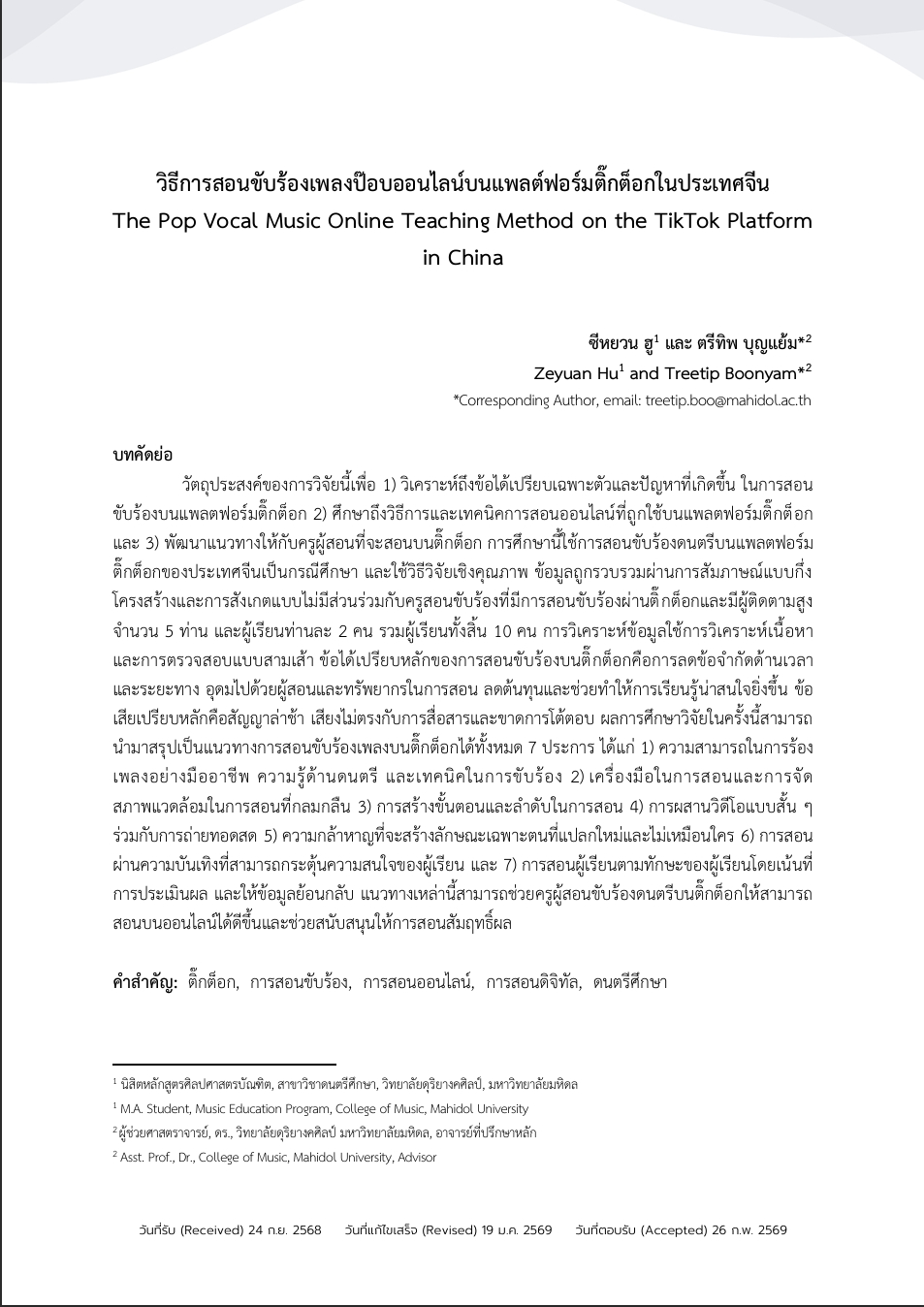
This study explores the opportunities and challenges associated with vocal music instruction on the TikTok platform. Utilizing a qualitative case study approach, it focuses on popular vocal music teaching practices in China. Data were gathered through semi-structured interviews and non-participated observations with five highly followed vocal music teachers on TikTok and their students at least 2 persons per teacher; total 10 students, and analyzed using content analysis and triangulation methods. The study identifies several advantages of TikTok-based vocal instruction, including the removal of time and location barriers, the availability of diverse teaching resources, reduced instructional costs, and enhanced student engagement. Conversely, the research highlights limitations such as signal latency, potential misinterpretation of vocal sound quality, and limited interactivity between instructors and learners. The study also examines instructional content, with an emphasis on mixed voice techniques commonly taught via the platform. As a result, seven key guidelines for effective vocal music teaching on TikTok are proposed: 1) professional vocal skills and musical literacy; 2) appropriate instructional equipment and a conducive learning environment; 3) structured and sequenced lesson planning; 4) integration of short videos and live streaming; 5) innovation and personal branding; 6) entertainment-based learning strategies; and 7) individualized instruction with an emphasis on assessment and feedback. These findings aim to provide practical insights for vocal music educators seeking to leverage TikTok as a pedagogical tool, and contribute to the broader discourse on digital music education.
References
Abidin, C., & Vizcaíno-Verdú, A. (2023, March 29). How ‘TeachTok’ is helping teachers connect with their students on TikTok. The Conversation. https://theconversation.com/how-teachtok-is-helping-teachers-connect-with-their-students-on-tiktok-202240
Bates, A. W. (2019). Teaching in a digital age: Guidelines for designing teaching and learning (2nd ed.). Tony Bates Associates Ltd. https://pressbooks.bccampus.ca/teachinginadigitalagev2/
Chen, M., Liu, S., & Li, X. (2023). Innovation strategy of music teaching in colleges and universities based on the view of new media. Frontiers in Educational Research, 6(5), 46-50. https://doi.org/10.25236/FER.2023.060509
Chen, X., & Wang, L. (2023). Short-form video platforms as supplementary tools for flipped learning: A case study of TikTok in vocal music education. International Journal of Educational Technology in Higher Education, 20(45), 1-16.
Condro, W., Mahmud, Z., Luluk, F., & Shuting, W. (2025). TikTok as an informal music learning platform: An analysis of the impact of music extracurricular activities on students of SMK 1 Pancasila Ambulu, Indonesia. Virtuoso: Jurnal Pengkajian dan Penciptaan Musik. 8(2), 105-123.
Ding, N., Xu, X., & Lewis, E. (2022). Short instructional videos for the TikTok generation. Journal of Education for Business, 98(4), 175–185. https://doi.org/10.1080/08832323.2022.21 03489
Hidayatullah, R., Jazuli, M., Suharto, S., & Syarif, M. I. (2021). Educators’ perceptions of TikTok as music instructional materials. ISET: International Conference on Science, Education and Technology, 7(1), 500–505.
Hu, T., Rasool, U., Wang, L., Chen, H., & Shi, H. (2025). The effectiveness of the TikTok flipped classroom method on students’ academic performance in folk art course. Acta Psychologica, 257, Article 105094. https://doi.org/10.1016/j.actpsy.2025.105094
Li, X. (2021). Analysis and prospect of music teaching on short video platform [In Chinese]. Chinese Music Journal, 4(1), 168–171.
Li, Y., & Zhang, Q. (2024). The application of TikTok in flipped classroom for music theory teaching. Journal of Music Education Technology, 18(3), 112-127.
O’Brien, H. L., Davoudi, N., & Nelson, M. (2025). TikTok as information space: A scoping review of information behavior on TikTok. Library & Information Science Research, 47(4), Article 101379. https://doi.org/10.1016/j.lisr.2025.101379
O’Leary, E. J. (2023). Music education on YouTube and the challenges of platformization. Action, Criticism, and Theory for Music Education, 22(4), 14–43. https://doi.org/10.22176/act22.4.14
Pasawano, T. (2015). Results of enhanced learning with the edutainment format. Procedia –Social and Behavioral Sciences, 176, 946–951. https://doi.org/10.1016/j.sbspro.2015.01.563
People’s Network Science and Technology Channel. (2019, August 28). Yisheng Ouba: Building a millionaire through Kuaishou's knowledge payment with vocal music lessons [In Chinese]. http://m.people.cn/n4/0/2019/0828/c157-13130509-2_2.html
Qiu, C. (2020). The importance of the American SLS vocal method in popular singing teaching [In Chinese]. Explorations in Music, 37(1), 120–124.
Ren, L. (2021). The value and strategy of TikTok software application in music teaching [In Chinese]. Journal of Kaifeng Vocational College of Culture & Art, 5(1), 145–146.
Shi, Y. (2023). The use of mobile internet platforms and applications in vocal training: Synergy of technological and pedagogical solutions. Interactive Learning Environments, 31(6), 3780-3791. https://doi.org/10.1080/10494820.2021.1943456
Siwei, Z., Pattananon, N., & Kumjudpanpai, S. (2023). The promotion music education through social media in China: A case study of TikTok platform. Journal of Modern Learning Development, 8(2), 422–429. retrieved from https://so06.tci-thaijo.org/index.php/jomld/article/view/259127
Wali, S. M. (2025). Impact of short educational videos on learning and retention in undergraduate pharmacology education: A cross-sectional study. BMC Medical Education, 25(1), 1747. https://doi.org/10.1186/s12909-025-08410-1
Weng, K. (2014). On the laws and characteristics of national vocal music teaching and its efficacy in teaching [In Chinese]. Art Exploration, 28(2).
Wicks, D. (2019). Seth Riggs—His CCM Legacy. Journal of Singing, 75(4), 449-453.
Yang, Y., Zhang, C., Zhang, S., & Shen, J. (2025). TikTok in higher education: A systematic review of disciplinary applications, learning outcomes, and implementation factors. Interactive Learning Environments, 1–21. https://doi.org/10.1080/10494820.2025.2564736
Zhao, Y. (2019). Self-media public account—A new approach to music education [Unpublished master’s thesis]. China Conservatory of Music.
Zhong, Y. & Shoa, X. (2025). Innovative models of music teaching in universities in the digital age. Region - Educational Research and Reviews, 7(7), 39 – 42. https://doi.org/10.32629/rerr.v7i7.4325.
Downloads
Published
How to Cite
Issue
Section
License
Copyright (c) 2026 Journal of Psychological Educational and Social Sciences Research

This work is licensed under a Creative Commons Attribution-NonCommercial-NoDerivatives 4.0 International License.