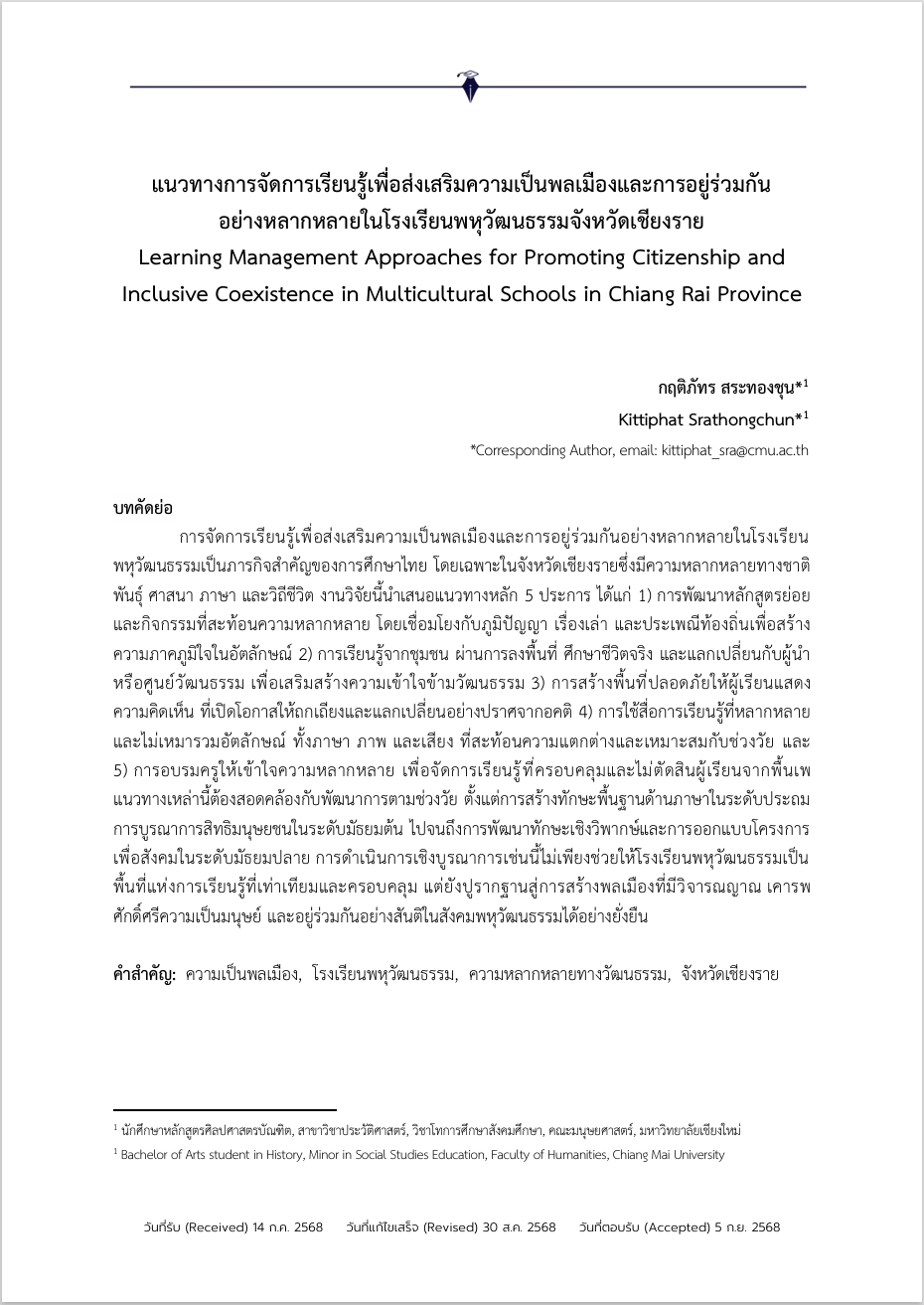
แนวทางการจัดการเรียนรู้เพื่อส่งเสริมความเป็นพลเมืองและการอยู่ร่วมกันอย่างหลากหลายในโรงเรียนพหุวัฒนธรรมจังหวัดเชียงราย
Learning Management Approaches for Promoting Citizenship and Inclusive Coexistence in Multicultural Schools in Chiang Rai Province
คำสำคัญ:
ความเป็นพลเมือง, โรงเรียนพหุวัฒนธรรม, ความหลากหลายทางวัฒนธรรม, จังหวัดเชียงราย, Citizenship, Multicultural School, Cultural Diversity, Chiang Rai Provinceบทคัดย่อ
การจัดการเรียนรู้เพื่อส่งเสริมความเป็นพลเมืองและการอยู่ร่วมกันอย่างหลากหลายในโรงเรียน พหุวัฒนธรรมเป็นภารกิจสำคัญของการศึกษาไทย โดยเฉพาะในจังหวัดเชียงรายซึ่งมีความหลากหลายทางชาติพันธุ์ ศาสนา ภาษา และวิถีชีวิต งานวิจัยนี้นำเสนอแนวทางหลัก 5 ประการ ได้แก่ 1) การพัฒนาหลักสูตรย่อยและกิจกรรมที่สะท้อนความหลากหลาย โดยเชื่อมโยงกับภูมิปัญญา เรื่องเล่า และประเพณีท้องถิ่นเพื่อสร้างความภาคภูมิใจในอัตลักษณ์ 2) การเรียนรู้จากชุมชน ผ่านการลงพื้นที่ ศึกษาชีวิตจริง และแลกเปลี่ยนกับผู้นำหรือศูนย์วัฒนธรรม เพื่อเสริมสร้างความเข้าใจข้ามวัฒนธรรม 3) การสร้างพื้นที่ปลอดภัยให้ผู้เรียนแสดง ความคิดเห็น ที่เปิดโอกาสให้ถกเถียงและแลกเปลี่ยนอย่างปราศจากอคติ 4) การใช้สื่อการเรียนรู้ที่หลากหลายและไม่เหมารวมอัตลักษณ์ ทั้งภาษา ภาพ และเสียง ที่สะท้อนความแตกต่างและเหมาะสมกับช่วงวัย และ 5) การอบรมครูให้เข้าใจความหลากหลาย เพื่อจัดการเรียนรู้ที่ครอบคลุมและไม่ตัดสินผู้เรียนจากพื้นเพ แนวทางเหล่านี้ต้องสอดคล้องกับพัฒนาการตามช่วงวัย ตั้งแต่การสร้างทักษะพื้นฐานด้านภาษาในระดับประถม การบูรณาการสิทธิมนุษยชนในระดับมัธยมต้น ไปจนถึงการพัฒนาทักษะเชิงวิพากษ์และการออกแบบโครงการเพื่อสังคมในระดับมัธยมปลาย การดำเนินการเชิงบูรณาการเช่นนี้ไม่เพียงช่วยให้โรงเรียนพหุวัฒนธรรมเป็นพื้นที่แห่งการเรียนรู้ที่เท่าเทียมและครอบคลุม แต่ยังปูรากฐานสู่การสร้างพลเมืองที่มีวิจารณญาณ เคารพศักดิ์ศรีความเป็นมนุษย์ และอยู่ร่วมกันอย่างสันติในสังคมพหุวัฒนธรรมได้อย่างยั่งยืน
Learning management to promote citizenship and coexistence in multicultural schools is a crucial mission of Thai education, particularly in Chiang Rai Province, where ethnic religious linguistic and cultural diversity is highly pronounced. This study proposes five key approaches: 1) developing localized curricula and activities that reflect diversity by integrating indigenous knowledge folklore and local traditions to foster pride in cultural identity 2) community-based learning which involves fieldwork real-life studies and exchanges with community leaders or cultural centers to enhance cross-cultural understanding 3) creating safe spaces for student expression, where learners can engage in open discussions and dialogues free from prejudice or discrimination 4) using diverse and non-stereotypical learning media including languages, images, and sounds that represent cultural differences appropriately across age levels, and 5) teacher training for diversity awareness enabling teachers to design inclusive learning experiences without judging students based on their backgrounds. These approaches should align with students’ developmental stages from building basic language and communication skills at the primary level integrating human rights education at the lower secondary level to fostering critical thinking and social project design at the upper secondary level. Such an integrated framework not only transforms multicultural schools into inclusive and equitable learning spaces but also lays the foundation for cultivating citizens with critical awareness, respect for human dignity, and the capacity to coexist peacefully in a multicultural society.
ดาวน์โหลด
เผยแพร่แล้ว
รูปแบบการอ้างอิง
ฉบับ
ประเภทบทความ
สัญญาอนุญาต
ลิขสิทธิ์ (c) 2025 วารสารวิจัยทางจิตวิทยา การศึกษาและสังคมศาสตร์

อนุญาตภายใต้เงื่อนไข Creative Commons Attribution-NonCommercial-NoDerivatives 4.0 International License.