Technology-Enhanced Chinese Language Learning: Effects of Interactive Intelligent Tools on Engagement and Cognitive Outcomes in Thai Primary Classrooms

Main Article Content

Yaxin Xu
Krittawaya Thongkoo
Kannika Daungcharone

บทคัดย่อ

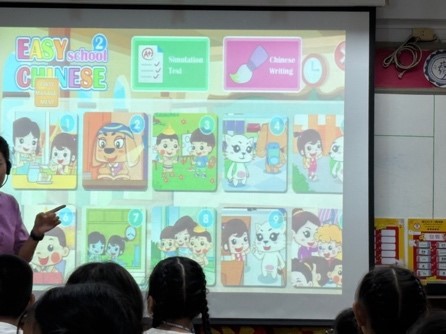
This study examines the impact of intelligent, technology-enhanced teaching tools on young learners’ engagement and cognitive development in primary Chinese language classrooms. Using a quasi-experimental design with 60 sixth-grade students, the study compared lessons supported by animated materials, multimodal resources, and gamified platforms with traditional instruction. Learning analytics from classroom video logs showed that students in the technology-enhanced group sustained exceptionally high levels of engagement (≥ 95%) with minimal fluctuation (CV < 5%), indicating stable and continuous motivation across instructional stages. Cognitive outcomes also improved markedly, with an average post-test gain of 8.47 points and a very large effect size (Cohen’s d = 1.62). Students further reported clearer comprehension—especially for abstract vocabulary—when learning activities incorporated animation, contextualized input, and immediate feedback. The findings demonstrate that intelligent teaching tools can significantly enhance learning efficiency, deepen cognitive processing, and create more responsive and motivating classroom environments. The study also highlights key design implications for engineering intelligent learning environments, particularly the integration of multimodal scaffolding, attention-stabilizing features, and interactive feedback loops to support effective technology-enhanced instruction in resource-limited primary school settings.

Article Details

รูปแบบการอ้างอิง
Xu, Y., Thongkoo, K., & Daungcharone, K. (2025). Technology-Enhanced Chinese Language Learning: Effects of Interactive Intelligent Tools on Engagement and Cognitive Outcomes in Thai Primary Classrooms. Journal of Digital Education and Learning Engineering, 1(4), 26–45. สืบค้น จาก https://so18.tci-thaijo.org/index.php/delethailand/article/view/1741
ประเภทบทความ
บทความวิจัย
ประวัติผู้แต่ง

Krittawaya Thongkoo, วิทยาลัยศิลปะ สื่อ และเทคโนโลยี มหาวิทยาลัยเชียงใหม่

Dr. Krittawaya Thongkoo is an Assistant Professor at the Division of Modern Management and

Information Technology in College of Arts, Media and Technology, Chiang Mai University,

Thailand. She is interested in technology-enhanced learning, ubiquitous learning, inquiry-based

learning, mobile and digital learning, learning analytics, knowledge management system, web-

based technology. She has been the principal investigator of research projects funded by

National Research Council of Thailand under the research projects relevant to designing and

developing collaborative learning support system to promote computational thinking in relation

to programming. She has published research articles in such professional journals as International

Journal of Mobile Learning and Organisations, Knowledge Management & E-Learning: An

International Journal, and International Journal of Information and Education Technology.

Kannika Daungcharone, วิทยาลัยศิลปะ สื่อ และเทคโนโลยี มหาวิทยาลัยเชียงใหม่

Asst. Prof. Kannika Daungcharone, Ph.D., is currently a lecturer at the College of Arts, Media, and Technology in Modern Management Information Technology department, Chiang Mai University, Thailand. Her main research interests are the development of innovative learning, digital game- based learning, mobile and ubiquitous learning, online collaborative learning, and promoting logical thinking skills. She has been the principal investigator of research projects funded by the National Research Council of Thailand under the research topic of Development of Logical-Thinking Diagnosis System for Support Individual University Students Learning in Computer Programming. In addition, she was granted CMU 21st Century Learning to design and develop an active and asynchronous learning approach for university students.