Innovating Chinese Reading Instruction through a Multimodal, Culture-Integrated Digital Platform: An Experimental Study with Thai High School Learners
Article Sidebar
Main Article Content
บทคัดย่อ
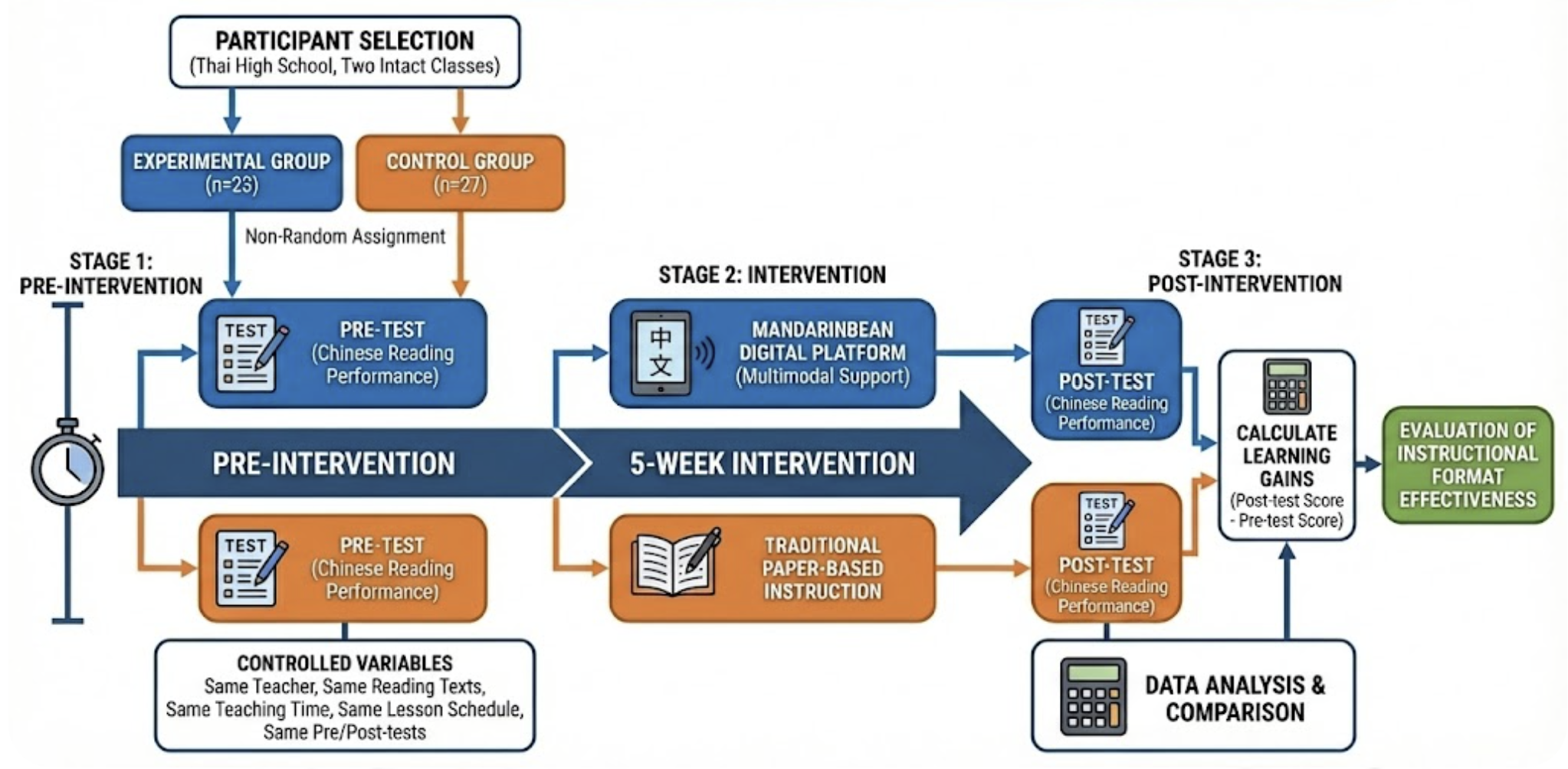
Chinese reading continues to challenge many Thai high school learners, particularly when comprehension extends beyond isolated vocabulary and sentence-level understanding. Classroom instruction often centers on lexical explanation and translation—approaches that support surface decoding but provide limited scaffolding for discourse-level meaning construction. Against this backdrop, the present study examines whether a multimodal, culture-integrated digital reading platform offers measurable advantages over traditional paper-based instruction. A quasi-experimental pre-test–post-test design was conducted with two intact classes (N = 50) over five weeks. One group engaged with a digital platform integrating textual input, audio support, visual representation, and culturally contextualized tasks, while the comparison group received parallel instruction through printed materials. Reading development was assessed across vocabulary recognition, sentence comprehension, and main idea extraction. Although both groups improved significantly and showed no baseline differences at pre-test (p = .423), students using the digital platform demonstrated significantly higher overall learning gains than those receiving traditional paper-based instruction (p = .005, Cohen’s d = 0.865). The most pronounced difference appeared in main idea extraction (p = .006, Cohen’s d = 0.836), whereas vocabulary recognition and sentence comprehension gains did not differ significantly. These findings suggest that multimodal, culturally embedded digital scaffolding may most strongly support discourse-level processing rather than foundational decoding skills. By differentiating effects across reading sub-skills, the study offers context-specific empirical insight into how instructional design shapes second language reading development in Thai secondary education.
