
Designing a Blended Vocabulary Learning Model Integrating Video Slicing and Cornell Note-Taking for Chinese Language Education
Article Sidebar
Main Article Content
บทคัดย่อ
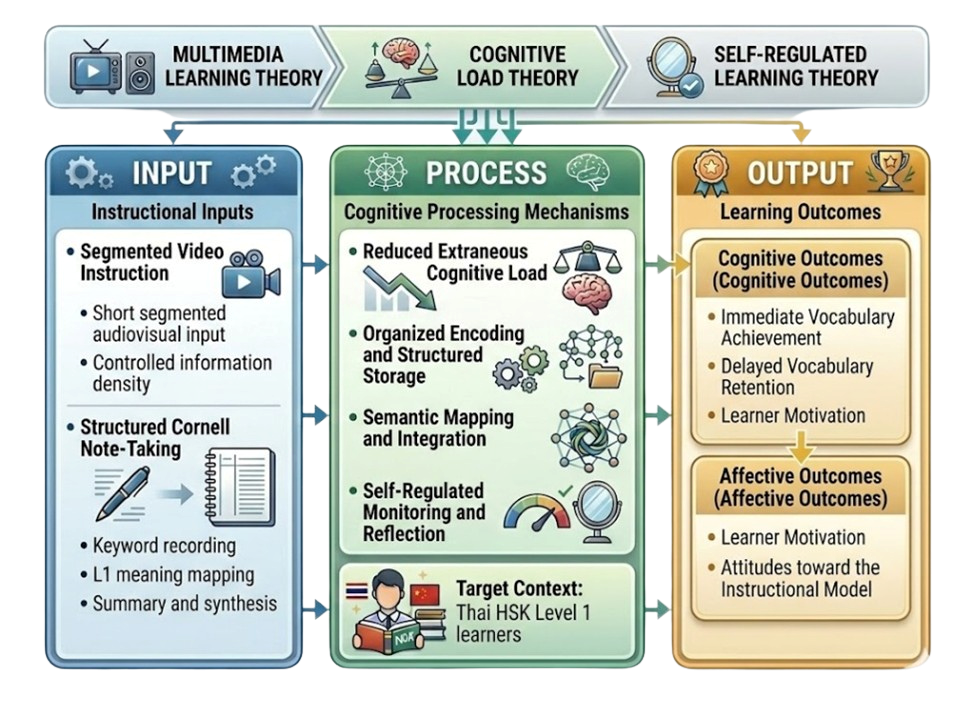
Vocabulary retention remains a persistent challenge for beginner Chinese as a Foreign Language (CFL) learners, particularly in sustaining long-term memory of character form, pronunciation, and meaning. Grounded in Cognitive Load Theory, Multimedia Learning Theory, and Self-Regulated Learning Theory, this study developed and empirically tested a blended vocabulary learning model integrating segmented video instruction with structured Cornell note-taking. A quasi-experimental 2 × 3 mixed design was employed with 65 Thai secondary students (31 experimental; 34 control). The intervention lasted four weeks and was followed by a four-week delayed testing period. Vocabulary achievement was measured through pre-test, post-test, and delayed post-test assessments. Mixed-design ANOVA revealed significant time-by-group interaction effects (p < .01). Although both groups demonstrated immediate post-test improvement, only the experimental group maintained and slightly increased performance at the delayed stage. At the delayed post-test, the experimental group significantly outperformed the control group with a large effect size (d = 1.03). Repeated measures analyses further indicated significant improvements in intrinsic motivation, self-efficacy, and self-determination over time (p < .05). These findings suggest that coordinating regulated multimedia pacing with structured learner processing enhances both delayed vocabulary retention and motivational development. The study provides classroom-based evidence for cognitively regulated blended instructional design in secondary CFL classrooms and offers practical implications for integrating multimedia segmentation and structured note-taking in vocabulary instruction.
