Beyond Learning Achievement: Investigating International Students’ Acceptance of Game-based Technology for Chinese Language Learning
Article Sidebar
Main Article Content
Abstract
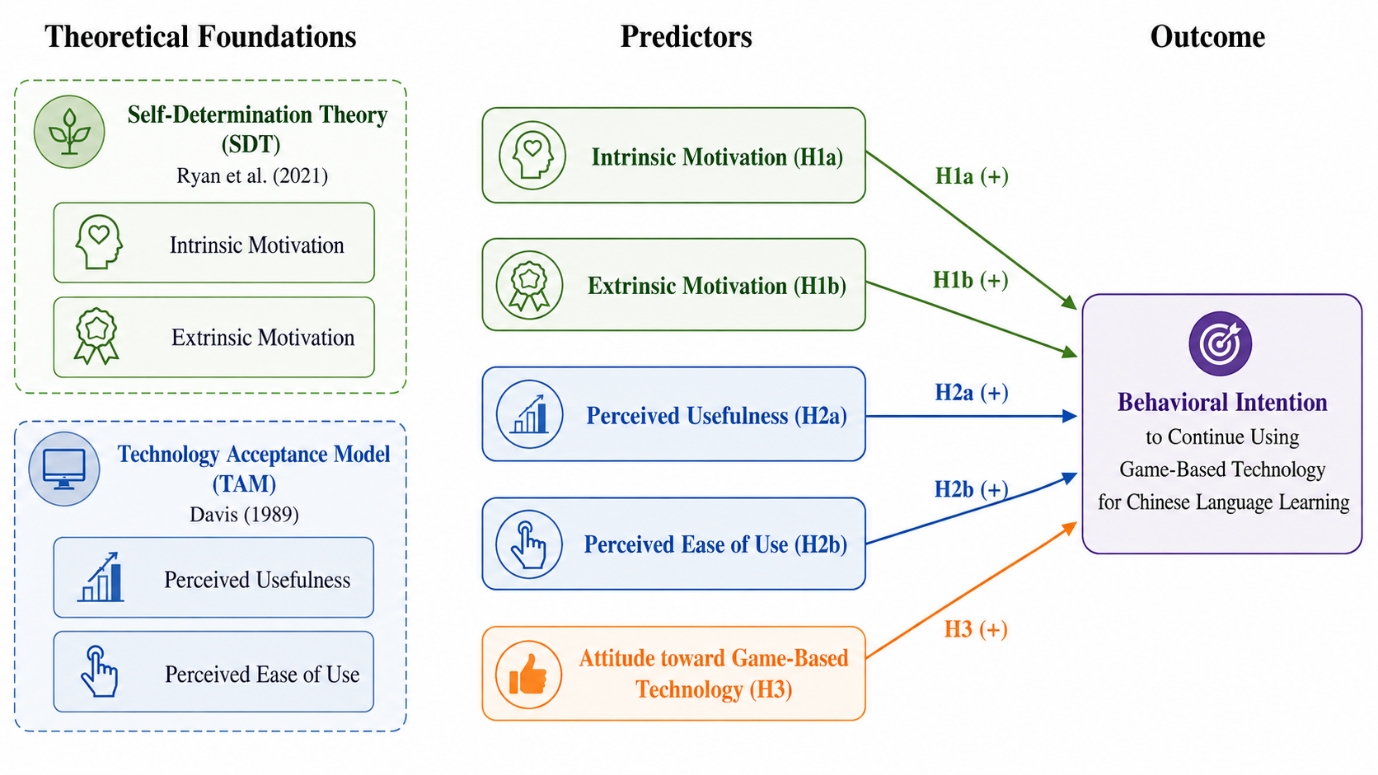
While previous studies on game-based learning have primarily focused on learning achievement, achievement results alone do not explain whether learners perceive the technology as useful, easy to use, and worth continuing to use. Learner acceptance is essential because successful technology implementation depends on learners’ willingness to adopt and continue using it. This study investigated international students’ acceptance of game-based technology for Chinese language learning by integrating the Technology Acceptance Model (TAM) and Self-Determination Theory (SDT). This acceptance-focused analysis used post-intervention questionnaire data from 40 international students enrolled in Chinese language courses at a language school in Chiang Mai, Thailand. A 12-item questionnaire measured intrinsic motivation, extrinsic motivation, perceived usefulness, perceived ease of use, attitude, and behavioral intention. Data was analyzed using descriptive statistics, Cronbach’s alpha, and Pearson’s correlations. All six constructs were rated at a high level. Attitude obtained the highest mean (M = 4.18), followed by intrinsic motivation and perceived usefulness (both M = 4.16), whereas behavioral intention obtained the lowest mean (M = 4.04). Behavioral intention was positively correlated with intrinsic motivation (r = .989), extrinsic motivation (r = .980), perceived usefulness (r = .989), perceived ease of use (r = .962), and attitude (r = .988), with all relationships significant at p < .01. However, the consistently high correlations suggest possible overlap among the constructs and should be interpreted cautiously. The findings indicate that continued-use intention is closely associated with learners’ technology perceptions and motivational orientations. By focusing on students’ acceptance rather than repeating the analysis of learning achievement, this study offers practical guidance for designing useful, manageable, and engaging game-based Chinese learning environments.
