
Vol.7 No.1: January-June 2026
Vol. 7 No. 1 (2026)
Music originates in sound and persists through memory, perception, ethics, community, and learning. This issue of PULSE: Journal for Music and Interdisciplinary Practices presents six articles examining how music interacts with these dimensions across contemporary opera, interdisciplinary composition, popular song, inclusive education, ethnographic practice, and classroom pedagogy. Collectively, these contributions reinforce the journal’s commitment to music as an artistic, cultural, social, and intellectual practice.
The issue begins with Daniel Serrano’s study of Salvotore Sciarrino’s II canto s’attrista, perché?, which analyzes how earlier musical genres and topics are reinterpreted within a contemporary operatic context. By examining the military march and the tempo notturno, the article demonstrates how historical materials can reappear in transformed forms, influencing dramaturgy, intensifying atmosphere, and guiding the listener’s perception of dramatic action. Dhorn Taksinwarajan subsequently broadens the inquiry into perception through an interdisciplinary investigation of music, magic, and illusion. His article prompts readers to reflect on how listening is influenced by expectation, deception, and the shifting boundary between what is heard, seen, and believed.
The following articles turn toward music as a site of ethical and social imagination. Thet Htar San and colleagues examine popular song in post-independence Myanmar, showing how love, affect, and musical structure participate in cultural sovereignty and postcolonial identity. Yoonil Auh and colleagues continue this ethical concern by studying inclusive music pedagogy in South Korea, arguing for a deeper understanding of access, belonging, and justice. Their work challenges music education to move beyond participation as presence toward participation as recognition, authorship, and cultural legitimacy.
Rachelle Ann D. Labasan’s article brings the issue into the lived sound world of the Gaddang marching band in Solano, Nueva Vizcaya. Framed through the idea of the gift, the study reveals how musical performance sustains obligation, reciprocity, kinship, and social cohesion. Closing the issue, Rujikarn Weerapong and Natsarun Tissadikun present the development of the “Stop It” card game as a learning medium for students. Their article reminds us that pedagogical innovation often begins with careful attention to how learners engage, participate, and find pleasure in understanding music.
Read together, these articles demonstrate the breadth of inquiry that PULSE aims to support. Music appears in the forms of historical residue, perceptual experiment, ethical discourse, inclusive practice, communal exchange, and educational design. Each article offers a distinct point of entry, yet all share a concern with how music becomes meaningful through the relations among sound and memory, people and place, learning and justice, and tradition and creative transformation. We are pleased to present this issue to our readers and hope it opens further conversations across music, scholarship, and practice.
The Pulse Editorial Team
Vol.7 Special Issue: March 2026
Vol. 7 No. Special Issue (2026)
Over the past four years, PULSE has brought together a growing body of articles and reflections engaging with the rich and diverse practices of sound and music-making across Southeast Asia. This special issue, Resonating Across Borders: Building Bridges through Music in Southeast Asia, builds on that foundation by foregrounding initiatives that connect communities, cultures, and knowledge systems across the region.
Focusing on events and activities organised throughout Southeast Asia, this thematic volume highlights efforts to foster intercultural dialogue and to draw renewed attention to musical traditions, philosophies, and practices often marginalised within the accelerated dynamics of globalisation. The contributions consider how festivals, workshops, and community-based initiatives function not only as sites of artistic exchange but also as platforms for cultural negotiation, mutual learning, and the reframing of identity.
For this issue, we invited selected contributors to critically reflect on projects that advance cultural understanding and integration across both national contexts and transnational settings. These studies examine curatorial strategies and participatory frameworks that enable musicians and artists to engage with diverse cultural perspectives, support intergenerational knowledge transmission, and foster sustained dialogue.
This volume also demonstrates how such initiatives contribute to the sustainable development of local cultures, particularly through adaptive pedagogies and community-led practices. Where possible, the articles are accompanied by relevant media materials, including recordings and video documentation, extending the issue beyond a textual format into a dynamic and accessible resource.
Ultimately, this special issue aims to serve not only as a scholarly contribution but also as a source of inspiration for practitioners, educators, and curators working within and beyond Southeast Asia, offering insight into music as a connective, transformative, and socially engaged practice.
In these troubled times, when the very idea of globalisation is under increasing scrutiny, we invite you to reflect on the importance of building bridges with your neighbours, nurturing mutual understanding, and reaffirming the value of cultural exchange in an increasingly fragmented world.
We hope you enjoy this first selection, which will be followed by a second volume next year.
The Pulse Editorial Team
Vol. 6 No. 2 (2025): June - December 2025
Vol. 6 No. 2 (2025)
As we step into a new year, we hope that 2025 brought moments of inspiration, creativity, and meaningful progress for each of you. While the year behind us offered reasons for optimism, it also reminded us of the challenges shaping our world today: growing divisions, the closing of minds and borders, and the increasing influence of technologies that can distort understanding as easily as they can connect us.
In this dystopian context, our role as creators, thinkers, educators, and researchers is more important than ever. Our work has the power to clarify rather than confuse, to open dialogue rather than deepen divides, and to offer thoughtful responses to complex global realities.
Through constructive dialogue, we strive to listen carefully to one another and to the world around us. It is through this listening that understanding emerges, and with it, the possibility of meaningful and sustainable solutions.
Our creative and academic endeavours should stand as a reminder that we inhabit a world built on connection, critical thought, and the possibility of sustainable progress.
As such, this volume of PULSE is once again a testament to the creative and resilient minds of musical researchers in the Southeast Asian region, this time featuring contributions from the Philippines and Sri Lanka, as well as Thailand and Malaysia. This volume welcomes reflections across a wide variety of music-related practices, with a special focus on pedagogical innovation and contextual adaptations.
Rey Sunglao examines, through the lenses of Filipino resilience and bayanihan, how the Manila Symphony Orchestra survived and adapted through World War II and the COVID-19 pandemic, demonstrating how core Filipino values, key individuals, and innovative responses have sustained the orchestra across generations.
Panicha Ponprasit, Napatsawan Ruamsap, Sirathee Maiwong and Juthatip Wiwattanapantuwong examine six early-adulthood musicians and finds that musical experiences shape self-identity through the development of musical self-clarity, support from others, perceived value in musical work, and music’s role in coping with difficult times.
Andrew Jaye Ocampo’s study is the first to investigate community rondalla pedagogy in the Philippines through digital ethnography, revealing how three community rondalla groups apply content knowledge, pedagogical knowledge, and pedagogical content knowledge in practice, while highlighting the crucial role of local government funding in sustaining groups and promoting Filipino culture.
Kylie Tan investigates the reception history and evolving interpretations of Miklós Rózsa’s Concerto for Violin and Orchestra, examining how performers, stylistic approaches, performance challenges, and historical context have shaped its legacy and limited mainstream presence, while arguing for its artistic significance and potential for renewed scholarly and performative interest.
Jirut Khamlanghan distils nineteenth-century bel canto vocal pedagogy into an accessible contemporary framework through the analysis of selected soprano arias by Bellini and Donizetti, culminating in a public performance that demonstrates and revitalises these techniques for modern audiences.
P. B. S. L. Pushpakumara and Rashmi Senevirathne employ mixed methodologies to demonstrate that arts-based learning, particularly through music and drama, enhances first-year Sri Lankan university students’ motivation, participation, and authentic English use by creating a low-anxiety, inclusive classroom environment that supports diverse learning styles and learner-centred ESL pedagogy.
We hope you enjoy reading through our pages and, as always, we look forward to hearing from you in the year ahead.
The Pulse Editorial Team
February - July 2025
Vol. 6 No. 1 (2025)
In a world increasingly saturated with noise, the act of intentional listening becomes radical. PULSE: Journal for Music and Interdisciplinary, in No.6, Issue 1, invites us to listen, but to dwell in resonance. The articles echo and ripple outward from their local contexts—Philippine bamboo, Ghanaian classrooms, Thai exhibition spaces, and Rajabhat rehearsal halls—into broader questions of pedagogy, identity, power, and care.
We begin with Tultugan: Contextualizing Music Education through the Artisan’s Performance-Teaching Process by Hermie F. Cartagena, a lyrical ethnography that draws us into the world of indigenous bamboo musical practices in the Philippines. Through the TCTF, Transmission Framework, Cartagena reframes artistry as pedagogy and performance as epistemology. Here, knowledge is resonant—passed from hand to hand, ear to ear, in rhythm, in silence, in gesture.
This deep resonance finds institutional counterpoint in Amanut Chantarawirote’s Teacher Agency among Music Teachers in Thailand: An Ecological Perspective. With clarity and conviction, unpacking how Thai music teachers navigate shifting landscapes of reform, expectation, and tradition. Grounded in ecological theory, the article reclaims teacher agency as a dynamic process—emergent, adaptive, and intimately tied to community and cultural responsibility.
The tempo shifts, geographically and conceptually, in Alfred Addaquay’s From Classroom to Career in Ghana, a powerful study that unearths the layers of social stigma, economic aspiration, and policy neglect that frame music education in Ghana. Anchored in Amartya Sen’s Capability Approach and decolonial thinking, Addaquay’s work is both critique and call: a reminder that when music is misused, so too are the dreams, identities, and potentials it carries. It inspires hope and shows the transformative power of music education.
Yet, even within formal institutions, music continues to space for healing and encounter. In Music Therapy in an Interdisciplinary Classroom, Smatya Wathawathana presents an elective course where students from diverse academic backgrounds engage with music as a therapeutic process. The Introduction of Music Therapy classroom becomes a liminal space—between disciplines, between certainty and vulnerability—where music restores, connects, and provokes.
These themes of immersion and reflection reach an aesthetic culmination in Art Pieces and Audiences on the Fading Boundary by Sarupong Sutprasert et al., in their poetic analysis of the immersive exhibition Voices Beneath the Loud Waves. Sound becomes solitude, the audience becomes participant, and the gallery becomes a site of collective introspection. The 52-hertz whale—forever singing alone—becomes a metaphor and a mirror. This article highlighs the importance of the audience's role in the immersive exhibition, making them feel valued and integral to the experience.
This issue closes with a crescendo: Methods for Creating the Sound of the Rajabhat Samphan Winds by Adiwach Panapongpaisarn et al., chronicling a cross-institutional wind ensemble across eight Rajabhat universities. The article reveals how sonic cohesion is achieved through shared intention, careful pedagogy, and mutual listening, embodied in the legacy of Edward S. Lisk and Niphat Kanjanahut. This collaborative nature of the wind ensemble makes the audience feel connected and part of a community.
Across these six articles, we are challenged to think differently about how we teach, how we listen, and how we locate ourselves within ever-shifting soundscapes of meaning, which encompass the literal sounds we hear through the cultural, social, and personal contexts that shape our understanding of those sounds. May this PULSE issue linger within you like a sustained chord—resonating, provoking, and renewing your sense of what music and interdisciplinary practice might yet become.
The Pulse Editorial Team
August 2024-January 2025
Vol. 5 No. 2 (2025)
We would like to wish a wonderful new year to all of our readers as we present another collection of engaging articles, each offering unique insights into the vibrant musical life of Southeast Asia.
We begin, appropriately, with a historical reflection spanning nearly a quarter of a century. In the early 2000s, the founders of Gitameit Music Institute in Yangon, Myanmar, set out to foster community and build confidence among young Burmese through a blend of creative music and art education. Societal isolation due to a repressive military dictatorship hindered connections with peers in other countries and advanced music studies. The founders faced critical questions about how to teach creatively, engage with outsiders, and build local audiences under constant surveillance, while also navigating the dominance of Western music over Myanmar’s indigenous traditions. Nay Win Htun, Ne Myo Aung, and Kit Young celebrate Gitameit’s 21st anniversary by reflecting on the unique development of this pioneering music school, highlighting key events and individuals, and exploring both the educational growth and emotional challenges faced during these formative years while considering how this growth may shape Myanmar’s uncertain future.
Pusit Suwanmanee et al., investigate how The Southern Thailand Wind Band Conference, held from the 17th to the 22nd of June 2024 at Songkhla Rajabhat University, fosters musical growth and knowledge exchange through lectures, workshops, and performances while enhancing skills and inspiring creativity among local musicians. This well-planned event, with targeted training and expert guidance, ensures effectiveness, with post-conference evaluations identifying opportunities for improvement.
Percussionist Nithi Rujikajorndej’s research focuses on producing high-quality concert snare drums from three types of Thai wood—Plum Mango, Jackfruit, and Padauk—demonstrating their potential to rival international snare drums. The study explores the origins and history of snare drums, collaborating with WASANA Drum Factory to create the drums and analysing expert feedback on their sound quality. The research found that each type of Thai wood produced distinct tonal qualities, making them suitable for different musical contexts.
Andrew Filmer, Yeoh Pei Ann, Maslisa Zainuddin, and Mohd. Firdaus Mohd. Anuar from Malaysia reflect on a collaborative project blending music and painting. Evolving from Bach’s solo works to improvisational music and live videography, it expanded from pandemic restrictions to a three-day event with exhibitions and workshops. The project investigates how cross-disciplinary collaboration fosters creativity and audience interaction, creating a model for future interdisciplinary engagements.
Thatchatham Silsupan’s paper examines sound-based art practice in Chiang Mai from the 2010s to the present, focusing on its socio-political aspects and shift from centralized aesthetics. Central to this is “lateral practice,” which prioritizes experimentation, collaboration, and adaptability over technical proficiency. The paper analyzes works by local artists such as Anusorn Tunyapalit, Anurak Tunyapalit, and Arnont Nongyao, exploring how lateral practice challenges traditional norms and fosters cultural resistance. Developed from Silsupan’s panel at the PGVIM International Symposium 2024, the paper highlights Chiang Mai’s sound art as a framework for addressing power dynamics and promoting collective agency.
Alex Dea reflects on his long-term study of Javanese classical music and performing arts, noting the unique blend of European, Chinese, and Muslim influences that initially appeared as a “mishmash.” Despite not fully understanding how Javanese artists effortlessly combine such diverse elements, he appreciates their creativity and flexibility. Through his observations, Dea aims to offer insight into a distinct approach to music and art-making, one that challenges conventional methods while celebrating the underlying depth of Javanese cultural practices.
We hope you enjoy exploring the pages of our journal and, as always, we encourage you to share your work with us. If you have an ongoing project or research article that aligns with the scope of our journal, we would be delighted to consider it for publication!
The Pulse Editorial Team
February - July 2024
Vol. 5 No. 1 (2024)
Welcome to the 5th volume of Pulse. We are delighted to announce that we are now officially hosted by Thaijo (Thai Journals Online), joining a prestigious network of academic publications that promote accessibility and scholarly exchange within the Thai academic community and beyond.
We start off this collection with the composer Scott Wilson who contemplates his over 20 years of experience making music in, around, and with the people of Asia through a collection of anecdotes and reflections. He advocates for the importance of openness—particularly to diverse methods of working, understanding, and learning—and underscores the immense value of collaboration.
Natsarun Tissadikun highlights efforts to preserve the Khaen ensemble of Wat Phothongcharoen in Suphanburi Province. Volunteers from Bansomdejchaopraya Rajabhat University used their skills to support sustainable community development. Survey data showed low engagement in folk music preservation among the youth. To address this, the Ban Kham Laos Culture Club was formed, and a forum was held to encourage community participation in preserving and promoting the Khaen ensemble.
Panthakan Northong and Pusit Suwanmanee’s collaborative research arranges orchestral music inspired by Rong Ngeng, a traditional Thai Muslim art form. By interviewing experts, they explored techniques, pitch range, melody, and history, selecting a lively Rong Ngeng piece in the Yoket rhythm. The result, “Dawn of Kelantan,” uses Western musical theory to preserve Rong Ngeng’s essence. The resulting piece is evaluated on folklore communication, performance authenticity, and orchestration fidelity to the original melody and rhythms.
Nadis Boonrod discusses his exercises and etudes for four mallets, covering techniques such as single independent strokes and double lateral strokes. Each technique is paired with a specific composition: Walk, Split, Groovy, and Bubble. Surveys and interviews with experts revealed that these exercises are well-designed and effective for teaching.
Komsun Dilokkunanant and Sethapong Janyarayachon study the shift to online chamber music education during COVID-19 at the Princess Galyani Vadhana Institute, identifying challenges like unclear outcomes and inconsistent assessments. They created a new competency framework that improved students’ skills and provided insights for future music education.
Finally, the composer Professor Dieter Mack reflects on how 20th-century advancements in reproduction technology and the rise of streaming platforms have significantly impacted accessibility and sustainability in music cultures and education, with various accompanying side effects.
May 2023
Vol. 4 No. 1 (2023)
Welcome to the fourth volume of PULSE.
Yui Shikakura and Enrico Bertelli give us a detailed summary of the Pomposa Project, a series of interconnected workshops conducted in Bangkok in August 22 and aimed at promoting creativity in young people, disabled youth, university students, and elderly people through the use of textile design and interactive technology.
Jonas Baes deconstructs the philosophies behind his recent work “virtual implosion” (2022) alluding to “the nature of composition and performance within the enclaves of late capitalist modernity and its impact on the Philippine social milieu.”
Anna Patricia Rodriguez-Carranza gives us detailed insights into some of the systems and criteria contributing to the sustainable development of undergraduate music education Programs in the Philippines.
Nootnapang Chumdee & Siriwan Siravanich reflect on a series of interdisciplinary fieldwork projects conducted in Thailand in view of investigating selected local histories while blurring the boundaries between pragmatism and intuition.
Tawan Laekhasathapon explores the the relationships between the architecture and soundscape found at Wat Phumin, an ancient Thai temple located in the Nan province, establishing links between the worldly and spiritual states that can be experienced through the sounds and cosmological symbols of this sacred space.
Finally, Pongthep Jitduangprem takes a close look at the legacy of Amartya Sen, a pioneer in welfare economics , highlighting the alignment between his approach and music education concepts in empowering underprivileged individuals through music.
January 2023
Vol. 3 No. 1 (2023)
Welcome to the third volume of PULSE.
The six articles compiled here cover a wide variety of music related topics which collectively contribute to forging an understanding of the shifting musical landscape within Asia with a clear focus on Thailand this time around. We are delighted to, yet again, propose a wonderful collection of reflections and studies focusing on investigating the intersections between cultures and between ancient and current practices.
The Hong Kong based composer-performer Kimho Ip shares some of his reflections based on an interview with the Hindustani musician Omkar Havaldar with whom he collaborated in 2019 through an intercultural project questioning the similarities and differences observed within the cultural landscapes of China and India.
The Thai trombonist Siravith Kongbandalsuk gives insight within the creative process behind his collaboration with the composer Piyawat Louilarpprasert leading to the creation of “Dino”, a piece exploring extended techniques for acoustic instruments in an attempt to recreate the vocal sounds of dinosaurs.
The Bangkok based virtuoso flutist Kalaya Phonsathorn harnesses the musical potentials of the piccolo flute through a series of commissions with local contemporary music composers, in an effort to popularise this underused instrument within the local classical music scene.
The Thai musician and musicologist Waraporn Cherdchoo takes us on an historical journey to 17th century Siam, investigating the cross-cultural exchanges that took place between the French ambassadors sent by Louis XIV and Thai musicians at the time of Ayutthaya.
Still on the topic of Thai music, Decha Srikongmuang proposes a study of the systematic use of onomatopoeic words in Thai traditional music terminology, looking more specifically at the use of this lexicon in Thai music pedagogy.
Bringing us back closer to recent history, The Thai sound artist Saranrat Sangchai reflects on the steps taken by sound designers on the local theatre scene as they adapted their craft from the traditional physical spaces to “virtual online spaces” as a direct consequence of the recent pandemic crisis.
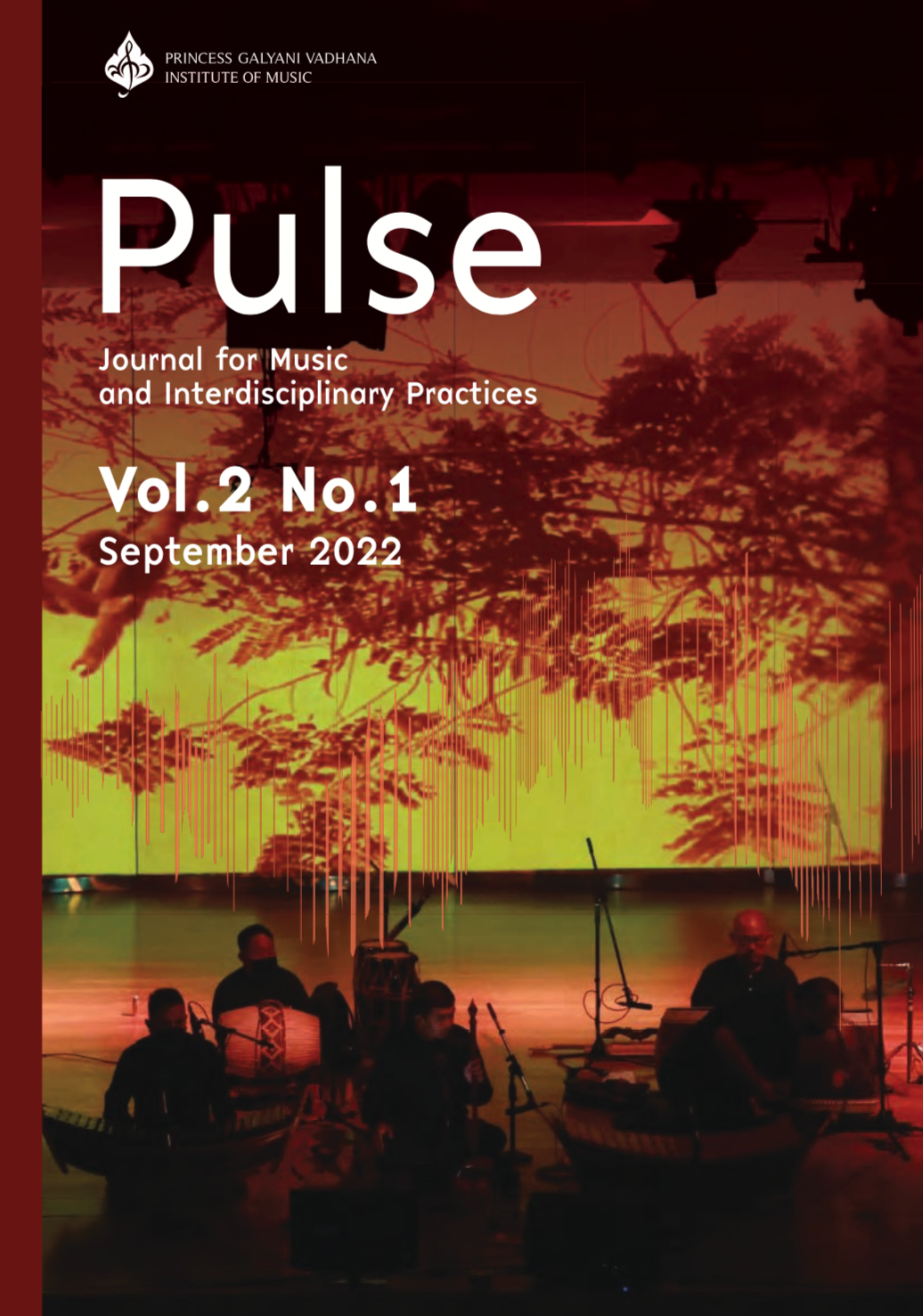
September 2022
Vol. 2 No. 1 (2022)
This second publication offers a wide and eclectic range of papers on topics related to music making
in Southeast Asia.
Anant Narkkong reflects on the live performance of the 1927 movie “Chang”, revisiting the
language of silent cinema as well as expanding the boundaries of Thai traditional music and sonic
creation while paying homage to the legacy of the late Bruce Gaston who sadly passed away last
year. Alex Dea offers a personal account of his forty years of assimilation of Gamelan culture, and
elucidates the connections between Javanese street traffic and the philosophy of improvisation.
Septian Dwi Cahyo shares his exploration as a composer of the ‘liminal’ space between Indonesian
musical expression and that of adopted western idioms. Solaiman Jamisolamin shares an overview of
the evolution of Haplos, a program designed to help patients with Hemophilia in the Philippines.
Kunthee Banjukeaw provides a philosophical reflection on the aesthetics of experimental electronic
music, with particular attention on the ever changing phenomenon of change within human
perceptions in relation to our cultural environment. Finally, Sethapong Janyarayachon shares
his fascination with the Baroque flute repertoire of Couperin and offers insights into his own
interpretation and experience with the music.
Pulse is a triannual publication with volumes published in May, September and January. We
accept submissions year round and are looking specifically for items that offer original arguments
with the aim of advancing knowledge in the fields of musicology, pedagogy, performance, and
interdisciplinary practices.
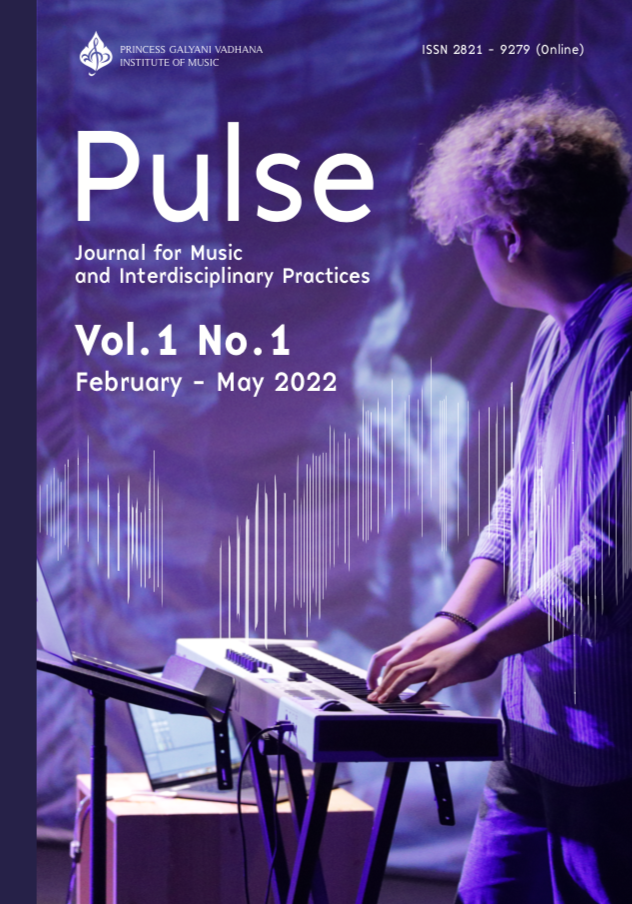
February - May 2022
Vol. 1 No. 1 (2022)
We aim for Pulse the journal to embody this spirit of connection.
Pulse is also designed to bridge the gap between the ivory tower and the community, with materials that will be of interest to everyone from seasoned music scholars and performers to students, amateurs, and music lovers. To this end, we welcome a broad range of possible submissions including academic research papers as well as more personal essays, interviews with practitioners, and books, concerts and recording reviews.
The papers in this first edition provide a sampling of several areas Pulse will encompass. Professor Jacques Moreau, a French pianist and pedagogue and also one of the founders of PGVIM, addresses the role of research in artistic practices throughout the history of classical music, reconnecting historical practices with the needs of today. The German composer Professor Dieter Mack, longtime PGVIM collaborator, uses autobiography to examine issues related to intercultural understanding and misunderstanding between Germany and Indonesia. The ethnomusicologist Dr.Verne dela Peña discusses the transition of Mindanao kulintang music from a local traditional form to an emblematic artform carrying the Filipino cultural identity among practitioners outside its original area. The digital
artist Kittiphan Janbuala shares the creative process behind his audiovisual project F(r)ee Road, a game-based composition that utilizes glitch-art and the aesthetic of error to generate visual and sound modifications. The sound artists Dr. Toeingam Guptabutra and Pattarapong Sripanya discuss
how they used the relations between voice and spatialisation to create an interactive work that reproduces the acoustical proportions found within the human body. Dr. Jonathan Day investigates the adoption of Reggae and Rasta ideas in the multifaceted cultures of the Asean region.