
Moral nationalism and the politics of memory: The construction of ‘enemy’ images in the Thai-Cambodian border dispute.
Article Sidebar
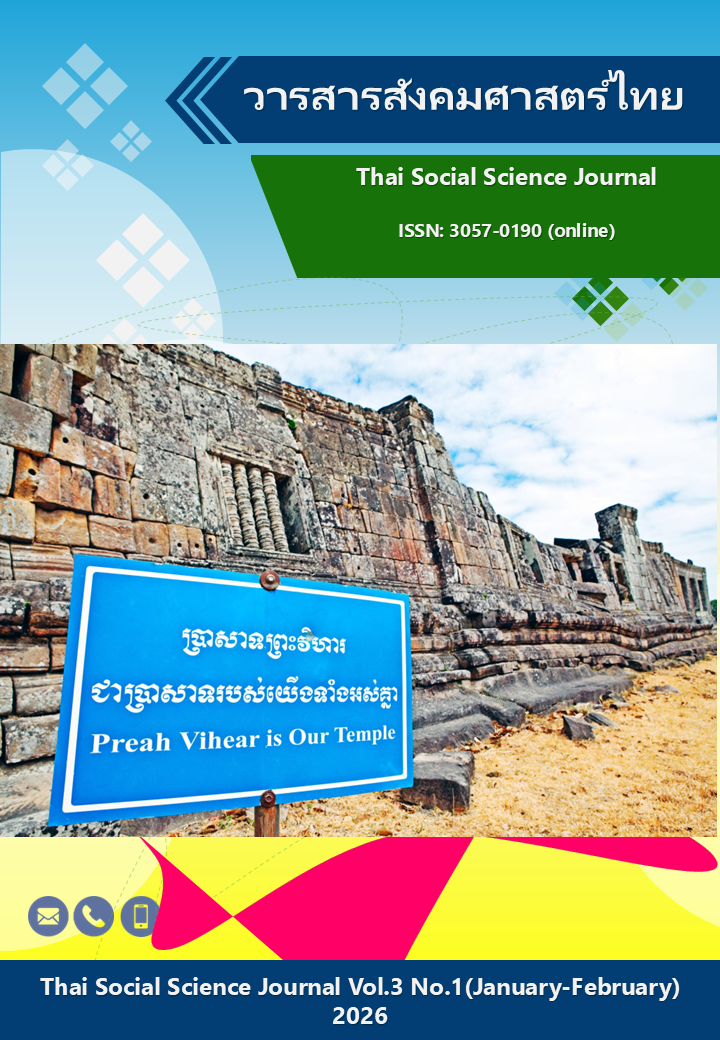
Main Article Content
Abstract
This article examines the Thai–Cambodian border dispute as a socio-political phenomenon through the analytical lenses of moral nationalism and the politics of memory. It argues that the dispute cannot be understood solely in terms of territorial sovereignty or international law, but must also be seen as a process through which moral meanings are produced and circulated. Narratives of nationhood, dignity, and history are mobilized to frame the border dispute in moral terms, significantly shaping public perception and legitimizing particular political positions adopted by the state.The analysis demonstrates that moral nationalism operates by elevating the nation to the status of the supreme moral subject, establishing rigid binaries of “right” and “wrong.” The politics of memory plays a central role in this process through selective remembering and forgetting, emphasizing historical loss and national humiliation while marginalizing alternative memories of coexistence, interdependence, and everyday cross-border life. As a result, the construction of the “enemy” becomes normalized, rendering the border dispute morally justified and seemingly unavoidable, while simultaneously narrowing the space for critique, compromise, and nuanced understanding.The article further explores the social consequences of moral nationalism for cross-border relations and domestic society. These include the erosion of trust among border communities, the stereotyping and moral stigmatization of Cambodian migrant workers and ethnic minorities, and the obscuring of structural problems such as inequality, underdevelopment, and vulnerability in border areas. Within a state-centered moral framework, human suffering is often subordinated to abstract notions of national dignity and security.In response, the article proposes a shift toward an analytical and normative framework grounded in human dignity and the ethics of shared memory. This approach challenges the monopolization of moral authority by the nation-state and calls for the recognition of plural memories, particularly those of borderland populations, as integral to a shared historical landscape. Rather than rejecting the nation or sovereignty, this perspective seeks to reposition the nation as one moral frame among others, subject to the primacy of human dignity. The article concludes that moving beyond moral nationalism toward a human-centered framework is essential for reducing the instrumentalization of border disputes in domestic politics and for opening possibilities for sustainable cross-border peace in the long term.
Article Details

This work is licensed under a Creative Commons Attribution-NonCommercial-NoDerivatives 4.0 International License.
