Utilizing Game-based Technology to Enhance Learning Achievement and Motivation in Chinese Language Speaking for International Students
Article Sidebar
Main Article Content
บทคัดย่อ
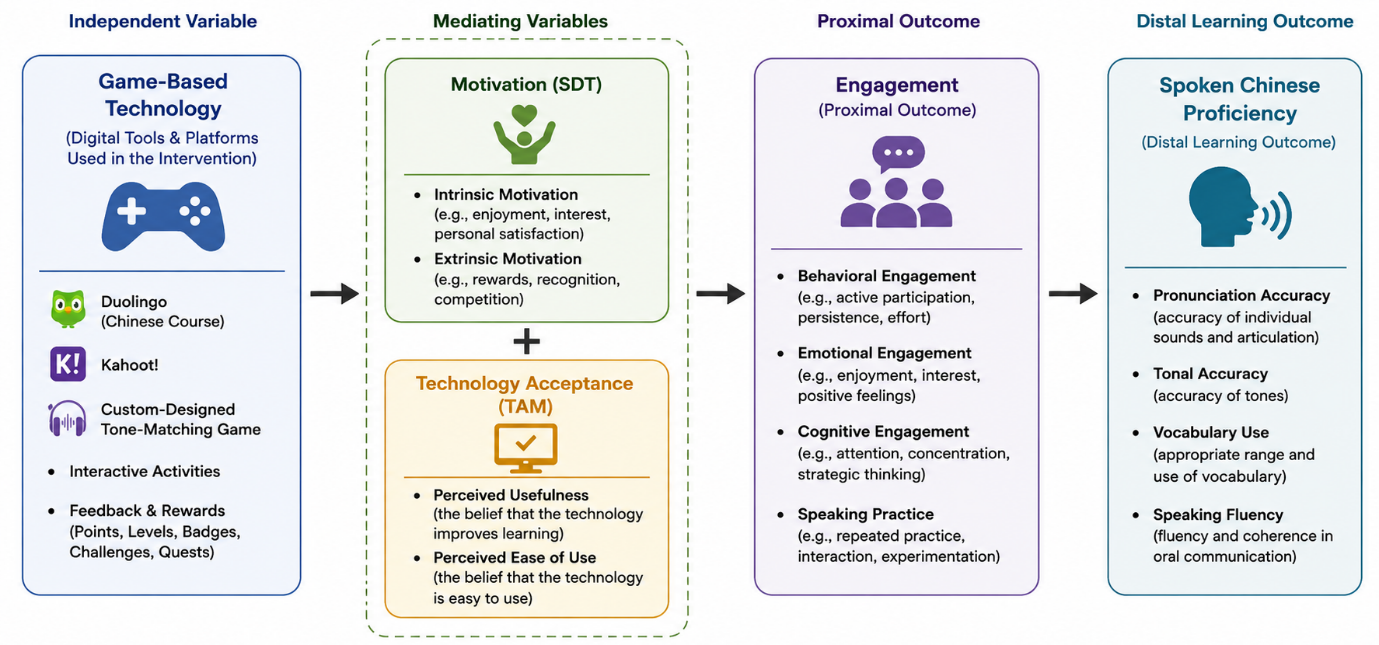
The development of spoken Chinese proficiency remains a significant challenge for international students, particularly in terms of pronunciation, tonal accuracy, and speaking fluency. Although game-based learning has been widely applied in language education, empirical evidence regarding its effectiveness in improving spoken Chinese skills remains limited. This study investigated the effects of game-based technology on spoken Chinese proficiency and learning motivation among international students. A quasi-experimental design was employed with 40 international students in Chiang Mai, Thailand, who were assigned to either a control group receiving traditional instruction or an experimental group receiving game-based technology instruction over six weeks. Data were collected through spoken Chinese proficiency tests, motivation and engagement questionnaires, classroom observations, and semi-structured interviews. Quantitative data were analyzed using descriptive statistics and t-tests, while qualitative data were analyzed through thematic analysis. The findings revealed that the experimental group achieved significantly higher post-test scores than the control group and demonstrated substantially greater improvement in spoken Chinese proficiency. Students in the experimental group also reported higher levels of motivation, engagement, perceived usefulness, and positive attitudes toward learning. Qualitative findings further indicated that game-based technology reduced speaking anxiety, encouraged repeated practice, promoted peer interaction, and enhanced learners’ awareness of tonal accuracy. These findings suggest that game-based technology can serve as an effective pedagogical approach for improving spoken Chinese proficiency and fostering learner motivation in Chinese language education.
